Imagine fleeing war, seeking refuge, and finding a new home that offers unparalleled opportunities. For millions, America represents that beacon of hope, a place where new beginnings are not just possible, but actively encouraged. But what happens when that incredible generosity is met with profound criticism, even condemnation, from within?
This is the heart of the intense national conversation surrounding Congresswoman Ilhan Omar. Her story began in a war-torn land, a stark contrast to the life she built in the United States. She arrived as a refugee, welcomed by a nation that promised safety, freedom, and the chance to thrive.
A Journey to Sanctuary: From Somalia to America
Ilhan Omar’s early life was marked by upheaval. Born in Mogadishu, Somalia, in 1982, she experienced the brutal realities of civil war firsthand. Her family, like countless others, was forced to abandon their home, seeking safety wherever they could find it. This harrowing experience led them to a refugee camp in Kenya, where they spent four difficult years.
The journey from a refugee camp to the United States is one that many dream of, a testament to America’s enduring role as a haven. In 1995, at the age of 12, Ilhan Omar and her family were granted asylum, arriving in Arlington, Virginia, before eventually settling in Minneapolis, Minnesota. This was not just a change of location; it was a profound shift from a life of fear and scarcity to one brimming with potential.
The Promise of the Land of Opportunity
Upon her arrival, Ilhan Omar was immediately immersed in the American system, a system designed to uplift and integrate newcomers. She entered public schools, learning English and adapting to a new culture. These foundational years were critical, providing her with the education and tools necessary to navigate her new society.
America, for many, represents a land where personal effort and talent can lead to extraordinary achievements, regardless of one’s origins. For a young refugee, the opportunities were boundless: access to quality education, freedom of speech, the right to practice any faith, and the chance to participate in a vibrant democracy. These were the fundamental gifts bestowed upon her.
From pursuing higher education to engaging in local community activism, the pathways to success were wide open. The American dream, often spoken of in abstract terms, became a tangible reality for her, offering a stark contrast to the hardships she had left behind. The nation’s taxpayers, through various public services and programs, contributed to her integration and development, expecting only that she embrace the values of her new home.
A Rapid Ascent: From Refugee to Congresswoman
Ilhan Omar embraced the opportunities presented to her with remarkable zeal. Her passion for social justice and political engagement quickly became evident. She rose through the ranks of local politics, demonstrating a keen understanding of community needs and a powerful ability to mobilize support.
Her journey culminated in a historic achievement: in 2016, she was elected to the Minnesota House of Representatives, becoming the highest-ranking Somali-American elected official in the United States. Just two years later, in 2018, she made history again, becoming one of the first two Muslim women, and the first Somali-American, to be elected to the U.S. House of Representatives.
This meteoric rise from refugee to a national lawmaker is often cited as a powerful example of the American dream in action. It showcases a system where anyone, regardless of their background, can aspire to and achieve the highest levels of political office, shaping the very laws of the land that welcomed them.
The Voice of Dissent: Controversial Criticisms of America
However, it is precisely this platform, granted by the American democratic system, that Congresswoman Omar has used to voice criticisms that many find deeply troubling and, some argue, ungrateful. Rather than solely championing the nation that offered her refuge and opportunity, she has frequently drawn international attention for her sharp critiques of American foreign policy, its domestic institutions, and even its foundational principles.
Critics point to numerous instances where Omar’s rhetoric has been perceived as anti-American or divisive. Her statements have touched on sensitive topics, from the role of lobbyists in Washington to the country’s historical treatment of minorities. For many, these criticisms cross a line, especially coming from someone who benefited so directly from the nation’s generosity.
One prominent area of contention has been her comments regarding Israel and the U.S.-Israel relationship, which have often been interpreted as echoing antisemitic tropes, leading to bipartisan condemnation. While she has apologized for some of these remarks, the underlying sentiment of her criticisms of American foreign policy and its allies has persisted, fueling ongoing controversy.
“She has a right to free speech, but when that speech consistently undermines the very nation that saved her, it raises serious questions about gratitude and loyalty,” one pundit remarked, reflecting a common sentiment among her detractors.
Furthermore, Omar has been a vocal critic of what she describes as systemic injustices within America, including issues of racial inequality and economic disparity. While such critiques are a part of a healthy democracy, the tone and frequency of her statements have led many to question whether she truly appreciates the country that provided her with her current standing.
Debate Over Loyalty and Gratitude
The controversy surrounding Ilhan Omar’s statements has sparked a nationwide debate about the expectations placed upon immigrants and refugees. Should those who have been granted sanctuary feel an inherent sense of gratitude and refrain from harsh criticism of their adopted home? Or is the freedom to critique one’s government, regardless of origin, a fundamental American right?
For many Americans, particularly those who advocate for stronger borders and a more nationalist stance, Omar’s criticisms are seen as a profound betrayal. They believe that having been given a new lease on life, she should be a vocal advocate for American exceptionalism and a testament to its virtues, rather than highlighting its perceived flaws.
This perspective often emphasizes the sacrifices made by American taxpayers and the military to maintain a secure and prosperous nation, a nation that then extends its hand to those in need. From this viewpoint, consistent criticism, especially when it echoes the rhetoric of America’s adversaries, feels like a slap in the face.
- Opportunity vs. Obligation: Is there an unwritten obligation for refugees to be perpetually grateful, or does their integration into society grant them the same rights to critique as native-born citizens?
- Defining Patriotism: Does true patriotism mean unwavering support, or does it include the right to challenge and seek improvement?
- The Cost of Criticism: How do public figures who were once refugees balance their personal history with their political rhetoric, especially when it’s critical of their adopted nation?
Impact and Public Reaction
The public reaction to Congresswoman Omar’s statements has been swift and often polarized. Her supporters often laud her as a courageous voice for marginalized communities and a necessary critic of policies they believe are unjust. They argue that her unique perspective as an immigrant and a woman of color allows her to see flaws that others might overlook, and that her criticisms are a form of patriotism, aimed at making America a better, more just nation.
Conversely, her detractors, including many prominent political figures and commentators, view her as ungrateful and divisive. They argue that her consistent focus on America’s negatives, without acknowledging its immense positives or the opportunities it provided her, undermines national unity and plays into the hands of those who seek to diminish America’s global standing.
The intensity of this debate highlights a fundamental tension within American society: the balance between welcoming immigrants and refugees, and the expectation of their assimilation and loyalty. Omar’s journey and her subsequent political career have become a flashpoint for these deeper societal discussions.
The Broader Conversation: Patriotism, Dissent, and the American Identity
Ilhan Omar’s story forces us to confront uncomfortable questions about what it means to be an American, and what kind of discourse is acceptable within our political arena. Is it possible to be deeply grateful for the opportunities afforded by a nation while simultaneously being its fiercest critic?
The principle of free speech is a cornerstone of American democracy, allowing citizens to voice dissent without fear of reprisal. However, for many, there is a perceived difference between constructive criticism aimed at improvement and rhetoric that seems to fundamentally disparage the nation itself.
This discussion extends beyond individual politicians, touching on the very fabric of American identity. How do we integrate new populations while preserving core national values? How do we distinguish between legitimate critiques necessary for progress and rhetoric that can be seen as undermining the very foundations of the country?
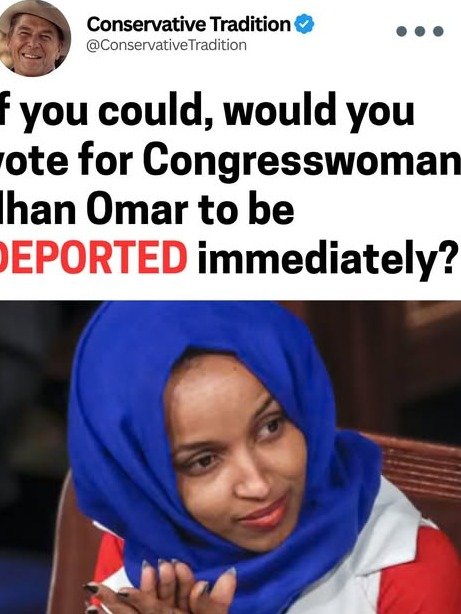
The sentiment expressed in the original post—that Omar “repaid” America’s generosity with criticism—resonates with a significant portion of the population who believe that gratitude should be a primary response from those who have found refuge and opportunity. This perspective often posits that while freedom of speech is paramount, there is also a moral dimension to how one speaks about the nation that provided a second chance at life.
Conclusion: A Complex Legacy of Opportunity and Critique
Ilhan Omar’s journey from a Somali refugee camp to the U.S. Congress is undeniably a powerful testament to the opportunities America offers. She was given a safe haven, an education, and the platform to rise to one of the highest political offices in the land. Yet, her subsequent career has been defined as much by her vocal criticisms of American policies and institutions as by her historic ascent.
For her critics, this trajectory represents a profound disappointment, a perceived betrayal of the generosity extended to her. They argue that the nation that opened its arms deserved a different kind of repayment than the consistent critique she has offered. Her story, therefore, remains a potent symbol of the complex and often contentious relationship between gratitude, opportunity, and the right to dissent in the American political landscape.
About the Author




