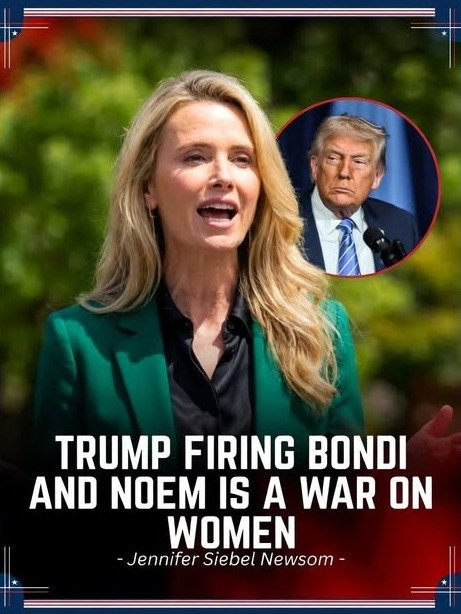
Imagine a world where powerful women, even those at the pinnacle of their careers, face unseen battles for respect and influence. This isn’t just a hypothetical scenario; it’s the very core of what California’s First Partner, Jennifer Siebel Newsom, appears to be challenging in her recent, pointed critique of Donald Trump’s actions involving prominent female political figures like former Florida Attorney General Pam Bondi and South Dakota Governor Kristi Noem.
Newsom, a renowned filmmaker and passionate advocate for gender equality, has consistently used her platform to highlight systemic issues that impact women in leadership and public life. Her recent denouncement goes beyond mere political commentary, aiming instead to dissect the underlying dynamics of power, gender, and political decision-making that often shape the careers of women in the spotlight.
Jennifer Siebel Newsom: A Respected Voice for Equality
Jennifer Siebel Newsom is far more than just California’s First Partner; she is a trailblazing documentarian and an unwavering voice for social justice. Her groundbreaking films, such as Miss Representation and The Great American Lie, have meticulously explored the pervasive influence of media on gender stereotypes and the economic anxieties that plague American society.
Through her work, Newsom has consistently championed the importance of authentic female representation and challenged the patriarchal structures that often limit women’s potential. Her advocacy is rooted in a deep understanding of how societal narratives and political decisions can either uplift or undermine women, making her criticisms particularly resonant and impactful.
The Political Landscape: Trump and Women in Power
Donald Trump’s presidency and his broader political career have been characterized by a complex and often controversial relationship with women. From his rhetoric to his appointments, his interactions with female figures have frequently sparked widespread debate, drawing both fervent support and sharp condemnation.
It is within this contentious backdrop that Newsom’s denouncement gains significant gravity. Her critique isn’t simply about individual policies; it speaks to the broader cultural and political climate concerning women’s roles, influence, and the perceived respect they receive—or lack thereof—within the highest echelons of power.
Unpacking the ‘Decisions’: Pam Bondi’s Trajectory
Pam Bondi, a prominent Republican figure, served as Florida’s Attorney General from 2011 to 2019, building a formidable political career. After her tenure, she became a vocal supporter and key ally of Donald Trump, notably joining his legal defense team during his first impeachment trial.
“The role of women in high-stakes political battles, particularly when aligned with powerful male figures, often invites scrutiny regarding autonomy and influence.” – A political analyst on the dynamics of female allies in presidential administrations.
Newsom’s critique, while not detailing a literal ‘firing’ in the traditional sense, likely zeroes in on the *nature* of decisions and the broader political environment that shaped Bondi’s post-AG career. It could be interpreted as a commentary on how women, even those with significant political capital, are positioned and utilized within a male-dominated power structure, and whether their independent agency is fully recognized or subtly constrained.
Her denouncement might question whether the opportunities presented to women like Bondi truly empower them to lead independently, or if they are, at times, channeled into roles that primarily serve a larger male political agenda. This perspective aligns with Newsom’s consistent advocacy for women to hold positions of genuine, uncompromised power.
Kristi Noem: A Governor’s Alliance and Its Implications
Kristi Noem, the current Governor of South Dakota, has emerged as another influential Republican woman and a staunch ally of Donald Trump. Her rise to national prominence has been significantly bolstered by her close association with the former president, leading to speculation about her future political ambitions.
Governor Noem has often been highlighted as an example of a conservative woman successfully navigating and thriving within the Trump-era Republican party. Her strong alignment with Trump’s policies and persona has made her a beloved figure among many of his supporters.
However, from Newsom’s perspective, this powerful alliance might invite a different kind of scrutiny. Her denouncement could be interpreted as a critical examination of the decisions and dynamics surrounding Noem’s political ascent. Does such an alliance truly represent an independent pathway for female leadership, or does it hint at a reliance on a male figure’s endorsement that, in Newsom’s view, might subtly compromise true autonomy?
Newsom’s advocacy often challenges the idea that success for women in politics must come through alignment with existing male power structures. Instead, she champions a vision where women rise on their own merit, driving their own agendas, free from implicit or explicit hierarchical constraints. Her critique could be a call to examine the cost and implications of such alliances for women’s long-term political independence.
The Deeper Message: Beyond Individual Incidents
Jennifer Siebel Newsom’s denouncement of Trump’s ‘decisions’ regarding these prominent women is not simply about specific instances; it’s a powerful amplification of her overarching message about gender, power, and equity. She consistently argues that true progress for women in politics requires a fundamental shift in how society values and supports female leadership.
Her critique serves as a reminder that even in an era where women hold significant political offices, the underlying biases and systemic challenges persist. It pushes us to ask tougher questions about the pathways to power for women, the conditions under which they operate, and the genuine extent of their influence.
Newsom’s films and public statements have consistently highlighted the often-invisible pressures and expectations placed upon women in the public eye. By calling attention to Trump’s ‘decisions’ involving Bondi and Noem, she prompts a broader conversation about how these dynamics play out, whether through perceived slights, limited opportunities, or the subtle ways in which women’s contributions might be framed or valued.
What This Means for Women in Politics
The public statements of figures like Jennifer Siebel Newsom are vital in shaping the discourse around gender equality in politics. They compel us to look beyond surface-level achievements and examine the deeper structural and cultural factors that still impede women’s full and equitable participation.
Her advocacy underscores the ongoing need for vigilance and critical analysis of how power is wielded and shared. It encourages aspiring female leaders to not only break barriers but also to critically assess the environments they enter and the alliances they forge, ensuring their voices and visions remain authentically their own.
Ultimately, Newsom’s denouncement is a call to action. It urges us to demand more transparent, equitable, and respectful political environments for all women, regardless of their political affiliation. It’s a powerful reminder that the fight for true gender equality in leadership is far from over, and that every ‘decision’ made about or by powerful women deserves careful and considered scrutiny.
Her brave stance encourages a necessary dialogue about the implicit and explicit challenges women face in the political arena, pushing us all to strive for a future where female leaders are not just present, but truly powerful and unencumbered.
About the Author




