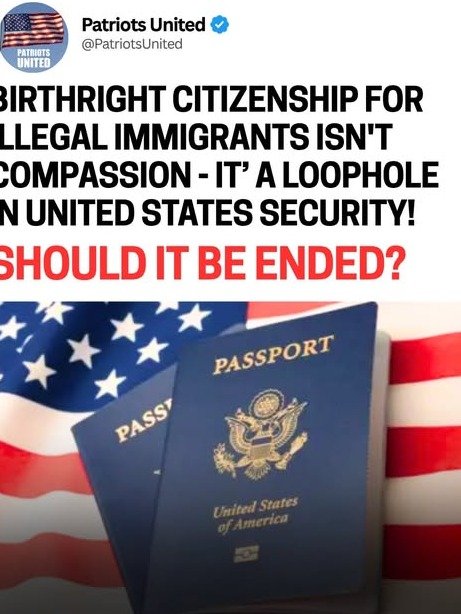
A silent constitutional earthquake is rumbling beneath the surface of American politics, threatening to redefine the very essence of what it means to be a citizen. This isn’t just another policy debate; it’s a high-stakes showdown over one of the most fundamental tenets of U.S. law: birthright citizenship.
For generations, the idea has been simple: if you’re born on American soil, you’re an American. But a powerful movement, spearheaded by figures like Donald Trump, is now challenging this long-held principle, pushing for an executive order that could dramatically alter the future for countless individuals and the nation as a whole. You might think this doesn’t affect you, but the implications of this battle are far-reaching, touching everything from immigration policy to national identity.
The 14th Amendment: A Cornerstone Under Scrutiny
At the heart of this explosive debate lies a single, powerful sentence from the 14th Amendment to the U.S. Constitution, ratified in 1868:
“All persons born or naturalized in the United States, and subject to the jurisdiction thereof, are citizens of the United States and of the State wherein they reside.”
This clause, often referred to as the Citizenship Clause, was primarily enacted to grant citizenship to formerly enslaved people after the Civil War.
For over a century and a half, this language has been widely interpreted by courts and legal scholars to mean that anyone born within U.S. borders, regardless of their parents’ immigration status, is automatically a citizen. This principle, known as jus soli (right of the soil), is a hallmark of American identity, differentiating it from many other nations that primarily follow jus sanguinis (right of blood), where citizenship is inherited from parents.
A History of Inclusion and Integration
The concept of birthright citizenship has served as a powerful engine for assimilation, ensuring that children of immigrants, even those without legal status, are integrated into American society from day one. This approach has historically been credited with avoiding the creation of a permanent underclass, fostering loyalty, and strengthening the nation’s social fabric.
Without birthright citizenship, critics argue, the U.S. could face a future where millions of individuals born and raised in America are denied full rights and opportunities, creating a marginalized population with profound societal and economic consequences. This historical context underscores the gravity of the current challenge, as it seeks to dismantle a system deeply embedded in American law and culture.
The Modern Clash: Why Now?
The resurgence of the birthright citizenship debate isn’t happening in a vacuum. It’s inextricably linked to broader anxieties about immigration, border security, and national sovereignty. Proponents of ending birthright citizenship often point to the perceived strain on public resources and the phenomenon of “anchor babies” – a derogatory term for children born in the U.S. to undocumented parents, who can then potentially sponsor their relatives for legal residency.
This renewed push gained significant momentum during the Trump administration, which viewed birthright citizenship as a magnet for illegal immigration and a loophole in the country’s immigration system. The idea of using an executive order to circumvent congressional action became a central tenet of this strategy, raising immediate and intense constitutional questions.
Trump’s Bold Challenge: An Executive Order?
Former President Donald Trump, both during his presidency and in his current campaign, has repeatedly voiced his desire to end birthright citizenship through an executive order. His argument is that the phrase “subject to the jurisdiction thereof” was never intended to apply to the children of undocumented immigrants or foreign visitors, but only to those who owe full allegiance to the United States.
He and his supporters contend that the original intent of the 14th Amendment was to grant citizenship to freed slaves, not to create an automatic path for children of non-citizens. They argue that a president has the authority to reinterpret this clause, bypassing the need for a constitutional amendment or congressional legislation, which would be far more difficult to achieve.
The Legal Minefield: Can an Executive Order Do This?
This proposed executive action immediately plunged the nation into a fierce constitutional debate. Legal scholars are sharply divided on whether a president possesses the authority to unilaterally alter the interpretation of a constitutional amendment through an executive order. The prevailing legal consensus among most constitutional experts is a resounding no.
- Constitutional Amendment Required: Many argue that changing a constitutional interpretation of this magnitude would require either a new constitutional amendment or a Supreme Court ruling.
- Separation of Powers: Allowing an executive order to redefine citizenship would be seen as a dangerous overreach of presidential power, undermining the legislative and judicial branches.
- Supreme Court Precedent: The 1898 Supreme Court case United States v. Wong Kim Ark affirmed birthright citizenship for children born in the U.S. to non-citizens, setting a strong precedent.
Opponents of Trump’s plan emphasize that the Supreme Court has already weighed in on the matter, and any attempt to circumvent that precedent via executive action would be immediately challenged and likely struck down by the courts.
Arguments FOR Birthright Citizenship: Stability and Integration
Advocates for maintaining birthright citizenship highlight several crucial benefits:
- Social Stability: It prevents the creation of a stateless, marginalized population, which could lead to social unrest and instability.
- Economic Integration: Children born with citizenship are more likely to be educated, find employment, and contribute to the tax base, rather than remaining in an informal economy.
- Administrative Simplicity: The current system is clear and straightforward. Changing it would create an enormous bureaucratic nightmare, forcing the government to track parental status at birth for millions of individuals.
- American Values: Many see birthright citizenship as embodying fundamental American values of opportunity, equality, and the idea that anyone born here can truly belong.
“Birthright citizenship is not a loophole; it is a pillar of our constitutional order and a testament to our nation’s commitment to equality and integration,” argues one prominent constitutional law professor. “To dismantle it would be to fundamentally alter who we are as a country.”
Arguments AGAINST Birthright Citizenship: Sovereignty and Resources
Conversely, those who seek to end birthright citizenship present their own compelling arguments:
- Sovereignty Concerns: They argue that allowing children of non-citizens to automatically become citizens undermines national sovereignty and encourages illegal immigration.
- “Anchor Babies”: Critics claim it incentivizes undocumented parents to enter the U.S. solely to have children who can then provide a path to citizenship for the family.
- Resource Strain: They contend that birthright citizenship places an undue burden on public services, schools, and healthcare systems, particularly in border communities.
- Original Intent: Proponents of ending it often rely on an “originalist” interpretation of the 14th Amendment, arguing that the framers never intended it to apply to those who are not legally residing in the U.S.
This side of the debate emphasizes the need to control borders and ensure that citizenship is earned or granted through a deliberate legal process, rather than simply by accident of birth location.
International Perspectives: How Do Others Do It?
It’s important to note that while birthright citizenship is common in the Americas, it’s not universal. Many European and Asian countries primarily follow jus sanguinis, granting citizenship based on the nationality of one’s parents. For example, in Germany, children born to non-citizens can gain citizenship under certain conditions, but it’s not automatic from birth.
This international comparison often fuels the debate, with those against birthright citizenship arguing that the U.S. should align itself with more restrictive practices seen in other developed nations. However, defenders of the current system counter that America’s unique history as a nation of immigrants makes jus soli particularly appropriate and beneficial.
The Road Ahead: Legal Battles and Political Stakes
Should a future administration attempt to implement an executive order to end birthright citizenship, it would undoubtedly trigger an immediate and unprecedented legal firestorm. Civil rights organizations, immigration advocacy groups, and a broad coalition of legal experts would swiftly challenge such an order in federal courts.
The battle would likely escalate all the way to the Supreme Court, forcing the justices to confront fundamental questions about constitutional interpretation, presidential power, and the very definition of American citizenship. The outcome of such a case would have profound implications, shaping immigration policy, social dynamics, and the political landscape for generations to come.
Beyond the courts, the debate over birthright citizenship will remain a potent political issue, influencing elections and fueling partisan divides. It taps into deep-seated questions about national identity, who belongs, and the future direction of the country. Every election cycle, this issue resurfaces, reminding us of its enduring power to galvanize voters and shape policy agendas.
The Future of American Identity Hangs in the Balance
The clash over birthright citizenship is far more than a legal technicality; it’s a battle for the soul of the nation. It forces Americans to confront fundamental questions about their values, their history, and their vision for the future. Will the U.S. continue its long-standing tradition of automatic citizenship for those born on its soil, or will it shift towards a more restrictive model?
The outcome of this debate will not only impact the lives of millions but will also redefine the very fabric of American society. As the arguments intensify and the political stakes grow higher, understanding the nuances of this complex issue becomes paramount. Your awareness and engagement in this discussion are crucial, for the future of American citizenship truly impacts us all.
About the Author




