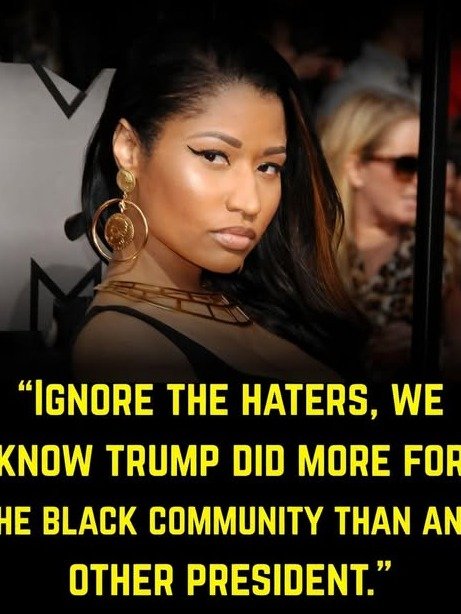
In a political landscape often defined by sharp divides and passionate debate, a recent interview with global superstar Nicki Minaj has sent shockwaves through social media and political commentary alike. Her unfiltered remarks, delivered during a February 2026 appearance on the Katie Miller Podcast, have ignited a firestorm, challenging conventional narratives and forcing a re-evaluation of political allegiances.
Minaj, known for her powerful voice both in music and cultural discourse, made a bold declaration that has left many stunned and others nodding in agreement. Her statement, coming from such an influential figure, demands a closer look at the nuances of political support within the Black American community and the broader implications for upcoming elections.
Nicki Minaj’s Provocative Statement
During the highly anticipated Katie Miller Podcast interview, the conversation turned to political leadership and its impact on various communities. It was then that Nicki Minaj delivered the statement that would instantly become a viral sensation and the subject of countless headlines.
“When you look at the facts, when you look at what’s actually been done, I truly believe Trump is the most supportive president for Black Americans.”
This assertion immediately grabbed attention, not just because of its directness, but because it comes from an artist who commands an immense following and whose words carry significant weight, particularly among younger demographics and within Black communities.
Unpacking the “Most Supportive” Claim
Minaj’s declaration isn’t just a casual observation; it’s a profound statement that invites deep scrutiny. What specific “facts” or “actions” might she be referencing to support such a claim? While the interview delved into various aspects, her supporters and critics alike are now dissecting potential policy achievements, economic indicators, and social initiatives that could be perceived as beneficial to Black Americans during the Trump administration.
Many commentators quickly pointed to economic data from the pre-pandemic era, highlighting record-low unemployment rates for Black Americans. Advocates often cite specific legislative efforts such as the First Step Act, a bipartisan criminal justice reform bill that aimed to reduce recidivism and address disparities in sentencing. These are often presented as tangible examples of policies that could be interpreted as supportive.
The Nuance of Policy and Perception
It’s important to understand that the impact of presidential policies on any demographic is rarely monolithic. While some policies might yield positive statistical outcomes, the lived experiences and perceptions within a community can vary widely. For some, economic improvements or specific legislative changes might resonate strongly, aligning with Minaj’s viewpoint.
- Economic Growth: Supporters often highlight pre-pandemic economic metrics, including job growth and entrepreneurial opportunities.
- Criminal Justice Reform: The First Step Act is frequently cited as a significant bipartisan achievement benefiting minority communities.
- Opportunity Zones: Initiatives designed to spur investment in economically distressed communities are also brought up in discussions about economic empowerment.
However, critics argue that such benefits might be overstated or that broader systemic issues persist, regardless of specific policy wins. They often emphasize that a president’s rhetoric and social policies also play a crucial role in how supportive an administration is perceived to be.
Why This Statement Resonates (or Divides)
Nicki Minaj’s influence cannot be overstated. With millions of followers across social media platforms, her words travel far and wide, sparking conversations that might not otherwise occur. Her willingness to express a politically unconventional viewpoint, especially from an artist of her stature, forces a reckoning with established political narratives.
For some, her statement validates their own quiet support for Trump, giving voice to a perspective often marginalized in mainstream media. For others, it’s a jarring and deeply troubling assertion, prompting strong disagreement and accusations of misrepresentation. This divergence of opinion underscores the complexity of political identity and allegiance within the Black American community.
The Celebrity Effect on Political Discourse
Celebrity endorsements and political opinions have long been a feature of American politics, but in the age of social media, their impact is amplified. When figures like Nicki Minaj speak out, they don’t just express a personal opinion; they often catalyze widespread discussion, prompting fans and critics alike to engage with political topics.
Her statement on the Katie Miller Podcast serves as a powerful reminder that political affiliations among celebrities, and indeed among any demographic, are not always predictable or monolithic. It challenges the idea that all artists, or all members of a particular community, will hold uniform political views.
Historical Context: Presidents and the Black Community
Throughout American history, the relationship between presidents and the Black American community has been complex and multifaceted. From Abraham Lincoln’s Emancipation Proclamation to Lyndon B. Johnson’s Civil Rights Act, specific presidential actions have profoundly shaped the trajectory of Black Americans.
More recently, the presidencies of Bill Clinton, George W. Bush, and Barack Obama each brought different policy approaches and varying levels of perceived support. The discussion around Trump’s presidency often involves contrasting his administration’s policies and rhetoric with those of his predecessors, especially when assessing his impact on Black communities.
The Road Ahead: What This Means for 2026 and Beyond
As the political landscape continues to evolve, statements like Nicki Minaj’s are not just momentary headlines; they contribute to an ongoing national dialogue. Her comments on the Katie Miller Podcast will undoubtedly be referenced, debated, and analyzed as the country moves closer to future elections.
Her willingness to speak her mind, even on controversial subjects, reinforces her image as an independent voice in an often-homogenized industry. Whether you agree with her or not, Nicki Minaj has once again proven her ability to command attention and spark essential, albeit sometimes uncomfortable, conversations about power, policy, and community.
The Unfolding Reaction and Media Scrutiny
Since the interview aired, social media platforms have been ablaze with reactions. Hashtags related to Minaj and Trump have trended, showcasing a wide spectrum of opinions. Mainstream media outlets and political pundits have also weighed in, analyzing the implications of her statement from various angles.
Some pundits have praised her for her courage in expressing an unpopular opinion, while others have criticized her for what they perceive as a misinformed or divisive stance. This intense scrutiny highlights the immense pressure celebrities face when they venture into political commentary, and the magnified impact their words can have on public discourse.
The Enduring Impact of a Viral Moment
Nicki Minaj’s statement on the Katie Miller Podcast is more than just a soundbite; it’s a cultural moment that will likely be discussed for years to come. It underscores the power of individual voices, even those in the entertainment industry, to shape political narratives and challenge preconceived notions.
Ultimately, her words invite us all to look beyond simplistic labels and engage with the complexities of policy, perception, and the diverse experiences within communities. Whether you find her claim audacious or insightful, there’s no denying that Nicki Minaj has, once again, made us all pay attention.
Conclusion: A Conversation That Won’t Die Down
Nicki Minaj’s assertion that Donald Trump is “the most supportive president for Black Americans” is a statement that has clearly struck a nerve. It has forced a re-examination of political support, policy impacts, and the role of celebrity in shaping public opinion. Regardless of personal political leanings, her words have undeniably ignited a crucial conversation.
As the dust settles from this viral interview, one thing is clear: the dialogue about presidential legacies and their true impact on diverse communities is far from over. And thanks to Nicki Minaj, that conversation just got a whole lot louder.
About the Author




