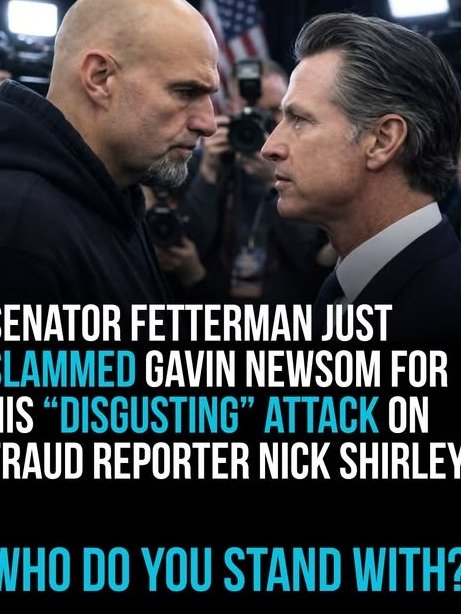
In a political landscape often defined by partisan divides, a rare and compelling drama is unfolding within the Democratic Party itself, sending shockwaves through Washington and beyond. Senator John Fetterman, known for his unconventional style, has publicly taken aim at California Governor Gavin Newsom, criticizing his approach to journalistic scrutiny. This isn’t just a minor disagreement; it’s a fundamental clash over the role of a free press and the accountability of those in power.
The controversy centers around Newsom’s interactions with journalist Nick Shirley, which Fetterman characterized as an attack on scrutiny rather than an engagement with it. Fetterman’s stark message is clear: attempting to silence or discredit journalists for doing their jobs is not only wrong but a dangerous precedent for any public official, regardless of party affiliation. This internal critique highlights a significant ideological divide that demands immediate attention.
The Heart of the Conflict: Scrutiny vs. Silence
At the core of this burgeoning dispute lies the principle of journalistic integrity and the public’s right to information. While the specifics of Newsom’s interactions with Nick Shirley remain somewhat veiled in the public discourse, Fetterman’s intervention suggests a perceived attempt to deflect or dismiss legitimate questions posed by the media. This goes against the very fabric of democratic transparency and accountability.
Fetterman’s statement underscores a crucial tenet of governance: that public officials should welcome, or at the very least tolerate, rigorous examination from the press. Rather than viewing critical reporting as an adversary, he argues it should be seen as an essential mechanism for ensuring good governance and maintaining public trust. His stance resonates deeply with proponents of a robust, independent media.
A Democrat Blasting a Democrat: Why This Is Significant
It’s not everyday you see prominent figures from the same political party publicly lambasting each other over fundamental issues. This ‘Democrat splitscreen,’ as some are calling it, speaks volumes about the differing philosophies within the party regarding media relations and executive power. Fetterman’s willingness to call out a fellow Democrat, especially one as high-profile as Newsom, signals a deep conviction in his beliefs about press freedom.
This isn’t merely political theater; it represents a significant moment for the Democratic Party. It forces a conversation about how its leaders should interact with the fourth estate and whether the pursuit of political advantage should ever come at the expense of transparency. The implications of this internal debate could shape future media strategies for Democratic candidates nationwide.
“Attacking scrutiny instead of answering it is the wrong move. Our democracy thrives on a free press holding power accountable, not on politicians trying to shut down uncomfortable questions.” – Senator John Fetterman (paraphrased)
The Unsung Hero: The Role of Nick Shirley
While the focus has largely been on the Fetterman-Newsom dynamic, it’s essential to acknowledge the catalyst for this debate: journalist Nick Shirley. Though not explicitly detailed in the initial reports, Shirley’s work presumably involved holding Governor Newsom accountable on matters of public interest. This incident serves as a stark reminder of the often-challenging, yet vital, role journalists play in our society.
Journalists like Shirley are the watchdogs of democracy, tasked with uncovering facts, asking tough questions, and providing the public with the information needed to make informed decisions. When a public official, regardless of their political stripe, is perceived to be targeting such scrutiny, it sends a chilling message that can undermine the very foundations of a free society.
The Fetterman Doctrine: A Call for Transparency
Senator Fetterman’s intervention can be interpreted as laying down a marker, a ‘Fetterman Doctrine’ perhaps, for how Democrats should engage with the media. His argument is simple yet profound: transparency and accountability are non-negotiable. He champions the idea that responding to scrutiny, even when it’s uncomfortable, is a sign of strength and respect for the democratic process, not a weakness.
This doctrine suggests a progressive ideal where power is exercised openly and subject to public review, rather than being shielded from critical examination. It’s a powerful message, especially in an era where trust in institutions, including the media and government, is often at an all-time low. Fetterman’s stance could inspire a new wave of political leaders to embrace genuine openness.
Newsom’s Challenge: Navigating Media Relations
Governor Newsom, a rising star in the Democratic Party and often touted as a potential future presidential candidate, now faces a significant challenge. His response to Fetterman’s criticism, and more broadly, his approach to media relations, will be closely watched. In the current political climate, how public figures handle dissent and journalistic inquiry can profoundly impact their public image and political trajectory.
Newsom has the opportunity to either double down on his current approach or to re-evaluate his strategy, demonstrating a commitment to the principles of a free press that Fetterman so vigorously defends. The perception of a politician attacking a journalist can be incredibly damaging, often overshadowing any perceived misstep by the media itself. This moment calls for careful consideration and strategic communication from the Governor’s office.
The Broader Implications for Press Freedom
Beyond the immediate political skirmish, this incident raises critical questions about the state of press freedom in America. When a prominent politician is accused of ‘attacking scrutiny,’ it resonates with broader concerns about attempts to control narratives, delegitimize news organizations, and undermine the public’s access to diverse perspectives.
- Erosion of Trust: Such incidents can further erode public trust in both political leaders and the media, creating a cycle of skepticism.
- Chilling Effect: Accusations against journalists can create a chilling effect, potentially discouraging investigative reporting on sensitive topics.
- Democratic Health: A healthy democracy relies on a vibrant, independent press. Any perceived threat to this independence is a threat to democratic health itself.
- Setting Precedents: How this situation is resolved could set important precedents for future interactions between politicians and the press.
What This Means for the Democratic Party’s Future
This public disagreement between Fetterman and Newsom is more than just a spat; it’s a symptom of underlying tensions within the Democratic Party regarding its core values and public image. As the party navigates complex national issues, its ability to present a united front on fundamental principles like press freedom will be crucial.
Will Fetterman’s strong stance be embraced as a guiding principle, pushing for greater transparency across the board? Or will Newsom’s approach, whatever its motivations, be seen as a necessary evil in the cutthroat world of modern politics? The answer will reveal much about the party’s direction and its commitment to the very ideals it often champions.
Moving Forward: A Call for Dialogue, Not Division
Ultimately, this ‘Democrat splitscreen’ moment presents an opportunity for introspection and dialogue within the party. It’s a chance to reaffirm the importance of a free and independent press and to establish clear guidelines for how public officials should engage with journalistic scrutiny. The goal should not be to silence critics, but to engage with criticism constructively, strengthening public trust in the process.
As the conversation around this incident continues, all eyes will be on both Fetterman and Newsom. Their actions and statements in the coming days and weeks will not only define their individual political narratives but could also significantly influence the Democratic Party’s stance on media relations for years to come. The stakes are incredibly high, not just for these two politicians, but for the health of our democracy.
About the Author




