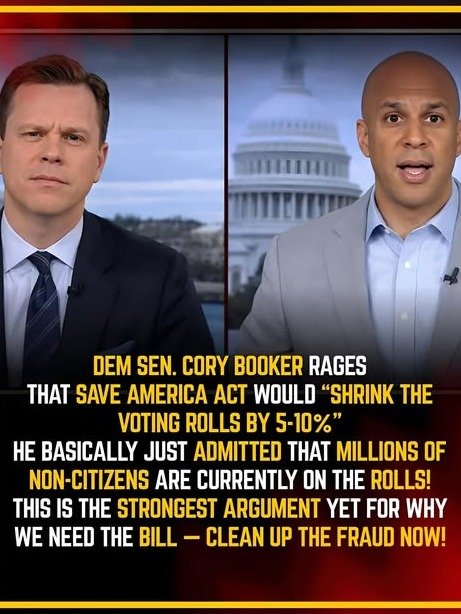
Imagine a world where casting your ballot, a fundamental right, suddenly becomes a bureaucratic maze. This isn’t a dystopian fantasy, but a very real concern for millions of Americans as a heated debate rages over a proposed piece of legislation: the SAVE America Act.
At the heart of this storm is Senator Cory Booker, who has vocally opposed this bill, sparking a nationwide conversation about voter rights, election integrity, and the very future of American democracy. His stand isn’t just a political maneuver; it’s a direct challenge to a bill that could fundamentally alter how citizens register to vote, potentially impacting millions.
The Core Controversy: What is the SAVE America Act?
The SAVE America Act, short for the “Safeguarding American Votes for Everyone” Act, is a legislative proposal designed to mandate proof of U.S. citizenship as a prerequisite for voter registration. Proponents argue this measure is crucial for ensuring that only eligible citizens participate in federal elections, thereby bolstering election integrity and preventing voter fraud.
This bill seeks to standardize voter registration requirements across all states, moving away from existing systems that vary significantly. Currently, many states rely on sworn affidavits or checks against existing databases, rather than requiring physical documentation of citizenship at the point of registration.
Decoding the Bill’s Intent and Potential Impact
On the surface, the SAVE America Act aims to eliminate the possibility of non-citizens registering to vote. Supporters often cite concerns about the potential for undocumented immigrants or other non-citizens to cast ballots, thereby diluting the power of legal votes. They contend that robust proof of citizenship is a straightforward solution to a perceived vulnerability in the electoral system.
However, the implications of such a requirement extend far beyond a simple verification process. Critics argue that while the intent might be framed as securing elections, the practical outcome could be a significant barrier to legitimate voters, particularly those who may struggle to obtain or present the required documentation.
Why the Opposition? Senator Booker’s Stance
Senator Cory Booker has emerged as a prominent voice against the SAVE America Act, articulating a passionate defense of voter access and civil rights. His opposition stems from a deep concern that the bill, if enacted, would disproportionately disenfranchise eligible citizens and create unnecessary hurdles for participation in the democratic process.
Booker and other opponents emphasize that existing laws already make it a felony for non-citizens to vote in federal elections. They argue that the focus should be on strengthening existing enforcement mechanisms rather than imposing new, potentially restrictive requirements that could suppress lawful votes.
“We should be making it easier, not harder, for every eligible American to vote. This bill is a solution in search of a problem, and its true impact will be felt by those who already face systemic barriers to participation.” – A sentiment often echoed by Senator Booker’s allies.
The Debate: Voter Integrity vs. Voter Access
The controversy surrounding the SAVE America Act is a microcosm of a larger, ongoing national debate: how do we balance the imperative of election integrity with the fundamental right to voter access? Proponents of strict voter ID and proof-of-citizenship laws often prioritize preventing any potential for fraud, even if the evidence of widespread non-citizen voting is statistically low.
Conversely, advocates for broader voter access argue that the risk of disenfranchising even a small percentage of eligible citizens outweighs the perceived benefits of such stringent measures. They point to the historical context of voter suppression efforts and the potential for these laws to disproportionately affect minority groups, the elderly, students, and low-income individuals.
Historical Context and Precedents
This isn’t the first time such measures have been proposed or implemented. Several states have attempted to enact similar proof-of-citizenship requirements for voter registration in the past, often leading to protracted legal battles. For instance, Arizona’s Proposition 200, passed in 2004, required proof of citizenship for voter registration and was challenged extensively in court.
The Supreme Court, in cases like Arizona v. Inter Tribal Council of Arizona (2013), has grappled with the interplay between state election laws and federal statutes like the National Voter Registration Act (NVRA). These legal precedents highlight the complex constitutional questions that arise when states attempt to impose additional requirements beyond federal standards.
Who Stands to Be Affected?
The impact of the SAVE America Act would likely be felt most acutely by specific demographics. While many Americans have readily available birth certificates or passports, a significant number do not. This includes:
- Elderly citizens: Especially those born at home, in rural areas, or who have lost original documents.
- Low-income individuals: Who may lack the resources or time to obtain new documents, which often come with fees.
- Racial and ethnic minorities: Who have historically faced greater barriers to accessing official documentation and may encounter systemic challenges.
- Students: Who may be registering away from their home states and lack easy access to original documents.
- Individuals with disabilities: Who may face mobility or logistical challenges in obtaining necessary paperwork.
For these groups, the requirement for specific proof of citizenship could transform a simple act of civic duty into an insurmountable bureaucratic hurdle, effectively silencing their voices at the ballot box.
Logistical Hurdles and Practicalities
Implementing a nationwide proof-of-citizenship mandate would present enormous logistical challenges. State election officials would need to establish new verification processes, train staff, and potentially overhaul existing registration systems. This would likely incur significant costs and could lead to delays and errors in processing voter registrations.
Furthermore, the sheer volume of documents that would need to be reviewed and verified could overwhelm election offices, especially during peak registration periods. Critics also question the practical availability of “proof of citizenship” documents for everyone, pointing out that not all citizens have passports, and birth certificates can be difficult and costly to replace.
The Path Forward and Political Implications
Senator Booker’s opposition to the SAVE America Act underscores the deep ideological divide that currently defines American politics. This debate isn’t just about a single bill; it’s about competing visions for the future of democratic participation.
The outcome of this legislative battle will have far-reaching political implications, potentially shaping voter turnout, the composition of the electorate, and the legitimacy of election results for years to come. It forces a critical examination of what it means to be an eligible voter in America and how we safeguard that fundamental right.
What Does This Mean for You?
Regardless of where one stands on the SAVE America Act, Senator Booker’s vocal opposition has brought this critical issue into the national spotlight. It serves as a powerful reminder that the mechanisms of democracy are constantly under scrutiny and that the right to vote, while fundamental, is perpetually subject to legislative challenges and reforms.
Understanding the nuances of this debate is crucial for every citizen. It’s about more than just a bill; it’s about protecting the integrity of our electoral process while ensuring that every eligible voice can be heard. The conversation around the SAVE America Act highlights the ongoing tension between security and access, a tension that defines much of our political landscape.
About the Author




