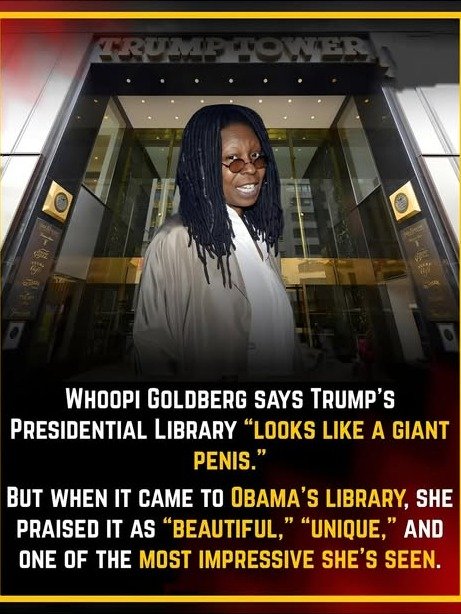
Did Whoopi Goldberg just say *that* on live television? A single, pointed comment on a recent episode of The View has ignited a firestorm across social media and news outlets, proving once again that late-morning talk television can still generate headline-grabbing moments.
The veteran host’s observation, made during a discussion about former President Donald Trump’s proposed Miami presidential library, was so striking that it immediately went viral, sparking both outrage and amusement. Her comparison of the library’s architectural renderings to a rather distinct, phallic symbol has everyone talking.
The Moment That Stopped the Show
It all unfolded on the March 31 episode of The View, a show known for its lively and often contentious political discussions. As the co-hosts deliberated over recent news, images of the conceptual designs for President Trump’s planned presidential library in Miami flashed across the screen. These renderings showcased a grand, imposing structure, typical of the aesthetic often associated with Trump’s brand.
As the panel discussed the architectural vision and the implications of such a project, Whoopi Goldberg interjected with a comment that cut through the polite chatter. With a mix of wry humor and bluntness, she openly compared the design to a phallic shape, a remark that sent a ripple of gasps and laughter through the studio audience and among her co-hosts.
Decoding Whoopi’s Commentary
Whoopi Goldberg’s remark wasn’t just a throwaway line; it was a potent piece of commentary. By likening the proposed library to a phallic symbol, she tapped into a long-standing cultural tradition of interpreting monumental architecture as expressions of power, dominance, and often, male ego. Her observation, though delivered with characteristic candor, highlighted a potentially subconscious message embedded within the design.
This kind of interpretation isn’t new. Throughout history, architects and leaders have used form and scale to convey authority and legacy. Goldberg’s comment brought this subtext to the forefront, challenging viewers to look beyond the surface grandeur and consider the deeper, possibly unintended, psychological implications of the proposed structure.
The Grand Vision: Trump’s Presidential Library
For context, presidential libraries in the United States are typically institutions dedicated to preserving the papers, records, and other historical materials of former presidents. They serve as museums, archives, and centers for public education, often reflecting the president’s legacy and achievements. Notable examples include the Ronald Reagan Presidential Library and the George W. Bush Presidential Center, each designed to embody the spirit and era of its namesake.
Donald Trump’s plans for his own presidential library have been a topic of speculation since he left office. While specific details remain fluid, early concepts have suggested a lavish, perhaps unconventional, approach. The proposed Miami location and the initial renderings hint at a design that aims to be as distinctive and impactful as the former president himself.
Architecture as a Statement: Intent vs. Perception
Architectural design is rarely neutral. Buildings, especially those intended to commemorate historical figures, are loaded with symbolism. They are meant to evoke feelings, convey messages, and solidify a particular narrative. However, the perception of a design can often diverge wildly from the architect’s or patron’s original intent.
Tall, imposing structures, for example, have frequently been associated with power and virility, a connection that dates back to ancient obelisks and towering monuments. Whether the designers of Trump’s library consciously intended such a comparison is unknown, but Whoopi Goldberg’s comment clearly articulated a common, albeit provocative, interpretation.
The Ripple Effect: Media and Social Media Erupt
Unsurprisingly, Whoopi’s comment immediately took on a life of its own. Clips of the segment flooded social media platforms like X (formerly Twitter), TikTok, and Instagram. The reaction was swift and polarized, mirroring the broader political landscape.
Supporters of Donald Trump criticized Goldberg for being disrespectful and crude, accusing her of petty partisan attacks. They argued that her comments trivialized a significant historical project. On the other hand, many online users found her remark hilarious and spot-on, applauding her for her boldness and humor in pointing out what they perceived as an obvious, if unspoken, truth about the design.
“It’s just Whoopi being Whoopi,” one fan tweeted, “saying what everyone else is thinking but is too afraid to vocalize!” Another user countered, “This is exactly why The View has lost its way. Pure childish nonsense.”
The Power of Celebrity Commentary in Political Discourse
This incident underscores the significant role that celebrity commentary plays in shaping public opinion and discourse. Figures like Whoopi Goldberg, with their vast platforms, have the ability to inject humor, critique, and alternative perspectives into serious political discussions. Their remarks, even if seemingly flippant, can resonate deeply with audiences, sparking conversations that might not otherwise occur.
In an age where information spreads instantaneously, a single quip from a prominent personality can become a national talking point, forcing a re-evaluation of public figures and their projects. It highlights the blurred lines between entertainment, news, and political analysis in contemporary media.
Beyond the Phallus: A Broader Conversation
While the immediate focus was on the specific comparison, Whoopi Goldberg’s comment also opened up a broader conversation about the nature of presidential libraries themselves. What kind of legacy should these institutions project? How much personal branding is too much? And what role does architectural design play in shaping historical narratives?
The controversy serves as a reminder that every public project, especially one associated with a polarizing political figure, is subject to intense scrutiny and diverse interpretations. It’s not just about the bricks and mortar; it’s about the message, the symbolism, and the public’s perception.
A Lasting Impression
In the end, Whoopi Goldberg’s audacious remark on The View will likely be remembered as one of the most memorable moments from the show this year. It perfectly encapsulated the intersection of pop culture, politics, and architectural critique, proving that a well-timed, unfiltered comment can indeed send shockwaves far beyond the television studio.
Whether you found it offensive, hilarious, or thought-provoking, there’s no denying that Whoopi Goldberg once again managed to capture the public’s attention and ignite a conversation that continues to reverberate. It leaves us to wonder what other unspoken truths lie hidden in plain sight, waiting for someone bold enough to point them out.
About the Author




