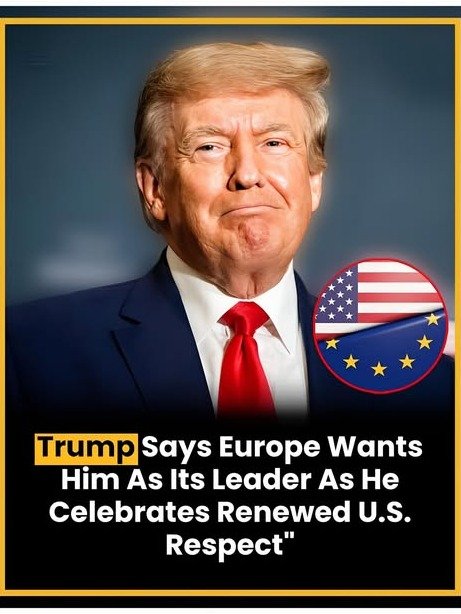
Did Donald Trump just drop a bombshell about his international appeal? Recently, the former President asserted that his unique leadership style isn’t just impactful domestically, but is surprisingly ‘well regarded internationally,’ specifically mentioning parts of Europe. This isn’t just a casual remark; it’s a bold declaration that immediately sparked widespread discussion and debate.
During a recent appearance, which quickly garnered significant media attention, Trump doubled down on this belief. He suggested that despite common narratives, many leaders and citizens abroad, particularly across the European continent, secretly admire or openly appreciate his decisive, ‘America First’ approach. This statement cuts directly against the grain of much mainstream reporting and diplomatic commentary from his time in office.
Unpacking the Controversial Claim
His assertion immediately raised eyebrows and ignited a fresh wave of scrutiny. For many, the idea of European nations universally or even widely embracing Trump’s often confrontational and nationalistic policies seems at odds with their traditional diplomatic norms and multilateral inclinations. Yet, the former President remains steadfast in his conviction, hinting at a deeper, perhaps less visible, undercurrent of support.
To truly understand the implications of Trump’s claim, one must first dissect what constitutes his distinctive leadership style. Characterized by a direct, often blunt communication approach, a willingness to challenge established norms, and a strong emphasis on national sovereignty, his presidency was a masterclass in disruption. He championed bilateral deals over multilateral agreements, often prioritizing what he perceived as immediate American interests above broader global consensus.
The ‘America First’ Doctrine Abroad
The ‘America First’ doctrine, a cornerstone of his administration, resonated profoundly with a segment of the global population, particularly those disillusioned with traditional political establishments. This nationalist stance, while often criticized by globalists and traditional allies, paradoxically found echoes among populist movements emerging across Europe. These movements, much like Trump’s base, often advocate for stronger national borders, reduced immigration, and a re-evaluation of international commitments.
Consider, for instance, his stance on NATO. While repeatedly demanding that European allies contribute more to their own defense – a point many analysts concede had some merit – his questioning of the alliance’s fundamental purpose sent shockwaves through European capitals. Similarly, his withdrawal from the Paris Agreement on climate change and the Iran nuclear deal were met with widespread dismay by many European leaders, who saw these moves as undermining global cooperation and stability.
His administration’s approach to trade, marked by tariffs and threats of economic retaliation, also created significant friction with key European partners like Germany and France. These actions, intended to level the playing field for American businesses, were often viewed in Europe as protectionist and damaging to global trade relations, further complicating the narrative of ‘well-regarded’ leadership.
Who in Europe Might ‘Regard’ Trump Well?
Despite the diplomatic friction, it’s undeniable that certain factions within Europe did, and perhaps still do, view Trump’s leadership with a degree of admiration. Foremost among these are leaders and supporters of various populist and right-wing nationalist parties. Figures like Hungarian Prime Minister Viktor Orbán openly praised Trump’s approach, seeing him as a strong leader unafraid to challenge liberal orthodoxies and prioritize national interests.
Beyond the political sphere, some business leaders and entrepreneurs might have appreciated Trump’s perceived pro-business policies, deregulation efforts, and his often transactional approach to international relations. They might have seen him as a pragmatic dealmaker, rather than an ideological statesman, a quality that can appeal to those focused on economic outcomes rather than diplomatic niceties and multilateral frameworks.
Furthermore, segments of the European populace, particularly those feeling left behind by globalization or frustrated with the European Union’s bureaucracy, might have found Trump’s anti-establishment rhetoric refreshing. His promise to ‘drain the swamp’ resonated with similar sentiments of distrust towards elites and established institutions that are prevalent in many European countries, offering an alternative to mainstream politics.
The Counter-Narrative: Widespread European Concerns
However, to suggest widespread ‘well-regard’ would be to overlook the significant and often vocal opposition Trump faced across the continent. Mainstream political leaders, from Germany’s Angela Merkel to France’s Emmanuel Macron, frequently expressed strong disagreements with his policies and rhetoric. Concerns ranged from his skepticism towards multilateral institutions and climate action to his protectionist trade policies and perceived undermining of democratic norms.
Public opinion polls conducted during his presidency consistently showed low approval ratings for Trump across most European countries. For instance, surveys by the Pew Research Center repeatedly highlighted widespread distrust in his leadership, with many Europeans viewing his presidency as a destabilizing force for global affairs and a threat to shared values. These findings directly contradict the idea of broad international admiration.
The transatlantic alliance, a cornerstone of post-World War II global security, experienced unprecedented strain during Trump’s tenure. His criticisms of NATO, his unilateral withdrawal from international agreements, and his often unpredictable foreign policy approach led to genuine anxiety among European allies about the reliability and future direction of American leadership. This was hardly a sign of being ‘well regarded’ by traditional partners, but rather a cause for significant alarm and strategic re-evaluation.
Distinguishing ‘Well Regarded’ from ‘Influential’
It’s crucial to differentiate between being ‘well regarded’ – implying respect, approval, and positive sentiment – and simply being ‘influential‘ or ‘talked about.’ There’s no doubt that Donald Trump was an immensely influential figure on the world stage, and his actions and statements were closely watched and debated by every major capital. But influence does not automatically equate to admiration or positive regard; it can also stem from concern or apprehension.
His leadership style was, and remains, deeply polarizing. While some might have respected his perceived strength or his willingness to challenge the status quo, many others viewed him with alarm, seeing his approach as a threat to international cooperation, democratic values, and global stability. This dichotomy makes any blanket statement about his international appeal highly simplistic and often misleading.
What Does This Mean for Future Relations?
Trump’s recent comments are not merely a reflection on his past presidency but also offer a glimpse into his potential approach should he return to power. His belief in a hidden international appreciation for his style suggests he might continue with similar foreign policy strategies, prioritizing bilateral deals and national interests over multilateral consensus and traditional alliances. This could signal a renewed period of unpredictability for global diplomacy.
European nations, having experienced the ‘America First’ era once, are likely more prepared for such an eventuality. They have already begun to explore greater strategic autonomy and diversification of alliances, recognizing the potential for continued unpredictability from Washington. This shift reflects a cautious adaptation and a strengthening of European self-reliance, rather than an embrace of Trumpian foreign policy or a widespread ‘regard’ for his methods.
The ongoing debate surrounding Trump’s international standing underscores the deep divisions within global politics and the evolving nature of leadership in the 21st century. His claims, while controversial, force a re-examination of how different nations and political factions perceive and react to unconventional approaches on the world stage, inviting a nuanced understanding beyond simple approval or disapproval.
Ultimately, Donald Trump’s assertion that his leadership style is ‘well regarded internationally, including in parts of Europe,’ is a complex claim. While certain populist elements and individuals may indeed admire aspects of his approach, the broader landscape of European public opinion and mainstream political sentiment paints a far more critical picture. His presidency was undeniably impactful and influential, but the notion of widespread positive regard remains a subject of intense debate and differing interpretations, highlighting the intricate tapestry of global perceptions.
About the Author




