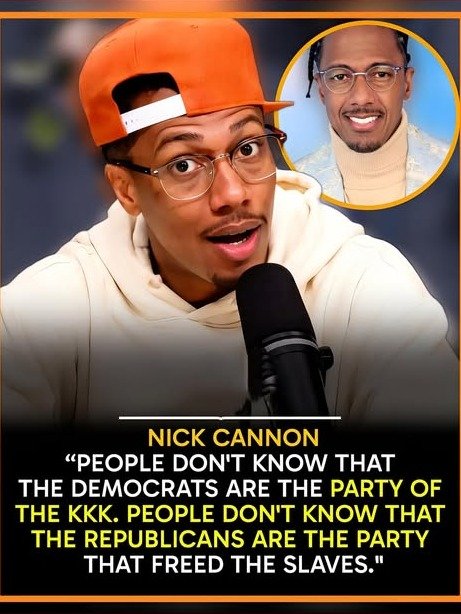
Imagine everything you thought you knew about American political parties was turned on its head by a single celebrity’s bold statement. That’s precisely what happened when Nick Cannon recently ignited a firestorm, challenging long-held perceptions about the historical foundations of the Democratic and Republican parties. His remarks didn’t just spark conversation; they detonated a full-blown online debate, forcing many to re-examine the complex, often uncomfortable truths of America’s political past.
The entertainer, known for his candid commentary, dove headfirst into a historical analysis that quickly went viral. He touched upon sensitive points regarding the origins and transformations of the two major U.S. political factions, prompting an immediate and intense reaction across social media platforms and news outlets alike. People were either vehemently agreeing, passionately disagreeing, or simply stunned by the historical claims he put forth.
The Spark That Ignited the Debate
Cannon’s comments, made during a public discussion, specifically centered on the historical alignment of the Democratic and Republican parties concerning issues of race and civil rights. He reportedly highlighted the Democratic Party’s historical ties to slavery and segregation, contrasting it with the Republican Party’s origins as an anti-slavery movement. This narrative, while historically accurate in broad strokes, often omits crucial nuances and context, leading to its controversial reception.
His statements suggested a simplified view:
“Historically, the Democratic Party was the party of slavery, the party of Jim Crow, and the Republican Party was founded to free the slaves.”
This assertion, while containing elements of historical fact, immediately drew both fervent support from those who felt it was a necessary historical correction and sharp criticism from those who accused him of oversimplifying a deeply complex and evolving political landscape.
The controversy wasn’t just about the historical facts themselves, but about how they were presented and interpreted in a modern context. Many felt that such a stark comparison disregarded the significant ideological shifts both parties have undergone over more than a century and a half. The internet, predictably, became a battleground for historical interpretation, political ideology, and the role of celebrity in public discourse.
A Dive into America’s Political Past: The Democratic Evolution
To truly understand the depth of Cannon’s comments and the ensuing reactions, we must delve into the historical record. The Democratic Party, founded by Andrew Jackson in the 1820s, indeed held vastly different positions in its early days compared to its modern incarnation. For much of the 19th century and well into the 20th, the party was the dominant political force in the American South, a region deeply entrenched in slavery and, later, segregation.
Key figures like Stephen A. Douglas, a prominent Democrat, championed
About the Author




