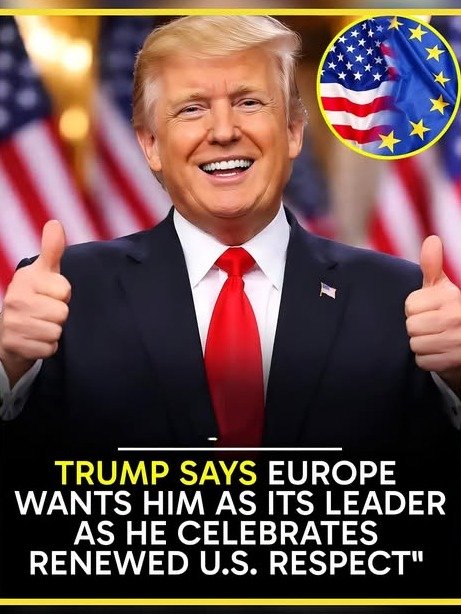
Donald Trump has once again ignited a firestorm of discussion, this time by suggesting a provocative idea: that certain European nations might actually respond positively to his unique leadership style. This isn’t just a fleeting comment; it stems from his deeply held views on crucial global issues like security and trade, which have historically caused friction but could, in his eyes, find surprising resonance across the Atlantic.
Could it be true? Is there a hidden undercurrent of European sentiment that aligns with Trump’s ‘America First’ approach? This article delves into the complexities of his claims, exploring the nuanced geopolitical landscape and economic realities that might lend credence to his audacious predictions, and what it means for the future of transatlantic relations.
The Trump Doctrine on Security: A Transactional Alliance?
For years, Donald Trump has been an outspoken critic of what he perceives as an imbalanced burden-sharing within NATO. His consistent demand for European allies to significantly increase their defense spending has been a cornerstone of his foreign policy rhetoric. He views military alliances less as sacred bonds and more as transactional agreements, where each member must pull their weight financially.
This perspective, while jarring to traditionalists, has undeniably pushed many NATO members to re-evaluate their defense budgets. Some nations, particularly those with strong domestic populist movements or those feeling less directly threatened by traditional adversaries, might find a certain appeal in Trump’s call for greater national autonomy and responsibility in defense.
NATO’s Future Under a ‘Trump 2.0’
A potential second Trump administration would undoubtedly reignite debates about the very foundation of NATO. His past comments, questioning the Article 5 collective defense clause, sent shivers down the spines of many European leaders. However, for some, particularly those eager to reduce reliance on the U.S. or to carve out a more independent defense posture, Trump’s transactional approach might inadvertently offer an opportunity.
They might see it as a chance to accelerate the long-discussed concept of ‘European strategic autonomy,’ taking greater control over their own security apparatus. This isn’t necessarily an embrace of Trump’s ideology, but rather a pragmatic adaptation to a perceived shift in U.S. commitment, which some European factions might even welcome as a catalyst for their own defense integration.
Trade Wars and Economic Nationalism: A Divisive Strategy?
Beyond security, Trump’s views on international trade have been equally disruptive. His administration’s imposition of tariffs on European goods, from steel and aluminum to agricultural products, sparked retaliatory measures and frayed economic ties. Yet, even here, Trump believes his stance might resonate with certain European sensibilities.
His focus on reducing trade deficits and protecting domestic industries aligns, in some ways, with burgeoning economic nationalist movements across Europe. These movements, often critical of the European Union’s free-trade policies, might see a parallel in Trump’s ‘America First’ approach and envision a ‘France First’ or ‘Germany First’ economic policy for their own nations.
Bilateral Deals vs. Multilateral Blocs
Trump’s preference for bilateral trade agreements over large multilateral blocs like the EU poses a significant challenge but also a potential opportunity for some. While the EU is designed to negotiate as a unified bloc, a Trump presidency might seek to exploit existing divisions or offer more favorable terms to individual nations willing to break ranks.
This could be particularly appealing to smaller economies or those feeling marginalized within the larger EU structure, who might believe they could secure better deals directly with the U.S. Such a scenario, while threatening EU unity, could be perceived by some national leaders as a way to enhance their country’s specific economic interests.
“The world is shifting, and national interests are becoming paramount. Some European leaders, despite public pronouncements, might privately appreciate a U.S. president who prioritizes national sovereignty, even if it means challenging established norms.” – A geopolitical analyst.
Who Might Be Receptive? The European Political Landscape
So, which European nations or political factions might actually respond positively to Trump’s leadership style? It’s unlikely to be the traditional, pro-EU, transatlanticist establishment. Instead, the receptiveness might come from the growing populist and nationalist movements across the continent.
Hungary and Poland: Nations with strong conservative, nationalist governments, like Hungary under Viktor Orbán, have often expressed admiration for Trump’s strongman image and his emphasis on national sovereignty over globalist institutions.
Italy and France: Right-wing populist parties in countries like Italy (e.g., Lega) and France (e.g., National Rally) often share Trump’s skepticism of multilateral institutions, his tough stance on immigration, and his focus on national economic protectionism.
Brexit Supporters: Even within the UK, many who supported Brexit might find common ground with Trump’s anti-establishment rhetoric and his vision for independent national action.
These groups often champion a vision of their own nations as strong, independent actors, less constrained by EU bureaucracy or international agreements. Trump’s ‘America First’ message, therefore, might not be seen as a threat, but rather as an inspiration or even a template for their own national agendas.
The Challenge to European Unity
A second Trump term, with its potential for transactional diplomacy and a focus on bilateral relationships, could profoundly challenge the unity of the European Union. While many European leaders would undoubtedly resist such overtures, the temptation for individual nations to pursue what they perceive as their own best interests could create significant internal strains within the bloc.
This dynamic is precisely what Trump seems to be banking on: the idea that underlying national interests and existing ideological fissures within Europe could lead some to quietly, or even openly, welcome a leader who champions a similar philosophy of national self-interest.
Beyond the Headlines: Understanding the Nuance
It’s crucial to understand that ‘responding positively’ doesn’t necessarily mean full endorsement of Trump’s policies or personality. Instead, it could signify a pragmatic recognition that his approach, however unconventional, might align with certain strategic or economic goals of specific European nations or political parties.
For some, a more unpredictable U.S. foreign policy might be seen as a necessary jolt, forcing Europe to finally take greater responsibility for its own destiny. For others, particularly those disillusioned with globalism, Trump’s emphasis on national sovereignty and economic protectionism might resonate deeply with their own political platforms.
The Future of Transatlantic Relations: An Uncertain Path
Donald Trump’s suggestion is not just a rhetorical flourish; it’s a reflection of a deeper understanding of the evolving political landscape in Europe. While many traditional allies would undoubtedly view a return to Trump’s leadership with apprehension, the rise of populist movements and a growing desire for national autonomy among certain factions cannot be ignored.
The debate sparked by Trump’s comments forces a critical examination of the true state of transatlantic relations and the future direction of Europe itself. Whether these European nations would truly embrace his leadership, or simply adapt to it, remains a pivotal question that will shape global politics for years to come.
Conclusion: A Divided Continent Awaits
Ultimately, Donald Trump’s assertion that some European nations might respond positively to his leadership style is more than just a bold claim; it’s a mirror reflecting the complex and often contradictory political currents sweeping across Europe. From security burden-sharing to protectionist trade policies, his vision challenges the very foundations of post-war transatlantic cooperation.
While the traditional establishments may recoil, the rising tide of nationalism and a desire for greater national sovereignty in certain corners of Europe could indeed lead to a surprisingly receptive audience. The coming years will reveal whether this is a prophetic insight or merely wishful thinking, but one thing is clear: the discussion Trump has sparked is far from over.