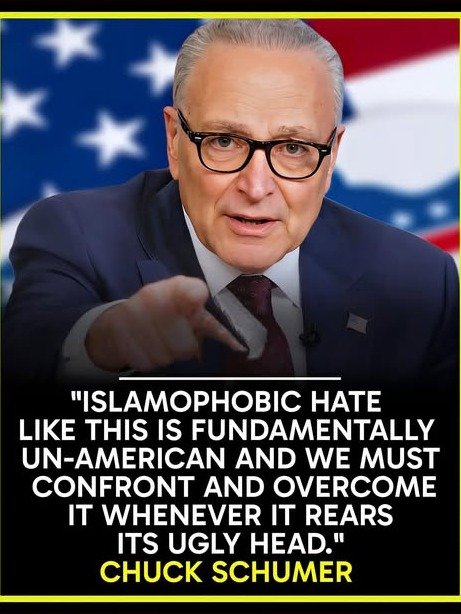
In a world often fractured by division and prejudice, the words of influential leaders carry immense weight. Recently, a powerful statement from Senate Majority Leader Chuck Schumer cut through the noise, delivering a stark condemnation of Islamophobia and shining a much-needed light on the invaluable role Muslim Americans play in our society.
His address wasn’t just a political soundbite; it was a profound call for understanding and unity, labeling Islamophobia as nothing short of “mindless hate.” This declaration serves as a crucial reminder that the fight against bigotry is an ongoing battle, one that demands unwavering commitment from all corners of society, especially from those in positions of power.
A Powerful Stance Against ‘Mindless Hate’
Senator Schumer’s remarks were a direct and unequivocal denouncement of prejudice directed towards Muslim communities. He articulated a truth often overlooked or deliberately ignored: that Islamophobia is not only morally wrong but also fundamentally irrational. It’s a form of bigotry that thrives on misinformation, fear-mongering, and a deliberate refusal to acknowledge the rich tapestry of American life.
By describing it as “mindless hate,” Schumer underscored the senseless nature of discrimination based on religion or origin. This isn’t about reasoned disagreement or policy debates; it’s about an irrational animosity that seeks to diminish and marginalize an entire group of people based on unfounded stereotypes and baseless fears.
“Islamophobia is mindless hate. It is an irrational fear and prejudice that has no place in a diverse and inclusive society like ours,” Schumer stated, emphasizing the urgent need to confront such bigotry head-on.
The Indispensable Contributions of Muslim Americans
Beyond condemning hate, Senator Schumer meticulously highlighted the profound and diverse contributions of Muslim Americans across every conceivable sector of American life. His statement served as a powerful antidote to the divisive narratives that often seek to portray Muslim communities as ‘other’ or somehow separate from the American fabric.
From the bustling corridors of public service to the quiet dedication in our hospitals and schools, Muslim Americans are not just participants; they are vital architects of our collective success. Their presence enriches our culture, strengthens our economy, and upholds the very ideals of liberty and opportunity that define the United States.
Shaping Public Service and Defense
Consider the countless Muslim Americans who dedicate their lives to public service. They serve in our armed forces, bravely defending our nation’s freedoms both at home and abroad, often making the ultimate sacrifice. They are the doctors and nurses on the front lines, healing communities and saving lives, especially evident during public health crises.
Moreover, Muslim Americans contribute significantly as educators, police officers, firefighters, and civil servants, working tirelessly to uphold the rule of law, educate future generations, and ensure the safety and well-being of their fellow citizens. Their commitment to civic duty is a testament to their deep-rooted patriotism and belief in the American dream.
Pioneering Innovation and Economic Growth
The spirit of entrepreneurship and innovation thrives within the Muslim American community. From launching successful small businesses that create local jobs to leading groundbreaking research in science and technology, their contributions to the American economy are undeniable. Many are engineers, scientists, and tech innovators, pushing the boundaries of discovery and contributing to advancements that benefit everyone.
Their ingenuity fuels economic growth, fosters competition, and ensures that America remains at the forefront of global innovation. These contributions are not just about individual success; they are about building a stronger, more prosperous nation for all.
Enriching Culture and Community
Beyond professional achievements, Muslim Americans profoundly enrich the cultural landscape of the United States. They bring diverse traditions, culinary arts, literature, and artistic expressions that add vibrant new layers to America’s multicultural mosaic. Mosques often serve as vital community hubs, fostering not only religious worship but also charitable initiatives, interfaith dialogue, and social support networks.
These community-driven efforts exemplify the core values of compassion, generosity, and mutual aid. They demonstrate how faith can be a powerful force for positive social change, bridging divides and building stronger, more resilient neighborhoods.
Why Leadership Matters in Combating Hate
When a prominent leader like Senator Schumer speaks out, it sends a powerful message that resonates far beyond the immediate audience. It validates the experiences of those who have faced discrimination and provides a sense of solidarity. More importantly, it sets a moral standard and challenges others, both in leadership and in everyday life, to reflect on their own biases and to stand up against injustice.
Such statements help to normalize the conversation around Islamophobia, bringing it out of the shadows and into mainstream discourse. This is crucial for fostering an environment where hate is not tolerated and where diversity is celebrated as a fundamental strength rather than a source of division.
The Broader Impact of Islamophobia
Islamophobia isn’t just about individual acts of hatred; it has systemic consequences. It can lead to discriminatory policies, unfair targeting by law enforcement, and the marginalization of entire communities. This fear-driven prejudice erodes trust, stifles potential, and ultimately undermines the very democratic principles upon which the United States was founded.
When any group is targeted by
About the Author




