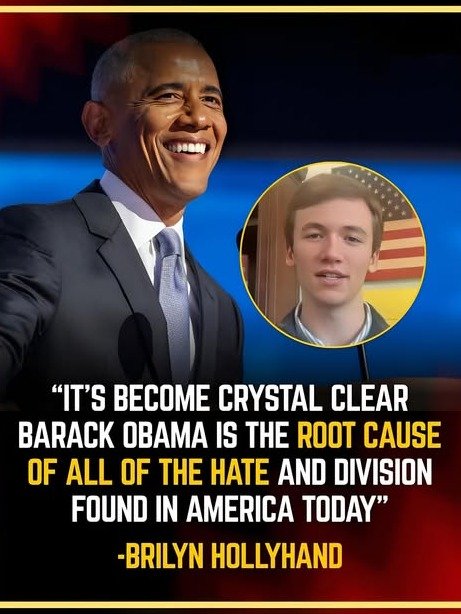
America feels more fractured than ever before. From heated political debates to seemingly irreconcilable cultural divides, a sense of profound disunity permeates the national conversation. But where did this intense polarization truly begin? A recent, provocative claim by conservative commentator Brilyn Hollyhand has ignited a firestorm, pointing a direct finger at past political leadership, specifically implicating the presidency of Barack Obama.
Hollyhand’s assertion isn’t just a casual observation; it’s a bold challenge to conventional narratives, suggesting that many of the societal schisms we grapple with today were either initiated or significantly exacerbated during the Obama years. This perspective forces us to critically re-examine the historical timeline of America’s divisions and consider the complex interplay between leadership, policy, and public sentiment.
The Core of Hollyhand’s Accusation
Brilyn Hollyhand, a rising voice in conservative media, recently made waves by articulating a viewpoint that resonates with many on the right: the idea that the current state of American political and social fragmentation is not a sudden phenomenon, but rather the culmination of trends set in motion by previous administrations. His particular focus on Barack Obama has sparked considerable debate, forcing a re-evaluation of a presidency often viewed through a lens of hope and unity.
The criticism centers on the notion that certain policies, rhetorical strategies, and cultural shifts during Obama’s two terms inadvertently or directly contributed to the deepening of partisan lines and the amplification of identity politics. This isn’t just about policy disagreements; it delves into the very fabric of national discourse and the perceived erosion of shared values.
Understanding America’s Deepening Divides
Before dissecting the claims, it’s crucial to acknowledge the multifaceted nature of America’s divisions. These aren’t monolithic; they encompass a spectrum of issues including economic inequality, racial justice, cultural values, and the fundamental role of government. We see these divides manifest in everything from legislative gridlock to social media skirmishes, often making common ground seem impossible.
The political landscape, in particular, has become increasingly tribal. Voters often identify more strongly with their party than with national unity, and compromise is frequently viewed as a weakness rather than a strength. This environment of ‘us versus them’ has created fertile ground for accusations like Hollyhand’s to take root, as people search for definitive explanations for the current state of affairs.
The Obama Years: A Closer Look at Policy and Perception
When considering the argument that Obama’s presidency contributed to divisions, several key areas often come under scrutiny. The Affordable Care Act (ACA), for instance, was a landmark piece of legislation that polarized the nation. While hailed by supporters as a necessary expansion of healthcare access, opponents viewed it as an unprecedented government overreach, leading to years of intense partisan battles and ‘repeal and replace’ efforts.
The response to the 2008 financial crisis, including the stimulus package and bailouts, also generated significant resentment, particularly among those who felt their tax dollars were being used to prop up failing institutions. This period fueled the rise of the Tea Party movement, a populist conservative uprising that explicitly defined itself in opposition to Obama’s policies and expanded government.
“The divisions we see today are not new, but their intensity and pervasiveness have certainly escalated. Pinpointing a singular cause is complex, but the perception of leadership’s role is undeniably powerful.”
Furthermore, Obama’s administration navigated complex social issues, including the debate over same-sex marriage and evolving discussions around racial justice. While his personal stance on marriage evolved to support equality, and his administration took steps to address systemic inequalities, these actions often inflamed cultural conservatives and those resistant to rapid social change. The rise of Black Lives Matter during his second term, while driven by grassroots activism, also highlighted deep-seated racial tensions that many felt were not adequately addressed.
The Role of Rhetoric and Identity Politics
Beyond specific policies, the discourse surrounding the Obama presidency is often cited as a factor in deepening divisions. While Obama himself often spoke of unity and bridging divides, his critics argue that his rhetoric, particularly on issues of race and class, sometimes exacerbated existing fault lines. The focus on ‘identity politics’ – where political action is driven by specific group identities rather than broader national interests – is another area of contention.
Some argue that while the Obama administration sought to empower diverse communities, this emphasis inadvertently led to a greater focus on differences rather than commonalities. This perspective suggests that by highlighting various group grievances, the administration, however unintentionally, contributed to a more fragmented national identity, where groups saw themselves in opposition to one another rather than as part of a collective whole.
Pre-Existing Conditions: America’s Historical Divides
It’s crucial to place Hollyhand’s criticism within a broader historical context. America has always been a nation of diverse opinions and, at times, profound divisions. From the Civil War to the Civil Rights Movement, and the culture wars of the 1980s and 90s, periods of intense national disagreement are not new. The partisan rancor of the George W. Bush years, particularly surrounding the Iraq War and judicial appointments, predates Obama’s arrival in the White House.
- The Clinton Era: Impeachment proceedings and fierce ideological battles set a precedent for heightened partisan conflict.
- The Bush Years: The “red state/blue state” divide became increasingly entrenched, exacerbated by the 9/11 attacks and the subsequent “War on Terror.”
- Media Landscape: The fragmentation of media, with the rise of partisan news outlets like Fox News and MSNBC, began long before Obama, creating echo chambers that reinforce existing biases.
Therefore, while the Obama presidency certainly navigated and responded to these divisions, attributing their origin solely to his leadership overlooks a much longer and more complex history of American political and social fragmentation. Presidents inherit the nation’s problems; they don’t always create them from scratch.
The Blame Game: Is It Fair to Pinpoint One Leader?
The question of whether it’s fair to attribute such complex societal divisions to any single leader, even a two-term president, is a central point of contention. Modern presidencies operate within an intricate web of congressional power, judicial review, global events, and an increasingly vocal and diverse public.
The rise of social media, for example, has undeniably played a significant role in amplifying divisions, creating filter bubbles and facilitating the rapid spread of misinformation and emotionally charged narratives. Economic globalization, technological shifts, and demographic changes also exert powerful influences on society, often beyond the direct control of any single political figure.
To suggest that one individual, however powerful, is the sole or primary architect of deeply entrenched national divisions risks oversimplifying a multifaceted problem. It also sidesteps the responsibility of other political actors, media institutions, and indeed, the citizenry itself, in contributing to the current state of affairs.
Moving Forward: Addressing the Roots of Disunity
Regardless of where one stands on Brilyn Hollyhand’s specific accusation, his comments serve as a potent reminder of the ongoing national conversation about unity and division. Understanding the historical context, acknowledging the various contributing factors, and recognizing the role of leadership – both past and present – is essential for charting a path forward.
Addressing America’s divisions will require more than just assigning blame. It demands a willingness to engage across ideological lines, to foster civil discourse, to seek common ground, and to reinforce institutions that support democratic processes and shared national identity. While the debate over historical responsibility continues, the urgent task remains to build a more cohesive and less fractured future for the nation.
Conclusion: A Continuous Dialogue
Brilyn Hollyhand’s criticism of Barack Obama, suggesting his leadership sowed the seeds of today’s divisions, is a powerful and controversial statement. It forces us to reflect on the legacy of a transformative presidency and the complex factors that contribute to national unity and disunity. While the notion that one leader is solely responsible for such deep-seated societal issues is debatable, the conversation itself is invaluable.
It challenges us to look beyond simplistic narratives and to delve into the intricate interplay of policy, rhetoric, historical context, and evolving social dynamics. Ultimately, understanding the origins of our divisions, whether rooted in specific presidencies or broader societal trends, is the first step toward healing them and fostering a more unified American future.
About the Author




