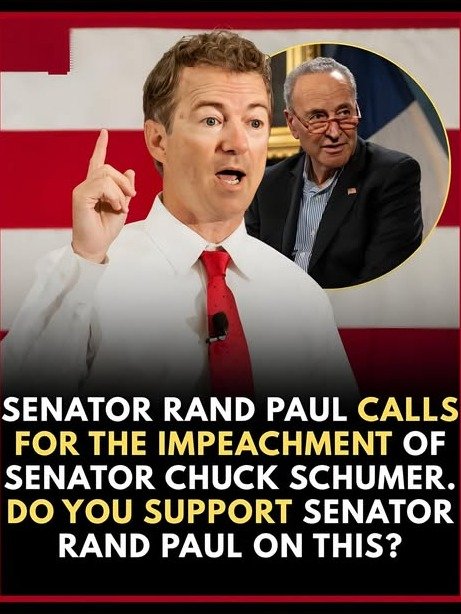
Imagine a political landscape where one leader faces relentless investigations, media storms, and public condemnation, while another, holding similar power, seems to glide through untouched. Is this the reality of Washington today? Senator Rand Paul certainly thinks so, and he’s not holding back. Recently, the Kentucky Senator ignited a firestorm by publicly demanding that Senate Majority Leader Chuck Schumer be subjected to the same intense level of scrutiny that has been directed at former President Donald Trump.
This bold call isn’t just political theater; it’s a profound challenge to the perceived double standards within Washington’s corridors of power. Paul’s statement forces us to confront uncomfortable questions about accountability, fairness, and the selective application of justice in an increasingly polarized political climate. It suggests that the mechanisms of oversight, media attention, and public judgment might not be as impartial as we’d like to believe, depending on who holds the reins of power.
The Call for Equal Scrutiny: A Matter of Principle
Senator Rand Paul’s demand wasn’t merely a casual remark; it was a deliberate and pointed challenge to the established order. His core argument centers on the principle of equal justice and consistent accountability. Paul contends that if certain actions, rhetoric, or leadership styles warrant exhaustive investigations, media frenzies, and calls for impeachment when undertaken by one political figure, then similar benchmarks should apply to all powerful leaders, regardless of their party affiliation.
The senator’s assertion brings into sharp focus the notion that political power should not grant immunity from rigorous examination. He suggests that the intensity of scrutiny often appears to be dictated more by partisan alignment than by the objective severity of alleged actions, leading to a system where some are pursued relentlessly while others operate with what appears to be relative impunity. This perceived imbalance erodes public trust and fuels cynicism about the integrity of our institutions.
The Unprecedented Scrutiny Faced by Donald Trump
To understand the weight of Paul’s comparison, it’s crucial to acknowledge the extraordinary level of scrutiny that former President Donald Trump endured throughout his political career. From the moment he announced his candidacy, and especially during his presidency, Trump was subjected to an unparalleled barrage of investigations, media probes, and political attacks. This wasn’t just typical political criticism; it was a sustained, multi-faceted effort to examine every aspect of his public and private life.
Consider the expansive Mueller investigation into alleged Russian interference, which lasted nearly two years and involved countless interviews and subpoenaed documents. Then there were two separate impeachment proceedings in the House of Representatives, both leading to trials in the Senate. Beyond these major events, Trump faced numerous inquiries into his business dealings, tax returns, and even his personal conduct. The January 6th Capitol attack sparked yet another high-profile investigation, with a dedicated House committee conducting extensive hearings and issuing a detailed report.
The media landscape also played a significant role, with constant coverage, analysis, and often critical commentary surrounding every move Trump made. This intense spotlight created an environment where every word, every tweet, and every decision was dissected under a microscope. For Senator Paul, this relentless pursuit of accountability, regardless of its merits in each specific case, sets a precedent for how powerful figures should be examined.
Chuck Schumer’s Leadership Under the Microscope
When Senator Paul calls for Chuck Schumer to face similar scrutiny, he’s implicitly asking what actions or statements by the Senate Majority Leader might warrant such intense examination. While Schumer has not been the subject of the same kind of high-profile criminal or impeachment investigations as Trump, he holds one of the most powerful positions in American politics. As Majority Leader, Schumer wields immense influence over the legislative agenda, judicial appointments, and the overall direction of the Senate.
Paul’s argument isn’t necessarily about specific allegations of wrongdoing against Schumer, but rather about the potential for unchecked power and the lack of a comparable level of public and political examination of his leadership decisions and rhetoric. For instance, critics might point to Schumer’s sometimes fiery political statements, his role in contentious legislative battles, or his influence over the confirmation processes for judges and executive appointments. The question Paul raises is whether these actions, when viewed through a similar lens of intense scrutiny, would reveal issues that warrant deeper investigation or public accountability.
“If the standard for scrutiny applied to one leader is exhaustive, then it must be applied across the board to maintain fairness and trust in our democratic processes,” a political analyst noted, echoing Paul’s sentiment.
The essence of Paul’s challenge is to apply an even hand. If certain political maneuvers, rhetorical flourishes, or displays of power by one party leader are deemed worthy of intense public and institutional scrutiny, then why should similar actions by a leader from the opposing party be treated differently?
The Dangers of Perceived Double Standards in Politics
The call for equal scrutiny isn’t just about individual politicians; it’s about the health of our democratic system. When the public perceives that justice and accountability are applied unevenly, it erodes trust in political institutions, the media, and even the rule of law itself. This perception of double standards can lead to several dangerous outcomes:
- Increased Polarization: If one side feels unfairly targeted while the other is protected, it deepens partisan divides and makes compromise nearly impossible.
- Erosion of Trust: Public faith in government and media diminishes when the application of investigatory power appears politically motivated. Citizens begin to question the legitimacy of findings and reports.
- Weaponization of Justice: The tools of investigation and oversight can be seen as weapons to be deployed against political opponents rather than instruments for impartial truth-seeking.
- Diminished Accountability: If only certain figures are held to account, others may feel emboldened to act without fear of consequence, knowing they might be shielded by their political alignment.
Senator Paul’s statement is a stark reminder that the appearance of fairness is almost as important as fairness itself in maintaining a functional democracy. When the scales of justice seem tipped, the entire system suffers.
The Broader Implications for Political Discourse
Rand Paul’s demand extends beyond the individuals of Trump and Schumer; it speaks to the very nature of political discourse in America. In an era where information is abundant but trust is scarce, calls for transparency and equal application of standards resonate deeply with many citizens who are tired of what they perceive as partisan hypocrisy. This kind of challenge forces a national conversation about what constitutes acceptable political conduct and how leaders, regardless of their party, should be held accountable.
It also highlights the power dynamics within Washington. The Senate Majority Leader holds immense sway, not just over legislation but also over the narrative and the political agenda. If Paul’s call gains traction, it could set a precedent for future demands for more rigorous examination of all powerful figures, not just those from the opposing party. This shift could lead to a more balanced, albeit potentially more contentious, environment for political leadership.
Navigating the Path to True Accountability
Achieving true accountability in politics is a complex endeavor. It requires a commitment to impartial investigation, a media willing to report without bias, and a public willing to demand consistent standards. Senator Paul’s challenge to Chuck Schumer is a step towards initiating this conversation, forcing us to ask uncomfortable questions about the equity of our political system.
Ultimately, the goal should not be to target any specific individual for political reasons, but to ensure that the mechanisms of oversight and accountability are applied fairly and consistently to all who hold positions of power. Only then can the public truly trust that justice is blind, and that no one, regardless of their political stature, is above the law or beyond rigorous public examination. The debate sparked by Senator Paul’s words is a crucial one for the future of American democracy.
About the Author




