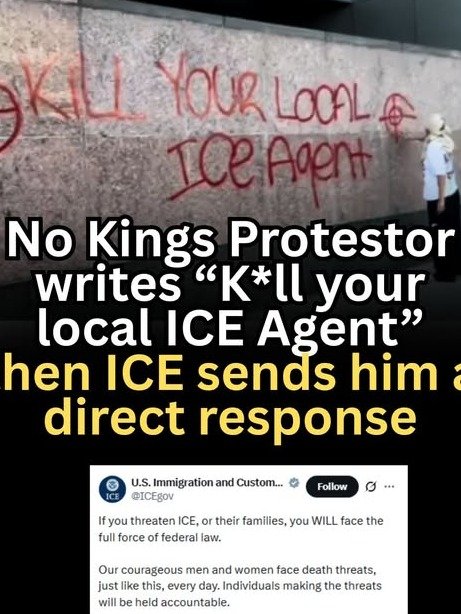
Imagine a world where those sworn to protect us are themselves targets of intimidation and violence. This isn’t a dystopian fantasy; it’s the stark reality faced by federal agents across the United States every single day. When threats are hurled at law enforcement, particularly agencies like U.S. Immigration and Customs Enforcement (ICE), the response from federal authorities is not just stern – it’s an unwavering promise of severe consequences.
Recently, a chilling exchange underscored this harsh truth, sending a clear message to anyone contemplating such dangerous actions. The statement from ICE was unambiguous and left no room for misinterpretation, serving as a powerful reminder of the boundaries that must never be crossed.
A Clear and Unmistakable Warning
The message delivered by ICE was direct and uncompromising:
“If you threaten ICE, or their families, you WILL face the full force of federal law. Our courageous men and women face death threats, just…”
This powerful declaration wasn’t merely a warning; it was a solemn pledge to uphold justice and protect those who serve on the front lines of national security and public safety.
The statement emerged in response to an individual who had evidently issued threats against the agency or its personnel. While the specific details of the initial threat remain private, ICE’s public stance highlighted a critical issue: the escalating hostility faced by federal agents and the absolute zero-tolerance policy against such behavior.
The Unseen Battleground: Daily Threats Faced by Federal Agents
For many, the work of federal law enforcement agencies like ICE is abstract, seen only through headlines or policy debates. However, for the men and women who wear the badge, their daily reality often involves confronting dangerous individuals and navigating complex, often hostile, environments. This exposure unfortunately makes them, and sometimes their families, targets for aggression and threats.
These aren’t just idle words exchanged online. Threats against federal agents can manifest in various terrifying forms, from anonymous death threats and doxing campaigns to direct physical intimidation and even attempts on their lives. These acts are designed to instill fear, disrupt operations, and ultimately undermine the rule of law.
ICE agents, specifically, operate in a highly scrutinized and often controversial arena, dealing with issues ranging from border security and customs enforcement to combating human trafficking and drug smuggling. This visibility, combined with the nature of their duties, frequently places them in the crosshairs of those who oppose their mission or seek to exploit vulnerabilities in the system.
What “The Full Force of Federal Law” Truly Means
When ICE states that offenders will face the “full force of federal law,” it’s not hyperbole. It signifies a comprehensive and relentless pursuit of justice, backed by a robust legal framework designed to protect federal officials. Threatening a federal agent is not merely a misdemeanor; it is a serious federal felony with severe penalties.
Key statutes, such as 18 U.S. Code § 115 – Influencing, impeding, or retaliating against a Federal official by threat or injury, explicitly criminalize such actions. This law makes it illegal to assault, kidnap, or murder, or attempt to assault, kidnap, or murder, any federal official, or to threaten to do so, with the intent to impede, intimidate, or interfere with them while they are performing their official duties.
The penalties for violating this statute are substantial. Depending on the nature and severity of the threat, an individual could face imprisonment for up to 10 years. If the threat involves a deadly weapon or results in bodily injury, the prison sentence can be even longer, potentially extending to 20 years or life imprisonment if a death occurs. Fines can also be enormous, adding to the punitive measures.
Beyond the Arrest: The Rigorous Investigative Process
When a threat against a federal agent or their family is made, it triggers an immediate and intensive investigation. Agencies like the Federal Bureau of Investigation (FBI) and Homeland Security Investigations (HSI), a principal investigative arm of the Department of Homeland Security (DHS) that works closely with ICE, dedicate significant resources to tracking down those responsible.
These investigations are thorough, utilizing advanced forensic techniques, digital tracing, and intelligence gathering to identify and apprehend perpetrators. There’s a strong interagency cooperation to ensure that every lead is followed and every stone is unturned. The message is clear: those who threaten federal agents will be found, regardless of how anonymous they believe their actions to be.
The commitment to these investigations is not just about punishment; it’s about deterrence. It sends a powerful message that such behavior will not be tolerated and that the safety and security of federal personnel are paramount. This unwavering resolve is crucial for maintaining order and ensuring that those who uphold the law can do so without undue fear.
The Human Toll on Agents and Their Families
Behind every uniform is a human being, often with a family at home. When threats are made against agents, the psychological impact can be profound. The fear isn’t just for their own safety, but for their spouses, children, and loved ones. This constant vigilance and stress can take a heavy toll, affecting their mental well-being and their ability to fully engage in their demanding roles.
Imagine receiving a death threat, knowing that someone wishes harm upon you or your family simply because of the job you do. This reality is a testament to the immense courage and dedication required to serve in federal law enforcement. Agents often make significant sacrifices, enduring long hours, dangerous assignments, and the constant specter of threats, all in service to their country.
Their families, too, bear a unique burden. They live with the knowledge that their loved ones are in harm’s way, and that their own safety could be compromised by the nature of their family member’s profession. Protecting these families is not just a moral imperative; it’s essential for maintaining the morale and effectiveness of our law enforcement agencies.
Upholding the Rule of Law: Why Protecting Federal Officials Matters
The ability of any society to function effectively hinges on the consistent application and enforcement of its laws. Federal agents are the embodiment of this principle, tasked with upholding statutes that govern everything from national security to public safety and economic integrity. If these individuals can be threatened and intimidated with impunity, the very foundation of the rule of law begins to crumble.
Protecting federal officials from threats is therefore not a partisan issue, nor is it about defending a specific agency’s policies. It is a fundamental requirement for a stable and just society. It ensures that those who are sworn to enforce the law can do so without fear of unlawful reprisal, allowing them to carry out their duties fairly and impartially.
When threats against law enforcement are tolerated, it creates a dangerous precedent, signaling that defiance of authority and violent rhetoric are acceptable. This erosion of respect for public servants ultimately harms everyone, leading to a more chaotic and less secure environment for all citizens.
The Broader Implications: A Dangerous Precedent
The internet and social media have, in some ways, amplified the ease with which threats can be made and disseminated. What might seem like an anonymous comment or a fleeting moment of anger online can quickly escalate into a federal investigation with life-altering consequences. Many individuals fail to grasp the gravity of their words in the digital age, believing they are beyond reach.
However, federal authorities are highly adept at tracing digital footprints and connecting online threats to real-world identities. The full force of federal law extends into the digital realm, ensuring that online intimidation is taken just as seriously as threats made in person. This capability serves as a critical deterrent, reminding everyone that their actions online have tangible repercussions.
Allowing threats against law enforcement to go unaddressed would set a dangerous precedent, potentially emboldening others to engage in similar destructive behavior. It would undermine the very institutions designed to protect society and maintain order, leading to a breakdown of public trust and safety.
A Message of Deterrence and Justice
ICE’s firm response serves as a stark reminder to the public, and particularly to those who might contemplate such actions, that threats against federal agents and their families will never be taken lightly. It’s a message of deterrence, making it clear that the consequences for such actions are severe and unavoidable.
Moreover, it is a message of justice. It reaffirms the government’s unwavering commitment to protecting its personnel, ensuring that those who dedicate their lives to public service can do so with the assurance that they and their families are safeguarded by the law they uphold.
In a world grappling with complex challenges, the stability provided by a robust legal system and protected law enforcement is indispensable. The courageous men and women of ICE, and all federal agencies, deserve our respect and protection, not threats. The full force of federal law stands ready to ensure that this principle is always upheld.
About the Author




