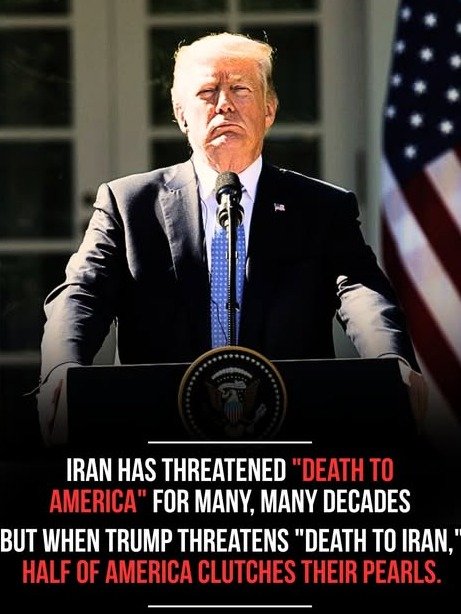
In today’s highly charged political landscape, it’s not uncommon to encounter statements that boldly connect a voter’s party affiliation with their stance on complex global issues. One such provocative claim has been making waves, asserting a direct line between voting Democrat and supporting those who chant ‘Death to America’ or live under tyrannical regimes. This isn’t just a casual observation; it’s a statement designed to spark intense debate and force a re-evaluation of political allegiances.
But what exactly lies beneath such a strong assertion? Is it a simplistic generalization, a deeply held belief, or a strategic attempt to frame political opponents in a particular light? To truly understand the sentiment behind such a statement, we must delve into the intricate layers of foreign policy, ideological divides, and the often-misunderstood nuances of international relations that shape public perception.
The Roots of a Divisive Claim: ‘Death to America’ Chants
The phrase ‘Death to America’ is instantly recognizable and deeply unsettling to many. Primarily associated with certain anti-Western movements and state actors, particularly in the Middle East, these chants are often perceived as a direct threat to American sovereignty, values, and global influence. For many, hearing such a phrase evokes feelings of anger, betrayal, and a demand for unwavering patriotism.
However, the interpretation of these chants is not universally monolithic. While some view them as literal calls for destruction, others argue they are symbolic expressions of opposition to specific U.S. foreign policies, interventions, or perceived imperialistic actions. This distinction, though subtle, forms a critical fault line in how different political ideologies approach international relations and national security.
The historical context is crucial. These chants often emerge from regions with long histories of conflict, colonial influence, and geopolitical tensions involving the United States. Understanding the grievances, real or perceived, that fuel such rhetoric is essential, even while condemning any calls for violence or destruction.
Navigating the Stance on Tyrannical Societies
The second part of the provocative claim links voting Democrat with supporting ‘tyrannical backwards societies.’ This segment opens up an equally complex discussion about how different political parties approach human rights, democracy promotion, and engagement with authoritarian regimes worldwide. No political party explicitly advocates for tyranny; however, their methods and priorities for dealing with such states can vary dramatically.
Historically, both Democratic and Republican administrations have faced the difficult dilemma of balancing national interests, economic ties, and human rights concerns when dealing with non-democratic nations. Sometimes, pragmatic engagement is prioritized to maintain stability or achieve specific geopolitical goals, while at other times, isolation and sanctions are favored to pressure for reform.
“Foreign policy is not a matter of ideology; it is a matter of pragmatism, of understanding realities and choosing the best path forward for our nation’s security and prosperity.”
The perception of ‘support’ can also be highly subjective. Is diplomatic engagement with a tyrannical regime considered ‘support’? Is providing humanitarian aid to a country governed by an authoritarian leader seen as ‘support’ for that leader? These are the kinds of questions that fuel partisan debates and contribute to sweeping generalizations.
Ideological Lenses: How Parties View Global Engagement
To understand why such a claim might resonate with some, it’s helpful to examine the generalized foreign policy tendencies often associated with America’s two major political parties. These are broad strokes, and individual politicians often deviate, but general patterns exist.
The Democratic Approach: Diplomacy and Multilateralism
Democrats are often perceived as favoring a foreign policy rooted in diplomacy, multilateralism, and international cooperation. This approach often emphasizes:
- Human Rights: A strong focus on promoting human rights and democratic values globally, often through international institutions and soft power.
- Diplomacy Over Confrontation: A preference for negotiation and dialogue, even with adversarial nations, to resolve conflicts and prevent escalation.
- Global Alliances: Strengthening alliances and working through international bodies like the United Nations to address shared challenges.
- Aid and Development: Utilizing foreign aid and development programs as tools for stability and influence.
Critics of this approach sometimes argue that it can be perceived as ‘soft’ on adversaries, too willing to engage with regimes that don’t share American values, or that it prioritizes global consensus over robust national interest. This perceived willingness to engage, even with hostile actors, can be misconstrued by some as ‘support’ for their ideologies or methods.
The Republican Approach: Strength and Unilateralism
Republicans, on the other hand, are often associated with a foreign policy emphasizing:
About the Author




