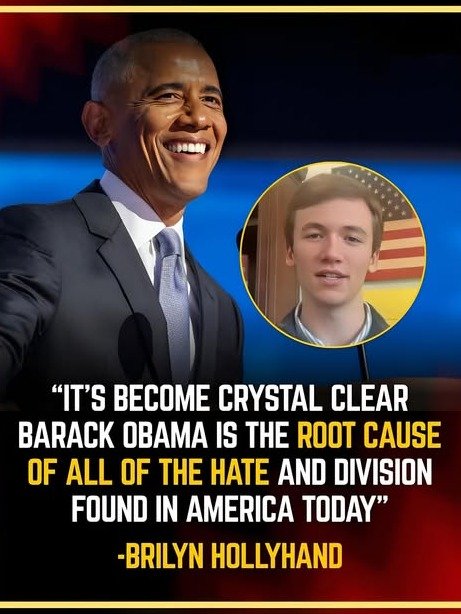
What if the political divisions tearing America apart today aren’t a new phenomenon, but rather the bitter harvest of seeds sown years ago? A rising conservative voice has just ignited a firestorm, pointing a finger directly at an unlikely figure for the deep rifts fracturing the nation: former President Barack Obama.
This isn’t just another casual observation; it’s a bold claim from Brilyn Hollyhand, a prominent young conservative commentator. She recently sparked intense debate by arguing that many of the profound divisions currently plaguing the United States can be traced back directly to earlier political leadership, implicitly centering on the Obama years.
A Young Voice Challenges the Narrative
Brilyn Hollyhand, despite her youth, has become a significant voice within conservative circles. Known for her sharp commentary and ability to articulate complex political viewpoints, her opinions often resonate with a segment of the population that feels traditional media narratives overlook their perspectives.
Her recent criticism of Barack Obama isn’t merely a partisan jab; it’s an assertion that the foundational cracks we see in American society today were exacerbated, if not initiated, during his time in office. This perspective challenges the widely accepted narrative of Obama as a unifying figure and forces a re-evaluation of his presidential legacy.
The Genesis of a Controversial Claim
Hollyhand’s argument suggests that specific policies, rhetoric, or leadership styles from the Obama era inadvertently contributed to the escalating polarization. While she didn’t detail every point in her initial post, the implication is clear: the divisions are not random, but have identifiable roots in recent history.
This claim invites a critical examination of the period from 2009 to 2017, prompting questions about how legislative battles, executive actions, and the overall political climate under Obama might have deepened ideological divides rather than bridging them. It’s a challenging thought for many, but one that demands consideration.
Obama’s Legacy: Unity or Division?
Barack Obama entered the White House on a wave of hope and a promise of unity, famously speaking of a post-partisan America. His campaign slogan, ‘Hope and Change,’ resonated with millions who longed for a less divided political landscape.
However, critics like Hollyhand argue that despite these aspirations, his presidency coincided with, or even accelerated, a period of profound political fragmentation. This perspective often highlights the intense resistance Obama faced from the Republican Party and the rise of protest movements like the Tea Party.
Key Policy Battlegrounds and Their Impact
Several landmark policy initiatives during Obama’s tenure became significant flashpoints, arguably contributing to the nation’s growing polarization. The most prominent among these was the Affordable Care Act (ACA), also known as Obamacare.
- The Affordable Care Act: Passed without a single Republican vote in the House or Senate, the ACA was hailed by supporters as a monumental step towards universal healthcare. However, opponents decried it as government overreach, an assault on individual liberty, and a costly burden. The highly partisan nature of its passage and subsequent repeal efforts fueled years of intense political animosity.
- The Economic Stimulus Package: Early in his presidency, Obama signed a massive economic stimulus package in response to the Great Recession. While proponents argued it saved the economy, critics claimed it was wasteful, ineffective, and swelled the national debt, laying groundwork for deep ideological clashes over government spending.
- Financial Regulations: The Dodd-Frank Wall Street Reform and Consumer Protection Act, enacted in response to the 2008 financial crisis, also drew sharp lines. While intended to prevent future meltdowns, it was criticized by many on the right as excessive regulation stifling economic growth.
These policy battles were not just disagreements over legislation; they became symbols of deeper ideological conflicts about the role of government, individual freedom, and economic philosophy, intensifying the partisan divide.
Rhetoric and Response in a Changing Landscape
Beyond specific policies, the rhetoric employed by political leaders and the media during the Obama years also played a crucial role in shaping public discourse. While Obama often called for unity, his critics frequently characterized his administration as radical or out of touch with mainstream American values.
The rise of new media platforms and the amplification of partisan news outlets further complicated matters. These channels often provided echo chambers, reinforcing existing beliefs and making it harder for opposing viewpoints to find common ground. The ‘us vs. them’ mentality solidified, transforming political differences into cultural warfare.
The Broader Tapestry of Division: Beyond One Presidency
While Hollyhand’s argument focuses on Obama, it’s crucial to acknowledge that political division is a complex, multi-faceted phenomenon with roots extending far beyond any single presidency. Many factors contribute to the current state of polarization, and attributing it solely to one leader oversimplifies a deeply intricate issue.
For instance, long-term economic shifts, such as globalization and automation, have led to significant job displacement and increased income inequality, creating a sense of resentment and economic insecurity among various segments of the population. These economic anxieties often translate into political grievances.
Other Significant Drivers of Polarization
Consider these additional factors that have undeniably contributed to America’s deepening divisions:
- Demographic Shifts: Rapid demographic changes in the U.S. have led to evolving cultural norms and political identities, sometimes creating friction between different groups struggling to adapt or assert their place.
- Social Media and the Echo Chamber Effect: The proliferation of social media platforms has revolutionized how people consume information. Algorithms often feed users content that aligns with their existing views, creating digital echo chambers where opposing perspectives are rarely encountered, thus entrenching biases.
- The Rise of Partisan Media: The fragmentation of traditional media and the rise of cable news channels and online outlets catering to specific political ideologies have meant that many Americans primarily hear news and commentary that reinforces their partisan leanings, further solidifying their views and demonizing the opposition.
- Cultural Wars: Deep-seated disagreements over social issues like LGBTQ+ rights, gun control, abortion, and religious freedom have intensified, becoming potent symbols of ideological conflict that often transcend traditional political party lines.
- Long-Standing Ideological Differences: Fundamental disagreements about the role and size of government, the balance between individual liberty and collective good, and the interpretation of the Constitution have always existed but seem to have become more intractable in recent decades.
These forces, operating in conjunction with political leadership, create a powerful current of division that is difficult to navigate or reverse.
A Historical Perspective on Polarization
It’s also worth remembering that political polarization is not a new phenomenon in American history. The nation has experienced periods of intense division before, from the Civil War era to the tumultuous 1960s. However, the nature of today’s division feels different to many, characterized by a deep personal animosity and an unwillingness to compromise.
What Brilyn Hollyhand’s critique highlights is the question of whether the Obama presidency, perhaps unintentionally, provided fertile ground for these pre-existing or emerging divisive forces to take stronger root and flourish, leading to the current political climate.
The Youthful Perspective: A Fresh Lens?
Hollyhand’s perspective, coming from a younger generation, offers a unique lens through which to view recent history. She represents a cohort that has grown up entirely in the shadow of the post-9/11 world and witnessed the full arc of the Obama presidency and its aftermath.
For her and many peers, the current divisions are not abstract; they are the lived reality of their political coming-of-age. Her willingness to challenge established narratives, even those surrounding a popular former president, underscores a desire to understand the true origins of contemporary challenges.
Beyond Blame: Finding Common Ground?
Ultimately, whether one agrees with Brilyn Hollyhand’s specific attribution of blame or not, her comments serve as a powerful reminder of the urgent need to address America’s deepening divisions. Understanding the perceived origins of these rifts, even if controversial, is a crucial first step towards healing them.
The path forward likely involves more than just identifying past mistakes. It requires a concerted effort from leaders across the political spectrum to foster genuine dialogue, encourage empathy, and prioritize common goals over partisan victories. Only then can America hope to move beyond the uncomfortable truths of its past and forge a more unified future.
About the Author




