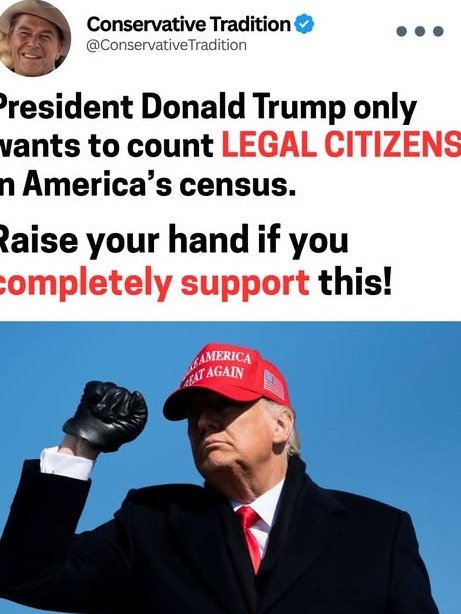
Imagine your state losing a congressional seat, or seeing crucial federal funding for schools, roads, and hospitals slashed. This isn’t a hypothetical scenario; it’s a very real and potentially imminent outcome if a groundbreaking proposal to redefine how America counts its population comes to fruition. Former President Donald Trump has signaled a dramatic intention: to retake the national census and count only legal American citizens.
This isn’t just a technical adjustment; it’s a seismic shift that could fundamentally reshape the political landscape of the United States, influencing everything from the balance of power in Washington D.C. to the daily lives of millions. The implications are vast, touching upon constitutional interpretation, demographic trends, and the very fabric of American representation. Understanding this proposal requires delving into the history and purpose of the U.S. Census, and why a change of this magnitude would reverberate across the nation.
The Cornerstone of American Democracy: Understanding the Census
For over two centuries, the United States Census has served as a foundational pillar of its democratic process. Mandated by Article I, Section 2 of the Constitution, a count of the entire population is conducted every ten years. This decennial tally isn’t merely an academic exercise; it’s the mechanism through which congressional representation is apportioned among the states, ensuring that political power reflects demographic realities.
Beyond congressional seats, the census data is instrumental in allocating over $1.5 trillion in federal funding annually across more than 300 programs. These funds support critical services like Medicare and Medicaid, highway planning and construction, school lunch programs, and various social services. The data also guides local planning decisions, from where to build new schools and hospitals to the placement of emergency services, directly impacting communities nationwide.
Historically, the census has always sought to count “the whole number of persons in each state,” as stipulated by the 14th Amendment. This interpretation has consistently included all residents, regardless of their legal status or citizenship. This approach reflects the idea that states are designed to represent all people living within their borders, not just eligible voters, ensuring comprehensive resource distribution.
Trump’s Bold Proposal: Counting Only Legal Citizens
The former President’s proposal marks a significant departure from this long-standing tradition. His stated intention is to conduct a new census that explicitly excludes non-citizens from the count used for congressional apportionment. This would mean that individuals who are not legal citizens – including undocumented immigrants, green card holders, and those on various visas – would not contribute to a state’s population total for the purpose of determining its number of representatives in the House.
This isn’t a new concept for Trump, who previously pursued adding a citizenship question to the 2020 Census, a move ultimately blocked by the Supreme Court due to concerns about its origins and potential impact on response rates. The current proposal goes further, suggesting a complete redefinition of who counts for representation, rather than just asking about citizenship status, escalating the debate significantly.
The rationale behind such a move, as articulated by proponents, often centers on the idea of “fairness” and ensuring that political power accurately reflects the citizen electorate. They argue that counting non-citizens inflates the representation of states with larger immigrant populations, thereby diluting the political influence of states with fewer non-citizens, particularly when it comes to the number of votes in the Electoral College, which is tied to congressional representation.
Constitutional Crossroads: The “Whole Number of Persons” Debate
At the heart of this debate lies a fundamental constitutional question: what does “the whole number of persons in each state” truly mean? Opponents of Trump’s plan argue that the plain language of the 14th Amendment, ratified post-Civil War, clearly intended to include all residents. They point to historical precedent and numerous court decisions affirming this broad interpretation, emphasizing an inclusive understanding of state populations.
“The Constitution is clear: the census counts persons, not just citizens, for apportionment. To do otherwise would be a radical departure from over 200 years of practice and a direct challenge to the bedrock principles of our democracy.” – Legal Scholar (example quote)
Legal scholars and civil rights advocates contend that excluding non-citizens would be unconstitutional, potentially sparking a prolonged legal battle that could reach the Supreme Court. They emphasize that states provide services and infrastructure for all residents, and therefore, all residents should be counted for the purpose of ensuring adequate representation and resource allocation, regardless of citizenship status.
The Staggering Impact: Shifting Power and Funding
If a “citizens-only” census were to be implemented, the ramifications would be nothing short of revolutionary. The most immediate and tangible effect would be a dramatic redistribution of political power in the House of Representatives. States with significant non-citizen populations, such as California, Texas, Florida, and New York, would likely see a reduction in their congressional seats, profoundly altering national politics.
- Congressional Apportionment: States with large non-citizen populations could lose multiple House seats, diminishing their legislative influence and voting power in Congress.
- Electoral College: Fewer congressional seats translate directly into fewer Electoral College votes, potentially altering presidential election outcomes and the balance of power in national elections.
- Federal Funding: The allocation of billions of dollars tied to population counts for programs like Medicaid, housing assistance, and infrastructure could be severely impacted. States losing population share would lose significant funding, affecting crucial public services.
- Redistricting: State and local legislative districts would also be redrawn based on a different population base, potentially shifting political boundaries and representation at all levels, from school boards to state legislatures.
Consider California, for instance, which has a substantial non-citizen population estimated in the millions. A shift to counting only citizens could potentially cost the state several congressional seats, drastically reducing its voice in national policy and its share of federal resources. Conversely, states with proportionally fewer non-citizens might gain seats or see their current representation solidified, leading to a significant geographical shift in political power across the nation.
Logistical Nightmares and Undermining Trust
Beyond the legal and political implications, the practical challenges of implementing a “citizens-only” census are immense. How would the government accurately and comprehensively determine citizenship status for every person residing in the United States? This would require an unprecedented level of data collection and verification, likely relying on sensitive government databases and potentially raising significant privacy concerns.
Such an effort could easily lead to widespread inaccuracies, undercounts, and a deep erosion of trust, especially within immigrant communities. Many fear that attempts to collect citizenship data would deter participation, even among legal residents and citizens, out of fear of repercussions or privacy concerns. An undercount would not only skew political representation but also cripple the ability of communities to plan for essential services and infrastructure.
The very act of attempting to identify and exclude non-citizens could be seen as discriminatory and divisive, further exacerbating social tensions and undermining the principle of inclusive governance. The purpose of the census has always been to count everyone, providing a complete demographic snapshot for the nation’s planning and representation needs. Deviating from this inclusive approach could have long-lasting negative consequences for national unity and civic participation.
The Road Ahead: A Battle for the Future of Representation
Should former President Trump pursue this policy again, it would undoubtedly ignite a fierce legal and political battle across the country. Opponents would argue that it’s an unconstitutional attempt to manipulate political power and disenfranchise communities, while proponents would double down on arguments about citizen representation and the integrity of the voting process, setting up a high-stakes showdown.
The stakes are incredibly high. The outcome of such a debate would not only determine how congressional seats are allocated for the next decade but also set a precedent for future census counts and the very definition of who “counts” in America. It would force a national reckoning with fundamental questions about democracy, inclusion, and the role of the federal government in defining its population.
As the nation looks towards future elections and the next census cycle, the discussion around who is counted, and why, will remain a central and contentious issue. This proposal is more than just a bureaucratic change; it’s a potential redefinition of American representation that demands careful consideration and public engagement from all citizens.
Understanding the historical context, the constitutional arguments, and the potential far-reaching impacts is crucial for every American citizen. The decisions made regarding the census today will shape the political landscape, resource allocation, and the very identity of the United States for generations to come. Your state’s power, and billions in vital funding, could truly be on the line.
About the Author




