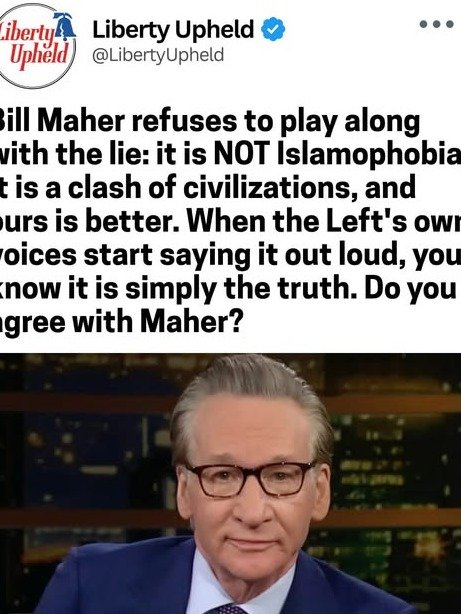
In an era where political discourse often feels like a minefield of carefully chosen words and ideological purity tests, one figure consistently stands out from the progressive crowd: Bill Maher. He’s not just a comedian or a talk show host; he’s become a rare, vital voice on the left, willing to articulate uncomfortable truths that many of his peers seem to shy away from.
Maher has carved out a unique space, fearlessly dissecting societal trends and political narratives, even when it means challenging the very ideologies he often aligns with. This willingness to critique his own side, to point out inconsistencies or excesses, is precisely what makes him such a compelling and, at times, controversial figure.
What truly sets Maher apart is his refusal to simply dismiss dissenting viewpoints or complex issues by labeling them with convenient, often pejorative, terms like ‘phobia.’ Instead, he insists on a more direct, often blunt, assessment of what he perceives to be the actual situation, regardless of how uncomfortable that truth might be.
The Shifting Sands of Progressive Discourse
The landscape of modern progressive thought has, for many observers, become increasingly rigid. There’s a pervasive sense that certain topics are off-limits for critical discussion, or that questioning prevailing narratives from within the left can lead to swift condemnation.
This environment can often stifle genuine debate and intellectual exploration. When dissenting opinions are automatically categorized as hateful or ignorant, it creates an echo chamber where nuance and critical self-reflection struggle to survive. This is precisely the dynamic Maher frequently pushes back against.
His platform becomes a stage for airing these uncomfortable questions, offering a perspective that many feel is desperately missing from mainstream liberal media. He acts as a kind of internal ombudsman, holding a mirror up to progressive movements and asking if they are truly living up to their stated ideals.
Beyond the ‘Phobia’ Label: Calling It What It Is
One of Maher’s most defining characteristics is his steadfast refusal to reduce complex societal concerns or criticisms to a simple ‘phobia.’ For him, genuine issues deserve genuine analysis, not just a dismissive label designed to shut down conversation.
Whether he’s discussing freedom of speech, cultural shifts, or the unintended consequences of well-intentioned policies, Maher insists on dissecting the underlying realities. He argues that by simply branding all opposition or discomfort as bigotry, progressives risk alienating potential allies and failing to address legitimate grievances.
This approach isn’t about validating prejudice; it’s about fostering an environment where concerns can be voiced and debated without immediate moral judgment. It’s about understanding the roots of disagreement rather than just condemning its symptoms.
“If you can’t criticize something without being called a bigot, then you’re never going to get to the truth,” Maher has often implied, highlighting his commitment to open, albeit sometimes raw, dialogue.
His candor serves as a powerful reminder that intellectual honesty requires more than just adherence to a party line. It demands a willingness to scrutinize, question, and sometimes even offend, in the pursuit of understanding.
The Price of Intellectual Honesty in a Polarized World
Operating as a truth-teller within one’s own ideological camp is rarely a path to universal popularity. Bill Maher frequently faces criticism, sometimes scathing, from segments of the left who view his commentary as unhelpful, divisive, or even as providing ammunition to conservative opponents.
Yet, this very criticism underscores his unique position. He is willing to endure the backlash because, it seems, he prioritizes what he believes to be factual accuracy and honest assessment over ideological conformity. This takes a significant amount of courage in today’s highly polarized media landscape.
His willingness to challenge sacred cows on the left can be seen as a strength, not a weakness. It demonstrates an authentic commitment to principles of free inquiry and critical thought, rather than a performative allegiance to a specific political agenda.
A Voice for Nuance in a World of Extremes
In an age increasingly defined by extremes and echo chambers, Maher offers a refreshing, albeit often abrasive, dose of nuance. He frequently highlights the complexities of issues that others prefer to simplify, urging his audience to look beyond black-and-white narratives.
He understands that real-world problems seldom fit neatly into ideological boxes. By resisting the urge to oversimplify or to assign blame solely based on political affiliation, Maher encourages a more sophisticated engagement with current events.
This pursuit of nuance is crucial for a healthy democracy. When all discussions are reduced to us-versus-them battles, the possibility of finding common ground or innovative solutions evaporates. Maher, in his own way, attempts to keep that possibility alive.
Why Maher’s Approach Resonates (and Why it’s Needed)
Maher’s distinctive voice resonates with a significant portion of the population, including many on the left who quietly harbor similar concerns but feel unable to express them. He articulates the unspoken anxieties and frustrations that exist beneath the surface of monolithic political narratives.
His appeal lies in his perceived authenticity and his refusal to be easily pigeonholed. He’s not afraid to be inconsistent or to evolve his views, which is a rare trait in public figures today. This makes him unpredictable, but also incredibly engaging.
In a media environment often criticized for its homogeneous viewpoints, Maher provides a vital counter-narrative. He demonstrates that being progressive doesn’t necessarily mean adhering to every single tenet of contemporary ‘woke’ ideology, and that critical thinking is a universal, not partisan, virtue.
- He challenges tribalism: By critiquing both sides, he encourages a move away from blind loyalty.
- He champions free speech: His show is a platform where controversial ideas are often debated, not just dismissed.
- He demands intellectual rigor: He pushes for evidence-based arguments over emotional appeals.
These qualities are not just valuable; they are essential for fostering a robust public sphere where ideas can be tested and truth can genuinely emerge.
The Future of Progressive Thought: Can It Embrace Dissent?
Bill Maher’s continued prominence raises an important question for the progressive movement: can it learn to embrace internal dissent and critical self-reflection more broadly? A movement that cannot honestly assess its own shortcomings risks stagnation and irrelevance.
His example suggests that there is a hunger for voices within the left that are willing to be honest, even when that honesty is uncomfortable. Ignoring these voices, or shaming them into silence, would be a disservice to the very principles of progress and open inquiry.
Ultimately, Maher’s role is not just about entertainment; it’s about modeling a type of intellectual courage that is increasingly rare but profoundly necessary. He reminds us that true progress often comes from challenging assumptions, not just from reinforcing them.
By refusing to simply categorize every opposing view as a ‘phobia,’ and by daring to call things exactly as he sees them, Bill Maher offers a powerful lesson. He shows that robust debate, even within one’s own ideological family, is not a weakness, but the very bedrock of a dynamic, evolving, and ultimately more effective political discourse.
His voice serves as a crucial check on ideological excesses, ensuring that the pursuit of a better society remains grounded in reality and open to honest, sometimes painful, truths. In a world desperate for clarity, Maher’s unfiltered perspective is a beacon for many.
About the Author




