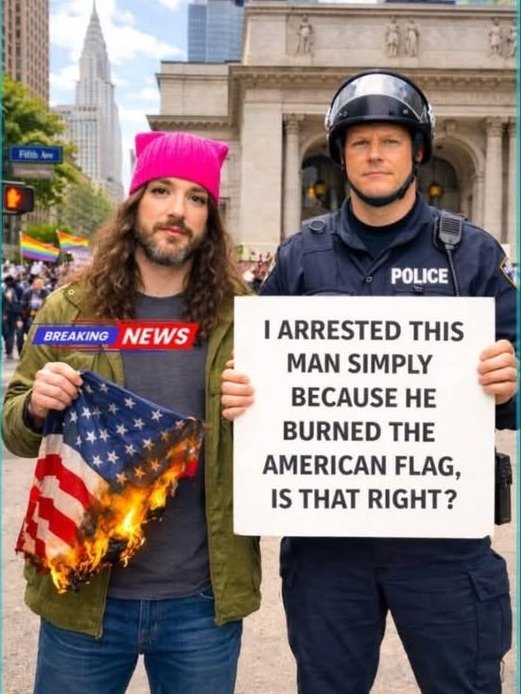
A recent arrest, reportedly linked to the burning of an American flag, has sent shockwaves across the nation, instantly reigniting one of the most polarizing debates in modern American history. This single act, and the subsequent legal action, has forced us once again to confront uncomfortable questions about patriotism, protest, and the very boundaries of free expression in a democratic society. It’s a discussion that cuts deep, touching the core of what it means to be American.
News of the arrest quickly spread like wildfire across social media platforms and traditional news outlets, drawing immediate and impassioned reactions from all corners. For some, it was an appalling act of disrespect against a cherished national symbol, demanding swift punishment. For others, it was a vital exercise of constitutional rights, a powerful statement against perceived injustices, and a testament to the resilience of American freedoms.
The Spark: A Single Act, A National Outcry
The incident itself, while specific in its details, quickly transcended the local context, becoming a focal point for long-simmering tensions. The act of flag burning, regardless of the perpetrator’s intent, carries an undeniable weight, capable of stirring profound emotions ranging from outrage to staunch defense of protest rights. It’s a dramatic visual statement, impossible to ignore, and often designed to provoke.
This particular arrest served as a stark reminder that even in an age saturated with digital content and fleeting controversies, certain symbols retain an extraordinary power to unite and divide. The American flag, in particular, embodies a complex tapestry of ideals, sacrifices, and historical narratives, making its desecration a flashpoint for deeply held beliefs and conflicting interpretations of national identity.
Historically, flag burning as a form of protest gained significant prominence during periods of intense social and political upheaval, notably the Civil Rights Movement and the Vietnam War era. It became a visceral way to express dissent against government policies, war, or perceived societal failures. These acts were never without controversy, but they undeniably carved out a space in the landscape of American protest.
Understanding Symbolic Speech: More Than Just Words
At the heart of this enduring debate lies the concept of “symbolic speech.” This isn’t just about spoken or written words; it encompasses actions and conduct that are intended to convey a particular message and are likely to be understood by those who view them. Burning a flag, wearing an armband, or staging a sit-in are all examples of actions that can carry profound political or social meaning.
The protection of symbolic speech is a cornerstone of the First Amendment to the U.S. Constitution, which guarantees freedom of speech. This fundamental right isn’t limited to popular or agreeable expressions; it extends to speech that might be offensive, unpopular, or even deeply unsettling to the majority. The rationale is that a truly free society must allow for the open exchange of ideas, even those considered radical or disrespectful, to prevent the government from stifling dissent.
This principle is vital for a healthy democracy, ensuring that citizens can voice grievances against their government without fear of reprisal. It allows for the challenging of norms, the questioning of authority, and the pushing for social change. Without the protection of symbolic speech, many impactful protest movements throughout American history might never have taken root or achieved their goals.
The Supreme Court’s Verdict: A Controversial Precedent
The legal battle over flag burning reached its zenith in 1989 with the landmark Supreme Court case, Texas v. Johnson. In a 5-4 decision, the Court ruled that flag burning constituted protected speech under the First Amendment. Gregory Lee Johnson had burned an American flag during the 1984 Republican National Convention in Dallas to protest Reagan administration policies, leading to his conviction under a Texas law prohibiting flag desecration.
Justice William Brennan, writing for the majority, famously stated,
“If there is a bedrock principle underlying the First Amendment, it is that the government may not prohibit the expression of an idea simply because society finds the idea itself offensive or disagreeable.”
The Court reasoned that the government’s interest in preserving the flag as a symbol of national unity did not outweigh an individual’s right to express political dissent, even through controversial means.
This ruling was met with widespread public outrage and calls for a constitutional amendment to ban flag desecration. In response, Congress passed the Flag Protection Act of 1989, attempting to circumvent the Supreme Court’s decision by making flag burning illegal at the federal level. However, this legislative effort was quickly challenged and subsequently struck down by the Supreme Court in United States v. Eichman (1990), which reaffirmed the protections established in Johnson.
Patriotism vs. Protest: The Enduring Divide
The legal precedent is clear: flag burning, as a form of political protest, is constitutionally protected. Yet, this legal reality often clashes with deeply held emotional and cultural beliefs. For millions of Americans, the flag is not merely a piece of cloth; it is a sacred emblem representing the sacrifices of veterans, the ideals of freedom, and the unity of the nation. To them, burning it is an unforgivable act of desecration, an insult to those who died defending it.
This perspective is often rooted in profound patriotism and respect for military service. Many veterans and their families view such acts as a direct affront to their service and the memories of fallen comrades. The sight of a burning flag can evoke feelings of betrayal and anger, overshadowing any message of protest the act might intend to convey.
Conversely, for those who engage in flag burning, the act is often a desperate cry for attention, a symbol of profound dissatisfaction with government actions, or a protest against systemic injustices. They argue that true patriotism involves holding one’s country accountable to its highest ideals, and sometimes that requires uncomfortable, even offensive, forms of dissent. They see the flag not just as a symbol of unity but also potentially as a symbol of policies or actions they vehemently oppose.
The Power of Symbols in a Digital Age
In today’s hyper-connected world, the impact of an act like flag burning is amplified exponentially. A single image or video can go viral in minutes, reaching millions and sparking instant reactions across social media platforms. This rapid dissemination of information, often without full context, can quickly polarize public opinion and deepen existing divides.
Social media acts as both a megaphone for protest and an echo chamber for outrage. It allows individuals to instantly share their views, find like-minded communities, and mobilize support or opposition. This digital landscape ensures that debates surrounding symbolic actions like flag burning remain perpetually in the public consciousness, constantly being re-litigated in the court of public opinion.
The ongoing discussion also reflects broader societal tensions: the struggle to balance individual liberties with collective respect, the differing interpretations of national identity, and the challenges of maintaining civil discourse in an increasingly polarized environment. It forces us to ask: What does it mean to be a patriot? Can one love their country and still protest its symbols? How do we navigate profound disagreements without resorting to further division?
Navigating the Tensions: Respect, Rights, and Dialogue
The arrest linked to flag burning serves as a potent reminder that the debate over symbolic speech is far from over. It highlights the inherent tension between the constitutional right to protest, even offensively, and the deeply felt reverence many hold for national symbols. There is no easy answer, no simple compromise that satisfies all parties.
Perhaps the most constructive path forward involves a commitment to understanding, if not always agreeing with, opposing viewpoints. It requires recognizing that both patriotism and protest stem from deeply held convictions and that a healthy democracy must make space for both. Upholding constitutional rights, even when uncomfortable, is fundamental, but so too is fostering respectful dialogue about the profound meanings we attach to our shared symbols.
Ultimately, the ongoing discussion about flag burning is not just about a piece of cloth; it’s about the soul of a nation. It’s about how we define freedom, how we express dissent, and how we navigate the complex, often contradictory, emotions that define the American experience. This arrest, like those before it, ensures that this vital, challenging conversation will continue.
About the Author




