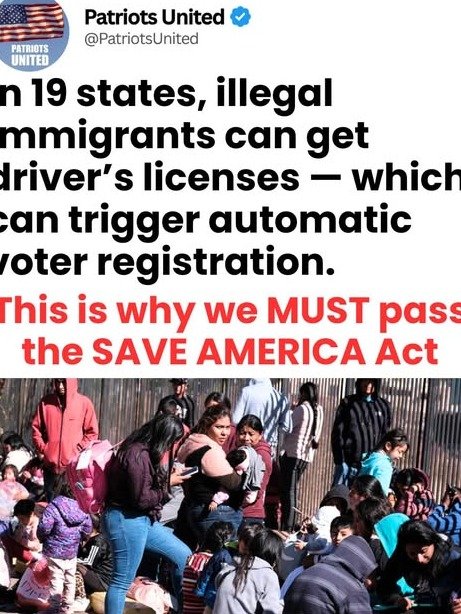
Imagine a scenario where the very foundation of our democratic process—the act of voting—could be inadvertently compromised. It’s a concern that’s gaining traction across the nation, fueled by a surprising intersection of state-level policies. What if a seemingly innocuous policy, designed for public safety, could open a ‘dangerous loophole’ that impacts the integrity of our elections?
This isn’t a hypothetical thought experiment. In 19 states across the U.S., undocumented immigrants are legally permitted to obtain driver’s licenses. While proponents argue for the safety and economic benefits of such policies, a critical question arises when these states also implement automatic voter registration (AVR) at their Departments of Motor Vehicles (DMVs). This confluence of policies creates a complex and contentious debate: could non-citizens be inadvertently registered to vote, or even cast ballots, without proper safeguards?
The Dual Policies: Driver’s Licenses for All and Automatic Voter Registration
The discussion begins with understanding two distinct, yet now intertwined, policy trends. First, the growing movement to allow undocumented immigrants to obtain driver’s licenses. States began adopting these measures for various reasons, primarily focusing on practical benefits for both immigrants and the broader community.
Advocates for these licenses emphasize increased road safety, arguing that all drivers, regardless of immigration status, should be trained, tested, and insured. This reduces the number of uninsured motorists and ensures more drivers understand traffic laws. Furthermore, it provides a crucial form of identification, which can be vital for daily tasks, from picking up children from school to interacting with law enforcement.
- Enhanced Road Safety: All drivers are tested and insured.
- Economic Benefits: Increased insurance sales, potential tax revenue.
- Law Enforcement Aid: Easier identification during traffic stops.
- Community Integration: Enables access to work, medical appointments, and daily necessities.
On the other side of the coin is Automatic Voter Registration (AVR). This modern approach to voter registration aims to simplify the process and increase civic participation. When an eligible citizen interacts with government agencies, most commonly the DMV, they are automatically registered to vote unless they choose to opt out. The intention is noble: to remove barriers to voting and ensure that eligible citizens are on the voter rolls.
The ‘Dangerous Loophole’ Emerges
The ‘dangerous loophole’ isn’t in either policy alone, but in their combination. When a state allows undocumented immigrants to obtain driver’s licenses and also has an automatic voter registration system at the DMV, the potential for unintended consequences arises. The concern is that an individual, applying for a driver’s license without being a U.S. citizen, might be prompted by the AVR system to register to vote, potentially leading to their unlawful registration.
The process often works like this: an applicant visits the DMV for a driver’s license. During the application, they are asked a series of questions, including one about U.S. citizenship. In an AVR state, if they affirm citizenship—either mistakenly, intentionally, or due to a misunderstanding of the process or language barrier—they could be automatically added to the voter rolls. This raises serious questions about the integrity of voter registration databases and the potential for non-citizen voting, which is illegal in federal elections and most state and local elections.
“The intersection of these policies creates a clear vulnerability in our election systems. While the intent of driver’s licenses for all may be laudable, and AVR aims to boost participation, we must ensure that our voter rolls are exclusively for eligible citizens,” stated one election integrity advocate.
Safeguards: Are They Enough?
Proponents of these dual systems often point to existing safeguards. Most AVR systems require applicants to attest to their U.S. citizenship, often by checking a box or signing a declaration. It is a felony in many places to falsely claim citizenship for the purpose of voting. However, critics argue that a simple checkbox or verbal affirmation is insufficient, especially given the complexities of immigration status and language differences.
The effectiveness of these safeguards is a major point of contention. Are DMV workers adequately trained to identify and prevent non-citizens from inadvertently registering? Are the digital systems robust enough to cross-reference databases and flag potential ineligible registrations before they become active? The answers vary widely from state to state, leading to inconsistencies and heightened concerns about election security.
- Citizenship Attestation: Applicants must declare they are U.S. citizens.
- Penalties for False Claims: Felony charges for unlawful registration or voting.
- Data Matching: Some states attempt to cross-reference DMV data with other databases to verify citizenship.
However, the reality of high-volume DMV operations means that errors can occur. An applicant might check the wrong box, or a staff member might not fully explain the implications of the citizenship question. For those who are not fluent in English, or who are unfamiliar with the nuances of U.S. election law, the process can be confusing, potentially leading to unintentional registration.
The Impact on Election Integrity and Public Trust
The core concern for many is the potential erosion of election integrity. If voter rolls contain non-citizens, even in small numbers, it can undermine public confidence in the electoral system. The principle that only eligible citizens should vote is a fundamental tenet of democratic governance, and any perceived deviation from this principle can fuel skepticism and distrust.
While instances of confirmed non-citizen voting are often reported as rare by election officials, the very possibility is enough to alarm those who prioritize stringent election security. The argument is not necessarily about widespread fraud, but about maintaining the purity of the voter rolls and ensuring that every legal vote counts, untainted by ineligible participation.
On the other hand, many immigrant rights advocates and some election officials argue that the risk is often overblown. They contend that the number of non-citizens who would intentionally or unintentionally register and vote is negligible, and that focusing on this issue distracts from more significant challenges to voter access and election administration. They also emphasize that the driver’s license policies serve vital public safety and economic functions, irrespective of voter registration.
Calls for Reform and Diverse Perspectives
Given the complexities, various solutions and reforms have been proposed. One primary suggestion is to decouple the driver’s license application process for non-citizens from the automatic voter registration prompt. This would mean that when an undocumented immigrant applies for a license, they would not be presented with the option to register to vote, thereby eliminating the potential loophole.
Another approach involves strengthening citizenship verification processes. This could include more robust data matching with federal databases, or requiring additional proof of citizenship beyond a simple attestation for voter registration purposes. However, these measures can also raise concerns about voter suppression and making it harder for eligible citizens to register.
- Decouple AVR: Separate the voter registration prompt for non-citizen driver’s license applicants.
- Enhanced Verification: Implement more rigorous citizenship checks for voter registration.
- Improved Training: Better educate DMV staff on citizenship requirements for voting.
- Clearer Language: Ensure voter registration forms are unambiguous, especially for non-English speakers.
The debate is highly politicized, with different groups holding strong, often opposing, views. Civil rights organizations stress the importance of voter access and avoiding policies that could disenfranchise eligible voters. Election integrity groups emphasize the sanctity of the ballot box and the need for rigorous safeguards against any form of ineligible voting. Lawmakers are caught in the middle, attempting to balance these competing priorities.
Conclusion: Navigating a Complex Landscape
The issue of driver’s licenses for undocumented immigrants intersecting with automatic voter registration at the DMV presents a multifaceted challenge for states. It highlights the tension between public safety, immigrant integration, and the fundamental principle of election integrity. While individual policies may serve distinct benefits, their combination can create unforeseen vulnerabilities that demand careful attention and robust solutions.
As states continue to grapple with these interconnected policies, the conversation must evolve beyond simple accusations or dismissals. It requires a nuanced understanding of how these systems operate, an honest assessment of existing safeguards, and a commitment to ensuring that our democratic processes remain secure, accessible, and above all, trustworthy for every eligible citizen.
The ‘dangerous loophole’ isn’t just a political talking point; it’s a call to action for policymakers to design systems that uphold both the spirit and letter of the law, ensuring that the right to vote remains exclusively for those legally entitled to it, while also addressing the practical realities of a diverse society.
About the Author




