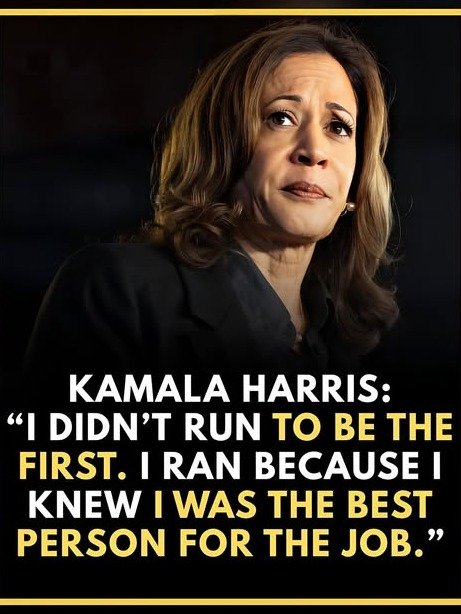
Vice President Kamala Harris recently made a powerful assertion that immediately captured national attention. She declared that her motivation for seeking high office was not to be a historic ‘first,’ but rather because she genuinely believes she is ‘the best person for the job.’ This bold statement has naturally sparked widespread debate, prompting many to scrutinize her extensive political career and question what truly defines ‘best’ in the complex, demanding landscape of American leadership.
Her words resonate particularly strongly in a political climate where every move and utterance by a high-ranking official is meticulously analyzed. The declaration invites a deep dive into her qualifications, experience, and the tangible impact of her time in public service, pushing the public to look beyond historical milestones and focus on the substantive aspects of her performance.
The Dichotomy: ‘First’ Versus ‘Best’
Harris’s statement deliberately draws a line between the symbolic significance of her position and her perceived substantive merit. As the first female Vice President, the first African American Vice President, and the first South Asian American Vice President, her place in history is undeniably groundbreaking. Yet, she seems intent on shifting the narrative away from identity politics and towards a focus on her capabilities and track record.
This distinction is crucial for any politician aspiring to higher office, especially one who has already broken multiple barriers. It suggests a desire to be judged on qualifications and performance, rather than on the historical novelty of her presence. However, for many, the two concepts are not mutually exclusive; being ‘first’ often comes with an inherent pressure to also be ‘best’ to pave the way for future generations.
A Formidable Resume: From Prosecutor to Senator
Before ascending to the Vice Presidency, Kamala Harris built a significant career in law and public service. She began as a prosecutor, eventually becoming District Attorney of San Francisco. Her tenure saw her tackling various criminal justice issues, earning her a reputation as a tough, yet reform-minded, prosecutor.
Her rise continued as she was elected Attorney General of California, a position she held for six years. During this time, she managed a large legal department, overseeing a wide array of cases from consumer protection to environmental enforcement. Supporters often point to her experience in these roles as evidence of her deep understanding of the legal system and her executive capabilities.
“My mother would tell me, ‘Kamala, you may be the first to do many things, but make sure you are not the last.’ I’ve always carried that with me,” Harris has often said, underscoring her awareness of her historic role while emphasizing her commitment to paving the way for others.
The Senate Years: Building a National Profile
In 2017, Harris transitioned to the national stage, serving as a U.S. Senator for California. During her time in the Senate, she quickly gained prominence for her incisive questioning during high-profile hearings, particularly those involving Supreme Court nominees and executive branch officials. She served on key committees, including the Senate Intelligence Committee and the Senate Judiciary Committee.
Her legislative efforts in the Senate focused on issues such as criminal justice reform, affordable housing, and voting rights. While some critics argued her legislative record was relatively thin compared to some of her peers, her supporters highlight her effectiveness in raising important issues and her strong advocacy for progressive policies.
The Vice Presidency: Defining Her Role and Impact
As Vice President, Harris has been tasked with several critical portfolios, reflecting the Biden administration’s priorities. She has taken a leading role in addressing the root causes of migration from Central America, a complex and politically charged issue. Her efforts have involved diplomatic engagement with regional leaders and initiatives aimed at fostering economic development and stability.
Additionally, she has been a vocal champion for voting rights, advocating for federal legislation to protect and expand access to the ballot box. Her work on infrastructure, particularly promoting broadband access and clean energy initiatives, also forms a significant part of her portfolio. She chairs the National Space Council and has been instrumental in the administration’s AI policy development, underscoring her engagement across diverse, high-stakes sectors.
Navigating Complex Challenges and Public Scrutiny
However, her time as Vice President has not been without its challenges and criticisms. Her handling of the border crisis, in particular, has drawn fire from both sides of the political spectrum. Some critics argue that her approach has not yielded significant improvements, while others contend she has been handed an intractable problem with limited resources.
Her approval ratings have also been a point of contention, often lagging behind President Biden’s. Public perception is a powerful force in politics, and the narrative around her performance is constantly shaped by media coverage, political punditry, and the broader political climate. This intense scrutiny is part and parcel of being a heartbeat away from the presidency.
What Does ‘Best’ Truly Mean in the Political Arena?
The assertion of being ‘the best person for the job’ forces a deeper contemplation of what qualities truly define exceptional leadership. Is it purely about legislative achievements, or does it encompass a broader set of skills like communication, empathy, crisis management, and the ability to inspire confidence?
- Experience: Her extensive background in law enforcement and legislative work provides a solid foundation.
- Policy Acumen: Her detailed engagement in areas like AI, space, and infrastructure demonstrates intellectual capacity.
- Leadership Style: Critics and supporters often debate her executive presence and ability to rally diverse groups.
- Public Trust: A critical component, often reflected in approval ratings, which can fluctuate wildly based on current events and political narratives.
For some, ‘best’ might mean an unwavering commitment to a specific ideological agenda. For others, it could signify a pragmatic problem-solver capable of bipartisan cooperation. The subjective nature of the term ensures that Harris’s claim will continue to be evaluated through various lenses, each reflecting different priorities and expectations.
The Road Ahead: Aspirations and Ongoing Evaluation
As the 2024 election cycle progresses, and with ongoing speculation about her future political aspirations, the debate over Kamala Harris’s suitability and effectiveness will only intensify. Her claim of being ‘the best person for the job’ serves as an open invitation for voters, analysts, and political opponents alike to dissect her record, scrutinize her decisions, and weigh her potential.
Ultimately, the question of whether Kamala Harris is ‘the best person for the job’ is not one that can be answered definitively by a single individual or a simple checklist. It is a complex judgment that voters will make, taking into account her past performance, her stated vision, and their own hopes for the nation’s future. Her bold declaration has undeniably shifted the focus, demanding that the conversation move beyond historical firsts and delve into the substance of her leadership.
Conclusion: A Claim That Demands Scrutiny
Kamala Harris’s assertion that she didn’t run to be the first, but rather because she’s the ‘best person for the job,’ is a powerful statement that challenges the public to look beyond superficial narratives. It compels a thorough examination of her entire career, from her early days as a prosecutor to her current role as Vice President. While her journey has been marked by historic milestones, her claim insists on an evaluation based on merit and capability.
As the nation looks towards its future, the ongoing debate around her qualifications and performance will continue to shape public opinion. Whether her record truly backs up her bold claim remains a central question, inviting every citizen to engage critically with the evidence and decide for themselves.
About the Author




