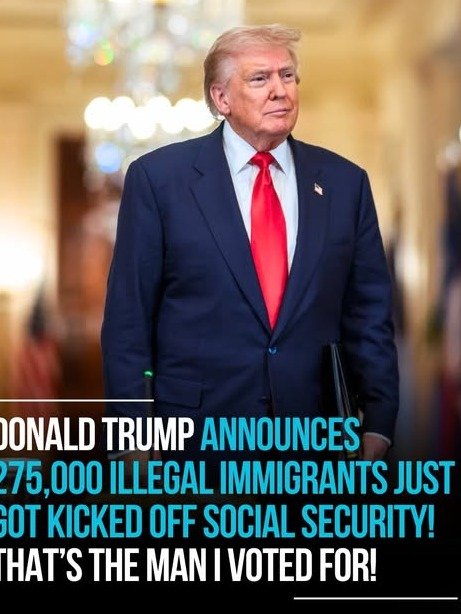
Are you ready for a seismic shift in how Social Security and public benefits are managed in America? A controversial initiative, spearheaded by the previous administration, is signaling a profound shake-up that could redefine who receives crucial support and how our social safety net operates.
This isn’t just about minor adjustments; we’re talking about a comprehensive re-evaluation of benefits eligibility, with a particular focus on immigration status. The proposals, highlighted by former President Trump, suggest a major crackdown on who can access public funds, sparking widespread debate and concern.
At the heart of this discussion lies a staggering figure: an estimated 275,000 undocumented immigrants reportedly receiving various benefits. This number has become a powerful rallying cry for those advocating for stricter immigration and welfare policies, setting the stage for a dramatic overhaul that could affect millions.
The Rationale Behind the Proposed Crackdown
The Trump administration consistently championed an “America First” agenda, which often translated into policies aimed at restricting immigration and prioritizing benefits for U.S. citizens and legal residents. This proposed crackdown aligns perfectly with that philosophy, seeking to limit access to public resources for those without legal immigration status.
Proponents of such measures argue that taxpayer-funded benefits should be exclusively reserved for those who have legally contributed to the system or are recognized as citizens. They contend that allowing undocumented immigrants to access these services places an undue burden on public coffers and disincentivizes legal immigration pathways.
The argument often extends to the idea of fiscal responsibility, suggesting that by curtailing benefits for non-citizens, the government can better allocate resources to address the needs of its legal population. This perspective frames the crackdown as a necessary step to ensure the long-term solvency and fairness of social programs.
Unpacking the “275,000 Undocumented Immigrants” Claim
The figure of 275,000 undocumented immigrants receiving benefits is a crucial data point that has fueled much of the debate. However, understanding what this number truly represents is complex. It’s vital to differentiate between various types of assistance and the legal frameworks governing them.
Often, when such figures are cited, they can encompass a broad range of services, including emergency medical care, school lunches for children, or even benefits received by U.S. citizen children of undocumented parents. It’s rarely a direct claim that undocumented individuals are receiving Social Security retirement or disability benefits in the same manner as legal contributors.
The challenge in accurately quantifying this population and their benefit access is immense. Data collection on undocumented individuals is inherently difficult, and the types of benefits they might indirectly access often fall under state or local programs, not necessarily federal Social Security funds. This ambiguity makes the figure a powerful rhetorical tool, but one that warrants careful scrutiny.
Social Security: Who is Truly Eligible?
It’s a common misconception that undocumented immigrants are widely receiving Social Security retirement or disability benefits. The reality is far more nuanced. Social Security is primarily an insurance program, funded by payroll taxes deducted from workers’ wages.
To qualify for Social Security benefits, an individual generally needs to have worked and paid Social Security taxes for a specified number of years (typically 10 years, or 40 credits). Furthermore, they must have a valid Social Security number and be a U.S. citizen or a legal resident with work authorization.
While undocumented immigrants generally cannot directly receive Social Security retirement or disability benefits, some may have worked using false Social Security numbers or Individual Taxpayer Identification Numbers (ITINs) and thus contributed billions into the system without ever being able to claim benefits. This complex reality often gets overlooked in simplified narratives.
However, there are limited exceptions. For instance, U.S. citizen children of undocumented parents might be eligible for certain benefits if their parent worked and paid into the system, or if a legal guardian is receiving benefits. These are specific scenarios, not a widespread direct receipt of benefits by undocumented individuals themselves.
The Scope of the “Benefits Crackdown”
When discussions turn to a “benefits crackdown,” it typically extends far beyond just Social Security. The administration’s focus has often been on a broader range of public assistance programs that undocumented immigrants might access, either directly or indirectly.
These could include federal programs like Medicaid (though eligibility is generally restricted for non-citizens), housing assistance, or food stamps (SNAP). State and local programs, which sometimes offer more flexibility for emergency or child-focused aid, could also be targeted for review and restriction.
Implementing such a sweeping crackdown presents significant administrative and legal challenges. Agencies would need to enhance data sharing, verify immigration statuses more rigorously, and navigate existing laws that protect certain emergency services regardless of status. The sheer scale of tracking and denying access across multiple programs is immense.
Moreover, denying access to essential services like healthcare or food assistance raises profound humanitarian and ethical questions. Critics argue that such policies could lead to increased public health crises, greater strain on emergency services, and heightened social instability, ultimately costing more in the long run.
Economic Ripple Effects: More Than Just Numbers
The economic implications of a major benefits crackdown are multifaceted and extend beyond simple budgetary savings. While proponents argue for fiscal prudence, opponents highlight potential negative consequences for the broader economy and social fabric.
On one hand, restricting access to benefits could theoretically reduce direct government expenditures on certain populations. However, the actual savings might be offset by increased costs in other areas, such as emergency room visits for untreated illnesses, or increased burdens on charitable organizations.
Undocumented immigrants, despite their status, contribute significantly to the U.S. economy. They work in various sectors, pay sales taxes, and often contribute indirectly to property taxes through rent. Many also pay federal, state, and local income taxes using ITINs, without receiving the corresponding benefits.
“Restricting access to basic necessities could lead to a less healthy, less stable population, which ultimately burdens society more than providing targeted assistance,” stated one economic analyst.
A sudden withdrawal of support could destabilize communities, reduce consumer spending in certain areas, and potentially lead to a decrease in overall economic activity. The economic impact is not a simple calculation of benefits denied, but a complex web of interconnected factors.
Human Impact and Humanitarian Concerns
Beyond the economic figures and political rhetoric, a benefits crackdown has profound human consequences. For individuals and families living without legal status, access to even basic services can mean the difference between stability and destitution.
Many undocumented immigrants are part of mixed-status families, where some members are U.S. citizens (often children) while others are not. Denying benefits to parents or guardians can severely impact the well-being of these citizen children, potentially pushing entire families into deeper poverty and hardship.
Humanitarian organizations and immigrant advocacy groups vehemently oppose such crackdowns, arguing that they are inhumane and counterproductive. They emphasize that access to food, shelter, and healthcare are fundamental human rights, regardless of immigration status.
The fear of deportation, combined with the denial of essential services, can create an environment of extreme vulnerability and fear within immigrant communities. This can lead to individuals avoiding necessary medical care, reporting crimes, or engaging with public services, further isolating them from society.
Legal Battles and Political Firestorms
Any significant policy shift concerning immigration and benefits is almost guaranteed to ignite fierce legal and political battles. The previous administration’s efforts to implement stricter immigration policies often faced immediate challenges in federal courts.
Civil liberties organizations, immigrant rights groups, and even some states have historically sued the government over policies they deem discriminatory, unconstitutional, or exceeding executive authority. These legal challenges can delay implementation, modify policies, or even strike them down entirely.
Politically, the issue is highly polarizing. Supporters of stricter measures view them as a matter of national sovereignty and fiscal responsibility, resonating with a base concerned about border security and the cost of immigration. Opponents, on the other hand, see them as inhumane, xenophobic, and damaging to the nation’s values.
- Proponents argue:
- Fiscal responsibility and protection of taxpayer dollars.
- Prioritizing U.S. citizens and legal residents.
- Discouraging illegal immigration.
- Opponents argue:
- Humanitarian crisis and increased suffering.
- Negative economic impacts from reduced consumption and increased emergency services use.
- Undermining social cohesion and public health.
The debate often becomes a proxy battle for broader ideological differences regarding immigration, social welfare, and the role of government.
What This Means for the Future of Social Security
While the immediate focus of a “benefits crackdown” might not directly target Social Security’s core retirement and disability programs for legal beneficiaries, the rhetoric and policies surrounding it have broader implications for the system’s future and public trust.
The debate over who is “deserving” of benefits, and the scrutiny of contributions versus receipts, can subtly shift public perception of all social safety nets. It raises questions about the long-term sustainability of these programs and the shared responsibility of supporting them.
Furthermore, by creating an environment of fear and uncertainty, such policies could inadvertently push more individuals into the informal economy, making it harder to track contributions and potentially reducing the tax base that supports Social Security in the long run.
Ultimately, the discussion around the 275,000 undocumented immigrants and benefits highlights the urgent need for comprehensive immigration reform. Without a clear, stable pathway for immigrants, and without addressing the underlying economic and social factors, these debates will continue to resurface, impacting not just immigrant communities but the fabric of American society and its critical social programs.
The proposed shake-up is more than just a policy adjustment; it’s a reflection of ongoing tensions regarding national identity, economic fairness, and humanitarian responsibility. As these discussions evolve, it’s crucial for citizens to stay informed and understand the full spectrum of potential impacts on their communities and their own future.
About the Author




