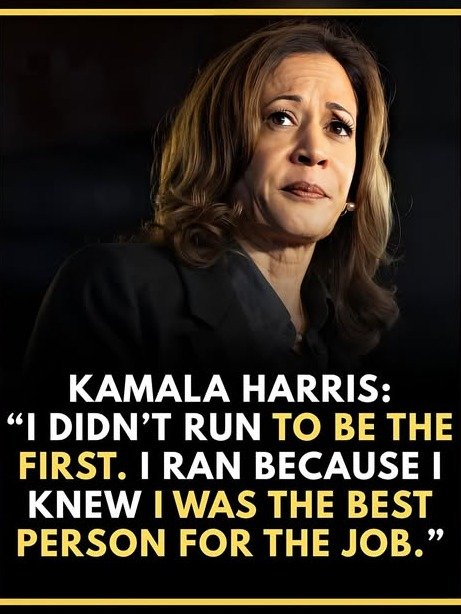
In the high-stakes arena of national politics, few statements grab attention quite like a leader boldly declaring themselves the ‘best person for the job.’ Vice President Kamala Harris recently did just that, asserting that her motivation wasn’t to be a trailblazer, but purely to serve because of her unparalleled suitability. But in a world where actions speak louder than words, does her record truly back up such a powerful claim?
This assertion, which sparked immediate debate, prompts a critical examination of her extensive career and the impact she has had in various high-profile roles. It forces us to look beyond the headlines and delve into the substance of her work, her decisions, and the challenges she has faced. The question isn’t just about her qualifications, but whether she has demonstrated the unique blend of leadership, vision, and effectiveness that such a declaration implies.
The Audacity of the Claim: “Best Person for the Job”
When Kamala Harris states she didn’t run to be the first, but rather because she believes she’s the ‘best person for the job,’ it’s more than just a campaign slogan; it’s a profound statement of self-belief and a challenge to her critics. This declaration immediately sets a high bar, inviting intense scrutiny from both her supporters and her detractors.
For many, the idea of any politician, particularly one in such a prominent and often controversial position, making such a definitive statement about their own superiority can be jarring. It sparks an immediate reaction: ‘Really, Kamala?’ This visceral response isn’t just about political affiliation; it’s about the very nature of leadership and accountability in a democratic society. It implies a level of performance that must be demonstrably superior, not merely adequate.
From Prosecutor to Vice President: A Career Trajectory
To assess her claim, we must first trace Kamala Harris’s journey through the American legal and political landscape. Her career began as a prosecutor, where she quickly rose through the ranks. She served as the District Attorney of San Francisco from 2004 to 2011, making her the first woman and first African American to hold that office.
Following her tenure as DA, Harris was elected Attorney General of California in 2011, again breaking barriers as the first woman, first African American, and first South Asian American to serve in that capacity. Her time as Attorney General was marked by both significant legal actions and controversies, setting the stage for her eventual leap into national politics.
In 2017, she transitioned to the U.S. Senate, representing California. During her time in the Senate, she gained national recognition for her questioning during committee hearings and her focus on issues like criminal justice reform, healthcare, and immigration. This period cemented her reputation as a formidable presence in Washington, culminating in her selection as Vice President in 2020.
Evaluating Her Record: Achievements and Policy Impact
Her record as District Attorney and Attorney General is a complex tapestry of progressive reforms and traditional law-and-order stances. As DA, she implemented initiatives aimed at reducing recidivism and addressing racial bias in the justice system. However, she also faced criticism for certain policies, such as her tough stance on truancy, which could lead to parents facing jail time.
“My career in public service has been driven by a singular purpose: to fight for the people.” — Kamala Harris
As California’s Attorney General, Harris tackled issues ranging from mortgage fraud to environmental protection. She launched programs to combat transnational gangs and cybercrime, and she defended the Affordable Care Act. Yet, she also drew criticism for not taking stronger action on certain police misconduct cases and for some of her office’s legal arguments in appeals.
Upon entering the Senate, Harris quickly became a vocal advocate for various causes. She introduced legislation on bail reform, housing assistance, and election security. Her sharp questioning style during Senate hearings on issues like judicial appointments and national security often went viral, establishing her as a prominent national figure.
As Vice President, Harris has been tasked with leading several key initiatives. She has focused on issues such as voting rights, maternal health, broadband access, and addressing the root causes of migration at the southern border. Her work has involved extensive travel, both domestically and internationally, to represent the administration’s policies.
Some of her notable efforts include advocating for the Bipartisan Infrastructure Law, promoting clean energy initiatives, and engaging with world leaders on diplomatic matters. She has also played a significant role in the administration’s efforts to address gun violence and protect reproductive rights. These responsibilities are immense, requiring a broad range of skills and a deep understanding of complex policy challenges.
The “First” vs. “Best” Dichotomy: A Deeper Look
Kamala Harris’s career is undeniably marked by a series of historic ‘firsts.’ She was the first woman, first African American, and first South Asian American to hold several of her offices, culminating in her groundbreaking role as the first woman Vice President of the United States. These achievements are significant and deserve recognition for breaking barriers and inspiring future generations.
However, her assertion that she didn’t run to be the ‘first’ but the ‘best’ creates an interesting dichotomy. It suggests a desire to separate her qualifications and performance from the historical significance of her identity. While being a trailblazer is a remarkable feat, the claim of being the ‘best’ demands a different kind of evaluation—one based purely on merit, effectiveness, and leadership capabilities.
The challenge lies in how these two aspects often intertwine in public discourse. Critics sometimes dismiss her qualifications by focusing solely on her identity, while supporters might overemphasize her ‘firsts’ without a detailed examination of her record. Harris’s own statement attempts to shift the focus firmly to her competence, inviting a more rigorous assessment of her actual impact.
Public Perception and Political Scrutiny
The public’s perception of Kamala Harris is, like most prominent politicians, polarized. Supporters often praise her intelligence, experience, and resilience, viewing her as a strong advocate for progressive values and a vital voice in the administration. They point to her policy efforts and her ability to connect with diverse communities.
Conversely, critics frequently question her effectiveness, particularly in her role as Vice President. Her handling of specific assignments, such as the border crisis, has drawn significant backlash. Some argue that her policy initiatives have lacked tangible results, while others criticize her communication style or perceived lack of a clear political identity.
Polling data often reflects these mixed views, with her approval ratings fluctuating and generally remaining lower than desired for a potential future presidential candidate. Media coverage also varies widely, from glowing profiles highlighting her achievements to sharp critiques dissecting her perceived shortcomings. This constant scrutiny is part and parcel of being in such a high office, but it makes the ‘best person’ claim a particularly bold one to make.
Navigating Future Challenges: Can She Convince the Nation?
As Kamala Harris looks towards the future, the challenge of convincing the American public that she is, indeed, the ‘best person for the job’ remains formidable. Her extensive experience across various branches of government is undoubtedly a strength, providing her with a unique understanding of policy and governance.
However, she faces hurdles in solidifying her public image and demonstrating a clear, compelling vision for the country. Overcoming past controversies, articulating distinct policy successes, and building broader public trust will be crucial. The ability to resonate with a diverse electorate, bridging divides and inspiring confidence, will ultimately determine the reception of her bold assertion.
Her political future hinges not just on her resume, but on her ability to translate that experience into palpable improvements in the lives of everyday Americans. It requires a sustained effort to communicate her value, demonstrate her leadership, and prove that her claim of being the ‘best’ is more than just aspiration—it is a verifiable reality.
Conclusion: The Verdict on a Bold Assertion
Kamala Harris’s declaration that she is the ‘best person for the job’ is a powerful statement that demands more than a superficial glance. It forces a deep dive into her career, from her days as a prosecutor to her current role as Vice President, examining both her groundbreaking achievements and the criticisms leveled against her.
While her historic ‘firsts’ are undeniable and inspiring, the claim of being the ‘best’ requires a different metric—one based on demonstrated effectiveness, strategic leadership, and tangible results. The evidence suggests a career marked by significant milestones and dedicated public service, but also by areas that have drawn considerable debate and scrutiny.
Ultimately, whether Kamala Harris truly is the ‘best person for the job’ is a judgment each individual voter must make, weighing her complex record against the immense demands of high office. Her assertion isn’t just a political soundbite; it’s an invitation to examine the full scope of her capabilities and impact. The truth, as always, lies in the nuanced details of her journey and the unwavering scrutiny of the public eye.
About the Author




