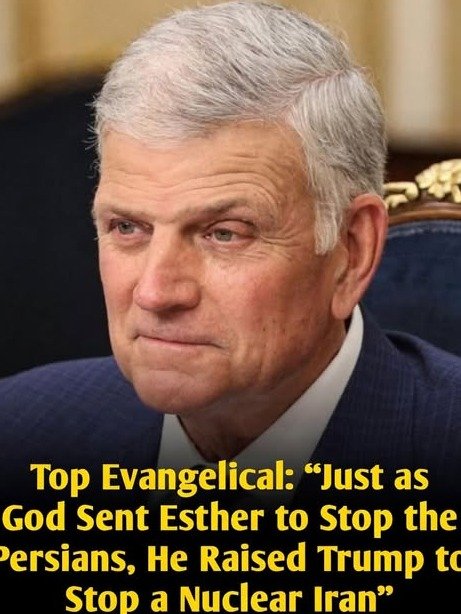
Imagine a religious leader, renowned for his influence, publicly drawing a direct parallel between a sitting president and a revered figure from ancient scripture. This isn’t a hypothetical scenario; it’s exactly what happened when prominent evangelical leader Franklin Graham compared former President Donald Trump to the biblical Queen Esther, igniting a firestorm of debate across the nation and within religious communities.
The statement, delivered with Graham’s characteristic conviction, didn’t just turn heads; it sparked a furious discussion about the intersection of faith and politics, the interpretation of scripture, and the very nature of leadership. Was this a prophetic declaration, a political endorsement, or a dangerous blurring of sacred and secular lines? The answer, it seems, depends entirely on who you ask.
Franklin Graham: A Voice in the Evangelical Landscape
To understand the gravity of Graham’s comparison, one must first understand the man himself. Franklin Graham is the son of the late, legendary evangelist Billy Graham, and he has carved out his own significant, albeit often controversial, path in American religious and political life. As the head of the Billy Graham Evangelistic Association and Samaritan’s Purse, he wields considerable influence among conservative Christians.
Graham is known for his outspoken political views, which often align with the Republican party, and his staunch support for Donald Trump throughout his presidency and beyond. His pronouncements carry weight within a significant segment of the evangelical community, making his words about Trump and Queen Esther particularly impactful.
The Provocative Parallel: Trump as Queen Esther
The core of the controversy lies in Graham’s assertion that God had ‘raised up’ Donald Trump “for such a time as this,” directly echoing the famous line from the Book of Esther (Esther 4:14). This verse describes Queen Esther’s cousin Mordecai urging her to use her position as queen to intercede for her people, the Jews, who were facing annihilation in ancient Persia.
Graham’s rationale for this comparison centered on Trump’s perceived actions and policies that, in Graham’s view, defended religious freedoms, appointed conservative judges, and stood against what he considered to be moral decay in America. For Graham, Trump was an unlikely hero, much like Esther, placed in power by divine providence to protect Christian values and interests.
“I believe it’s God who put him there. I don’t know that he totally understands that, but I believe God put him there for this time and this season,” Graham stated, reinforcing the idea of divine intervention in Trump’s presidency.
Who Was Queen Esther? A Biblical Refresher
To grasp the depth of Graham’s analogy, it’s essential to revisit the story of Queen Esther. She was a young Jewish orphan living in exile in Persia, who, through a series of unlikely events, became queen to King Ahasuerus. Unbeknownst to the king, Esther was Jewish, a secret she kept under the guidance of her cousin, Mordecai.
The central drama unfolds when Haman, a high-ranking official, plots to annihilate all Jews in the Persian Empire. Mordecai discovers the plot and implores Esther to intercede with the king, even though approaching the king without being summoned was punishable by death. Esther famously declares, “If I perish, I perish” (Esther 4:16), demonstrating immense courage and faith.
- Courage: Esther risked her life to save her people.
- Divine Providence: Her rise to power is often seen as divinely orchestrated.
- Intercession: She used her position to advocate for the vulnerable.
- Unlikely Hero: A young woman in a foreign land becomes a savior.
The Book of Esther is a powerful narrative about God’s unseen hand working through human actions to protect His people, even in the most dire circumstances. It’s a story of courage, faith, and the strategic placement of individuals for a divine purpose.
The ‘Heated Debate’: Reactions and Interpretations
Graham’s comparison immediately polarized opinions, revealing deep fault lines within both religious and political spheres.
The Supporters: A Divine Mandate for Trump
Many of Graham’s evangelical followers embraced the comparison, seeing it as validation of their belief that Trump was indeed a divinely appointed leader. For them, Trump’s presidency was a direct answer to prayer, a bulwark against secularism and liberal policies. The Esther analogy resonated because it framed Trump as an imperfect vessel chosen by God to protect religious freedom and conservative values, much like Esther was chosen to save her people.
This perspective often highlights Trump’s appointments of conservative judges, his pro-Israel stance, and his administration’s support for religious organizations as evidence of his ‘Esther-like’ mission. They believe that like Esther, Trump was uniquely positioned to act for the good of a specific group, in this case, conservative Christians in America.
The Critics: Theological and Political Pushback
However, the comparison drew sharp criticism from numerous quarters. The objections were multifaceted, ranging from theological concerns to political disagreements.
Theological Objections:
- Sacrilege and Idolatry: Many critics argued that comparing a political figure, especially one with a controversial personal history like Trump, to a revered biblical hero borders on sacrilege or even idolatry. They felt it inappropriately elevated a human leader to a near-divine status.
- Misinterpretation of Scripture: The Book of Esther is a story of a woman risking her life to save an entire people from genocide. Critics found it a profound misapplication to equate this with a president’s political actions, arguing it trivialized the biblical narrative and its profound message.
- Blurring Church and State: Opponents worried that such comparisons further blurred the lines between religious faith and political partisanship, potentially alienating those who share faith but not political views.
Political and Ethical Objections:
- Character Discrepancy: Many found it difficult to reconcile Esther’s humility, courage, and self-sacrifice with aspects of Trump’s public persona and actions, which critics often characterized as self-serving or divisive.
- Partisan Weaponization of Faith: Critics accused Graham of using religious rhetoric to provide a divine mandate for a political agenda, effectively weaponizing faith for partisan purposes. This, they argued, undermines the moral authority of religious leaders.
- Selective Application: Some pointed out that if God ‘raises up’ leaders, then all leaders, regardless of their policies, could be seen as divinely appointed, which complicates the notion of moral and political critique.
The Broader Implications: Faith, Politics, and Prophecy
Franklin Graham’s comparison of Trump to Queen Esther is more than just a passing comment; it’s a window into the complex and often contentious relationship between evangelical Christianity and American politics. It highlights several key themes:
The Search for Divine Intervention in Politics
For many evangelicals, the belief that God actively intervenes in human affairs, including the selection of political leaders, is a core tenet. This belief often fuels the hope for a leader who will uphold biblical principles and protect religious freedoms, leading to comparisons with biblical figures who served similar roles.
The Power of Biblical Narratives in Public Discourse
Biblical stories, with their archetypal heroes and timeless themes, continue to hold immense power in shaping public perception and mobilizing support. When a leader is cast in the mold of a biblical figure, it imbues their actions with a sense of destiny and moral imperative.
The Division Within Evangelicalism
While a significant portion of evangelicals embraced Trump, his presidency also exposed deep divisions within the movement. Comparisons like Graham’s further highlight these fissures, as not all evangelicals agree on the theological or ethical justification for aligning so closely with a particular political figure or party.
Historical Echoes: Other Biblical Comparisons
It’s worth noting that this isn’t the first time American political figures have been likened to biblical characters. Ronald Reagan was sometimes compared to Cyrus the Great, the Persian king who allowed the Jews to return to Jerusalem and rebuild their temple, seen as an unlikely savior. Similarly, Abraham Lincoln has been mythologized with parallels to Moses, leading his people through a great trial.
What makes Graham’s comparison particularly potent is its directness, its contemporary context, and the strong reactions it elicited. It taps into a deep well of religious belief and political passion that continues to shape the American landscape.
Conclusion: An Enduring Debate
Franklin Graham’s comparison of Donald Trump to Queen Esther remains a potent symbol of the ongoing interplay between faith and politics in America. For some, it was a divinely inspired validation of a president they believed was fighting for their values. For others, it was a dangerous and inappropriate theological stretch that risked conflating political power with spiritual authority.
Regardless of one’s personal stance, the debate sparked by Graham’s words underscores the enduring power of biblical narratives to frame contemporary events and the profound influence religious leaders continue to wield in shaping public discourse. As long as faith and politics intertwine, such provocative comparisons will undoubtedly continue to ignite conversation, challenge interpretations, and reveal the complex tapestry of belief in the modern world.
About the Author




