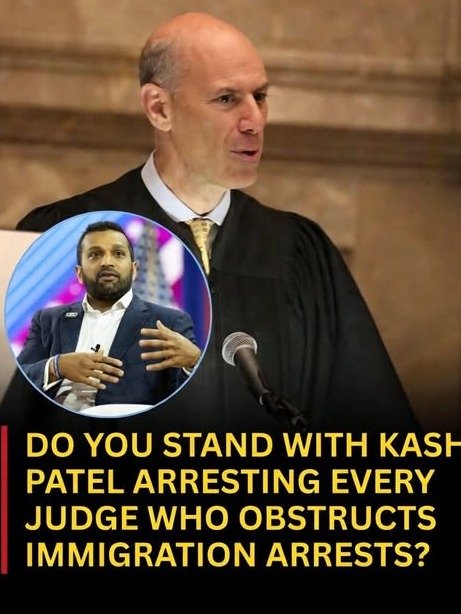
Imagine a world where the very judges tasked with upholding the law could face criminal charges for their judicial decisions. This isn’t a scene from a dystopian novel; it’s the groundbreaking, and highly contentious, initiative proposed by former national security official Kash Patel, aiming to hold what he terms ‘activist judges’ criminally accountable for their rulings on immigration arrests.
This bold proposition has ignited a fierce debate across legal, political, and public spheres, challenging the foundational principles of judicial independence and the separation of powers. It forces us to confront uncomfortable questions about the limits of judicial authority, the role of the executive branch, and the very nature of justice in America. Are we on the brink of a profound shift in how our judiciary operates, or is this a dangerous overreach that threatens the bedrock of our democratic system?
Who is Kash Patel? A Look at the Proponent
Before diving into the specifics of this controversial proposal, it’s crucial to understand the figure behind it. Kash Patel is a prominent former national security official, known for his roles during the Trump administration. He served as chief of staff to the Acting United States Secretary of Defense, senior director for counterterrorism at the National Security Council, and a top aide to Congressman Devin Nunes on the House Intelligence Committee.
Patel’s career has been characterized by a strong stance on national security, border integrity, and a firm belief in executive authority. His background in intelligence and defense has shaped his perspective on what he perceives as threats to national sovereignty and the rule of law, particularly concerning immigration enforcement. He has often been a vocal critic of what he describes as bureaucratic and judicial impediments to executive actions.
The ‘Activist Judge’ Argument: A Core Grievance
At the heart of Patel’s initiative is the concept of the ‘activist judge.’ This term is frequently used by critics to describe judges whose rulings are perceived to go beyond interpreting the law, instead creating new law or imposing personal policy preferences from the bench. In the context of immigration, this often refers to judges who issue injunctions, stay deportations, or rule against executive branch immigration policies, thereby ‘impeding’ arrests or enforcement actions.
Proponents of this view argue that such judicial actions undermine the will of the people as expressed through elected officials and executive agencies. They contend that judges, by stepping into what they see as legislative or executive roles, are overstepping their constitutional boundaries and creating loopholes that endanger national security and border control efforts. The argument posits that these judges are not merely interpreting statutes but actively obstructing government functions.
The Proposal: Criminal Accountability for Judicial Rulings
Kash Patel’s initiative proposes a radical departure from traditional legal norms: holding judges criminally accountable for decisions that impede immigration arrests. While the exact legal framework for such a proposal remains to be fully detailed, the implication is clear: judges whose rulings are deemed to obstruct immigration enforcement could face legal penalties, potentially including fines or even imprisonment.
This would move beyond existing mechanisms for judicial accountability, such as impeachment for high crimes and misdemeanors, or professional sanctions for misconduct. Instead, it targets the very substance of judicial decision-making in specific policy areas. The idea is to create a direct legal consequence for judicial actions that are perceived to frustrate the executive branch’s enforcement agenda.
Pillars of Justice: Judicial Independence and Separation of Powers
The concept of holding judges criminally liable for their rulings strikes at two fundamental tenets of American democracy: judicial independence and the separation of powers. Judicial independence ensures that judges can make decisions based on law and fact, free from political pressure or fear of reprisal from other branches of government or the public.
The separation of powers, outlined in the U.S. Constitution, divides governmental authority among the legislative (Congress), executive (President), and judicial (Courts) branches. Each branch has distinct powers and responsibilities, with checks and balances designed to prevent any one branch from becoming too powerful. The judiciary’s role is to interpret laws and ensure their constitutional application, often acting as a check on executive and legislative actions.
“Judicial independence is not for the benefit of the judges, but for the benefit of the citizenry.” – Former Supreme Court Justice Anthony Kennedy
Legal Precedents and Protections for Judges
Historically, judges in the United States have enjoyed significant protections, including judicial immunity, which shields them from liability for acts performed within their judicial capacity. This immunity is crucial for judges to perform their duties without fear of harassment or retaliatory lawsuits, ensuring they can rule impartially, even in unpopular cases.
While judges can be removed from office through impeachment for serious misconduct, and their decisions can be overturned by higher courts, direct criminal prosecution for the content of their rulings is virtually unprecedented in modern American legal history. The existing system is designed to correct legal errors through appeals, not to criminalize judicial interpretation.
Arguments for Stronger Judicial Accountability
Proponents of Patel’s initiative argue that the current system of judicial accountability is insufficient, especially when judges are perceived to be actively undermining national security or immigration laws. They believe that some judges have become too powerful, effectively legislating from the bench and creating a crisis at the border or within the immigration system.
Arguments in favor often highlight:
- Restoring Balance: A belief that the judiciary has overstepped its bounds, requiring a stronger check from the executive.
- Ensuring Rule of Law: The idea that if judges impede lawful arrests, they are themselves undermining the rule of law.
- Protecting National Sovereignty: Concerns that certain rulings jeopardize national security or border integrity.
- Addressing Perceived Abuses: A response to what some see as a pattern of judicial activism that thwarts executive policy.
From this perspective, criminal accountability is seen as a necessary, albeit drastic, measure to rein in judicial overreach and ensure that the executive branch can effectively carry out its constitutional duties, particularly in areas like immigration enforcement.
The Alarming Concerns: Chilling Effects and Constitutional Crises
Critics of Kash Patel’s proposal warn of dire consequences, arguing that it poses an existential threat to the independence of the judiciary and could plunge the nation into a constitutional crisis. Their concerns are multifaceted and deeply rooted in legal principles:
- Chilling Effect: The primary fear is that judges, facing potential criminal charges, would be hesitant to make unpopular but legally sound rulings, especially those that challenge executive power. This could lead to a judiciary that rubber-stamps executive actions rather than providing a critical check.
- Politicization of the Courts: Criminalizing judicial decisions could turn the judiciary into a political battleground, where judges are targeted by opposing political factions for their rulings, eroding public trust in the impartiality of the courts.
- Threat to Judicial Independence: This proposal directly undermines the principle that judges should be free to interpret the law without fear of reprisal, which is essential for a fair and just legal system.
- Constitutional Crisis: Such an initiative could lead to unprecedented conflicts between the executive and judicial branches, potentially paralyzing government functions and creating legal chaos.
- Erosion of Due Process: If judges can be criminally prosecuted for their interpretations, it could set a dangerous precedent, potentially extending to other government officials or even private citizens whose actions are deemed to impede government policy.
Legal scholars, bar associations, and civil liberties groups have largely condemned such proposals, viewing them as an attack on the very structure of American governance and an authoritarian impulse to silence dissenting judicial opinions.
Impact on Immigration Policy and the Rule of Law
Beyond the constitutional implications, this initiative would have profound effects on immigration policy and the broader application of the rule of law. If judges are deterred from scrutinizing immigration arrests or policies, it could lead to:
- Reduced Oversight: Less judicial review over the executive branch’s immigration enforcement actions, potentially leading to unchecked power and fewer protections for individuals.
- Human Rights Concerns: A diminished capacity for courts to protect the rights of immigrants, asylum seekers, and others caught in the immigration system, potentially leading to injustices.
- Uncertainty in Law: A climate where legal interpretations are constantly under threat of criminalization, making it difficult for individuals and attorneys to understand and rely on established legal precedents.
The rule of law depends on a system where all branches of government operate within their defined spheres, and where the judiciary can impartially interpret and apply laws, even when those interpretations challenge the executive’s agenda.
The Path Forward: A Divisive Debate
Kash Patel’s initiative to hold ‘activist judges’ criminally accountable for impeding immigration arrests represents a highly divisive and potentially transformative concept in American law. It forces a critical examination of the balance of power, the role of the judiciary, and the future of immigration policy.
As this debate unfolds, it is imperative for citizens to understand the arguments from all sides. The implications are vast, touching upon the fundamental principles that underpin our system of government. Whether one views this as a necessary reform to curb judicial overreach or a dangerous assault on judicial independence, its potential impact cannot be overstated.
Conclusion: What’s at Stake?
The discussion around Kash Patel’s proposal is not merely theoretical; it delves into the very practical realities of how justice is administered in America. At stake are not just the careers of individual judges, but the integrity of the judicial branch, the constitutional separation of powers, and the rights and protections afforded to all individuals under the law.
Engaging with this topic requires a thoughtful consideration of constitutional principles, historical precedents, and the potential long-term consequences for our democratic institutions. The question remains: should judges face criminal accountability for their rulings, or is judicial independence a non-negotiable cornerstone of our republic? The answer will undoubtedly shape the future of American jurisprudence.
About the Author




