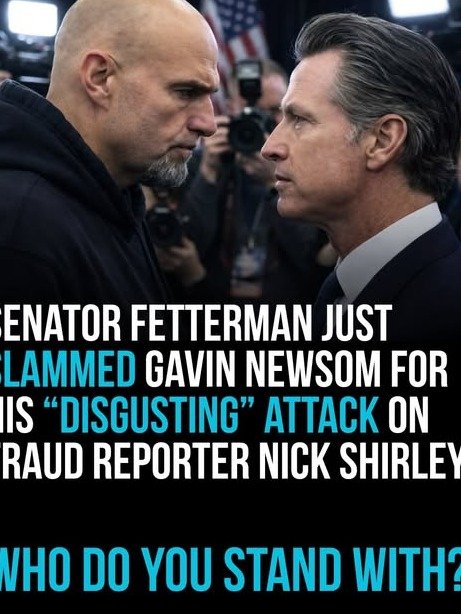
Imagine a political landscape where one prominent Democrat openly criticizes another, not over policy, but over the fundamental principle of press freedom and accountability. That’s precisely what’s unfolding as Pennsylvania Senator John Fetterman unleashes a scathing critique of California Governor Gavin Newsom’s approach to journalistic scrutiny. This isn’t just a minor spat; it’s a ‘Democrat Splitscreen’ moment that cuts to the core of how power should interact with the press.
The political world is buzzing after Fetterman publicly called out Newsom for his actions concerning journalist Nick Shirley. Fetterman didn’t mince words, arguing vehemently that for any public servant, the correct response to scrutiny is to address it, not to attack the messenger. This stance highlights a critical fault line emerging within the Democratic party itself.
The Unfolding ‘Democrat Splitscreen’
The essence of Fetterman’s criticism is straightforward yet profound: when faced with tough questions or critical reporting, a politician’s duty is to engage with the substance of the critique. To deflect, dismiss, or actively ‘go after’ a journalist, as Newsom is accused of doing with Nick Shirley, fundamentally undermines the democratic process and the vital role of a free press.
This isn’t a partisan attack from across the aisle; it’s an internal challenge, a Democrat calling out another Democrat on an issue that transcends typical political disagreements. It speaks volumes about the differing philosophies on transparency and accountability that can exist even within the same political party.
“Attacking scrutiny instead of answering it is the wrong move,” Fetterman stated, a clear and unequivocal condemnation of the alleged tactics employed by Governor Newsom. This statement resonates far beyond the immediate incident, setting a precedent for how public figures should ideally conduct themselves.
Fetterman’s Unconventional Voice Takes a Stand
Senator John Fetterman has carved out a unique identity in American politics. Known for his unconventional style, direct communication, and willingness to challenge norms, his intervention in this matter isn’t entirely surprising. He often positions himself as an authentic voice, unafraid to speak his mind, even if it means criticizing members of his own party.
His political brand is built on a foundation of blunt honesty and a populist appeal that often connects with voters who feel alienated by traditional political rhetoric. This incident with Newsom only reinforces his image as someone who prioritizes principle over party loyalty, especially when it comes to issues of transparency and public trust.
Fetterman himself has faced intense media scrutiny, particularly concerning his health. This personal experience might offer him a unique perspective on the pressures and challenges journalists can present, and perhaps, the importance of maintaining a professional and principled response, even under fire.
Newsom’s Stance Under Fire: The Peril of Attacking the Press
While the specific details of Governor Newsom’s interactions with journalist Nick Shirley remain a key point of discussion, Fetterman’s critique focuses on the principle. When politicians are perceived as ‘going after’ journalists, it raises serious questions about their commitment to transparency and their respect for the fourth estate.
The act of attacking a journalist often backfires, creating an impression that the politician has something to hide or is unwilling to face uncomfortable truths. It can erode public trust not only in the politician but also, paradoxically, in the media they are attempting to discredit.
Historically, such actions have been viewed with suspicion across the political spectrum. A healthy democracy relies on robust, independent journalism that holds power accountable, regardless of who is in office or what party they represent. Any attempt to silence or intimidate the press is seen as a dangerous step.
The Bedrock of Democracy: A Free Press
At the heart of this ‘Democrat Splitscreen’ is the fundamental importance of a free and independent press. Journalists serve as watchdogs, investigators, and conduits of information, ensuring that the public remains informed and that those in power are held responsible for their actions. This role is non-negotiable in a functioning democracy.
When politicians attack journalists, they are not just attacking an individual; they are attacking the very institutions designed to protect the public interest. This can have a chilling effect, potentially discouraging reporters from pursuing difficult stories and ultimately depriving citizens of crucial information.
- Accountability: Journalists uncover facts and ask tough questions, holding elected officials accountable.
- Transparency: They shed light on government operations, ensuring decisions are made in the open.
- Informed Public: A free press provides diverse perspectives and verified information, empowering citizens to make informed choices.
- Checks and Balances: Alongside legislative and judicial branches, the press acts as a crucial check on executive power.
Internal Party Friction: A Sign of Strength or Weakness?
The public criticism of one Democrat by another on such a fundamental issue raises interesting questions about the internal dynamics of the party. Is this a sign of disunity and weakness, or does it represent a healthy internal debate necessary for growth and ideological clarity?
Some might argue that Fetterman’s willingness to challenge Newsom publicly demonstrates a party that values principle and open discussion, even when it’s uncomfortable. It suggests that not all Democrats march in lockstep, and important ethical standards can be debated and upheld from within.
Conversely, others might view it as an unnecessary distraction or a sign of internal fragmentation that could be exploited by political opponents. In an era where political polarization is rampant, any perceived ‘splitscreen’ can be framed as a weakness by those looking to undermine the party’s broader agenda.
The Slippery Slope of Silencing Scrutiny
Fetterman’s warning about ‘attacking scrutiny instead of answering it’ points to a dangerous precedent. Once politicians begin to successfully diminish the credibility of journalists or create an environment where critical reporting is met with hostility, the path towards less transparency becomes clearer.
This slippery slope can lead to a public that is less trusting of legitimate news sources, more susceptible to misinformation, and ultimately, less capable of holding its leaders accountable. It undermines the very fabric of an informed citizenry, which is essential for self-governance.
The long-term consequences extend beyond individual politicians or specific news cycles. It impacts the health of democratic institutions, the quality of public discourse, and the ability of citizens to make decisions based on accurate, unbiased information. This is why Fetterman’s stand is so crucial.
What This Means for the Future of American Politics
The Fetterman-Newsom ‘Democrat Splitscreen’ is more than just a headline; it’s a litmus test for how politicians across the spectrum will navigate the increasingly complex relationship between power and the press. Will more public figures follow Fetterman’s lead, advocating for transparency and engagement?
Or will the temptation to push back against uncomfortable scrutiny prove too strong, leading to further erosion of trust in both political leaders and the media? This incident serves as a stark reminder that the battle for truth and accountability is ongoing, and it often requires vigilance from unexpected corners.
Ultimately, the public deserves leaders who are willing to face scrutiny head-on, answer difficult questions, and respect the indispensable role of journalists in a free society. Fetterman’s intervention underscores that these are not just abstract ideals, but practical expectations for those who seek to govern.
About the Author




