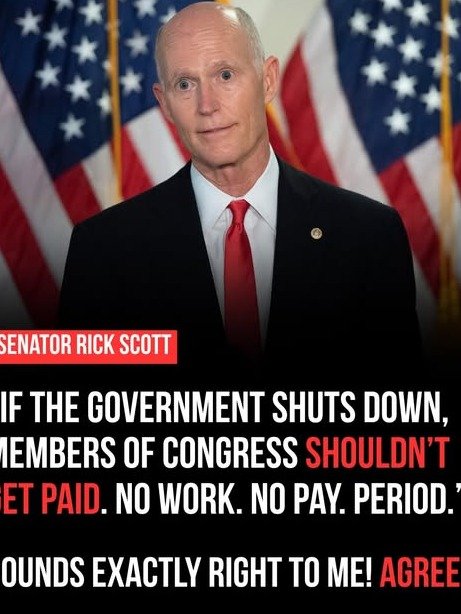
Imagine a job where you get paid regardless of whether you actually do the work. For members of Congress, that’s often been the reality, even when they fail to pass a budget and plunge the nation into fiscal uncertainty. But what if that all changed? What if their paychecks were directly tied to their performance, or lack thereof?
Senator Rick Scott is championing a groundbreaking proposal called the “No Budget, No Pay” plan, and it’s designed to do just that: force lawmakers to feel the genuine, immediate consequences of their own dysfunction. This isn’t just about accountability; it’s about fundamentally shifting the incentives in Washington, D.C.
The Unacceptable Reality of Congressional Dysfunction
For far too long, Americans have watched in frustration as Congress struggles to fulfill its most basic duty: passing a federal budget. These failures often lead to dramatic government shutdowns, last-minute deals, and a constant cloud of uncertainty that impacts millions of lives and the nation’s economy.
While essential government services hang in the balance and federal workers face furlough or delayed pay, members of Congress continue to receive their salaries without interruption. This stark contrast highlights a fundamental disconnect between the lawmakers and the people they serve.
What Exactly is the “No Budget, No Pay” Plan?
Senator Rick Scott’s “No Budget, No Pay” plan is remarkably straightforward in its premise. It mandates that if Congress fails to pass a budget by the constitutionally required deadline of October 1st each year, then congressional salaries would be withheld until a budget is finally enacted.
The goal isn’t to punish, but to incentivize. By directly linking their personal compensation to their legislative performance, the plan aims to create a powerful, undeniable motivation for members of both parties to come to the table, compromise, and get the nation’s financial house in order.
“Americans are tired of seeing politicians get paid while failing to do their most basic job: pass a budget,” Senator Scott has stated. “This plan will ensure that if Congress can’t do its job, they won’t get paid until they do.”
Why This Plan is More Critical Than Ever
The United States has seen numerous government shutdowns and near-misses over the past few decades, each one costing taxpayers billions of dollars, disrupting critical services, and eroding public trust. These episodes are not merely political theater; they have tangible, damaging effects on everyday Americans.
From delayed tax refunds and halted scientific research to disruptions in national parks and diminished national security operations, the repercussions of budgetary stalemates are severe. Yet, the current system often allows the architects of these stalemates to remain insulated from the very pain they inflict.
- Economic Impact: Each shutdown costs billions in lost productivity and economic activity.
- Public Trust: Repeated failures deepen public cynicism about government effectiveness.
- Service Disruption: Essential services, from food inspections to passport processing, are often impacted.
- Moral Hazard: Lawmakers face little personal consequence for legislative gridlock.
A History of Failed Budgets and Political Stalemate
The idea of tying congressional pay to performance isn’t entirely new, but it gains renewed urgency with each passing fiscal crisis. For years, the federal budget process has been plagued by partisan disagreements, leading to temporary funding measures (continuing resolutions) that kick the can down the road instead of addressing long-term fiscal challenges.
These short-term patches prevent agencies from planning effectively, waste taxpayer money, and contribute to a cycle of crisis management rather than proactive governance. The “No Budget, No Pay” plan seeks to break this cycle by introducing a personal stake for every legislator.
Addressing the Constitutional and Practical Challenges
Any proposal to alter congressional pay immediately brings up questions of constitutionality, particularly regarding the 27th Amendment, which states that “No law, varying the compensation for the services of the Senators and Representatives, shall take effect, until an election of Representatives shall have intervened.”
However, proponents argue that simply withholding pay, rather than reducing it, until a budget is passed, could navigate these constitutional waters. The pay isn’t permanently lost or reduced; it’s merely delayed until the job is done. This distinction is crucial for the plan’s legal viability.
The Power of Public Pressure and Accountability
While the legal framework is important, the true power of the “No Budget, No Pay” plan lies in its potential to amplify public pressure. When constituents know that their representatives’ paychecks are on the line, the demand for action and compromise will only intensify.
This increased scrutiny could make it politically untenable for lawmakers to engage in prolonged gridlock. It shifts the narrative from abstract policy debates to concrete, personal consequences for those in power.
How Would it Actually Work?
The mechanism of the “No Budget, No Pay” plan is designed to be straightforward:
- Deadline: If October 1st passes without a budget, salaries are frozen.
- Withholding: Funds for congressional salaries would be held in escrow.
- Release: Once a full budget is passed and signed into law, the withheld salaries would be released to members.
- No Back Pay if No Budget: If a budget is never passed, the salaries are never released. This acts as a powerful deterrent.
This direct and clear consequence is what makes the plan so compelling to many who are fed up with Washington’s endless squabbling.
Beyond the Paycheck: A Call for Fundamental Change
While the “No Budget, No Pay” plan addresses a symptom of congressional dysfunction, its broader impact could be a catalyst for more fundamental changes in how Washington operates. It forces a conversation about accountability, responsibility, and the basic expectations citizens have of their elected officials.
It’s not just about money; it’s about integrity. It’s about ensuring that those who make critical decisions affecting the entire nation are held to a standard of performance that reflects the gravity of their roles.
What This Means for You
For the average American, a functioning Congress that passes timely budgets means stability. It means government services operate without interruption, federal employees receive their pay, and the national economy isn’t held hostage by political brinkmanship. The “No Budget, No Pay” plan, if enacted, could be a significant step towards achieving that stability.
It empowers citizens by giving them a clearer, more direct way to hold their representatives accountable. It transforms abstract political failures into concrete, personal consequences for those who orchestrate them, making it harder for lawmakers to ignore the will of the people.
The Path Forward: Will Congress Embrace Accountability?
The question now remains whether Congress itself will embrace this level of accountability. Passing such a plan would require lawmakers to vote for a measure that directly impacts their own financial security, a move that could be politically challenging but immensely popular with the public.
Senator Rick Scott’s initiative is more than just a legislative proposal; it’s a powerful statement about the need for reform and a clear signal that the American people demand better from their government. The time for business as usual is over. It’s time for Congress to earn its pay, just like everyone else.
Final Thoughts: A Bold Step Towards Fiscal Responsibility
The “No Budget, No Pay” plan represents a bold and necessary step towards restoring fiscal responsibility and accountability in Washington. It offers a clear, tangible mechanism to ensure that congressional failures carry real consequences for those in power, not just for the American people.
As this vital conversation continues, it’s crucial for citizens to understand the implications of such a plan and to demand that their representatives prioritize effective governance over political games. The future of a more accountable and functional Congress may well depend on whether this common-sense idea gains the traction it deserves.
Support for the Initiative
Support for the “No Budget, No Pay” concept often cuts across party lines among the general public, indicating a broad desire for greater accountability from elected officials. It taps into a fundamental sense of fairness: if you don’t do your job, you shouldn’t get paid.
This widespread sentiment is a powerful force that lawmakers ultimately cannot ignore. The pressure from constituents who are tired of government shutdowns and fiscal irresponsibility could be the driving factor that eventually pushes this plan into law.
The Long-Term Vision for Washington
Implementing the “No Budget, No Pay” plan isn’t a magic bullet for all of Washington’s problems, but it could be a crucial first step in a larger movement towards more responsible governance. By establishing a baseline of accountability, it sets a precedent for future reforms aimed at improving efficiency, transparency, and responsiveness in Congress.
Ultimately, a government that effectively manages its budget is a government that can better serve its people. Senator Scott’s proposal is a direct challenge to the status quo, urging lawmakers to prioritize their duties and the needs of the nation above all else.
About the Author




