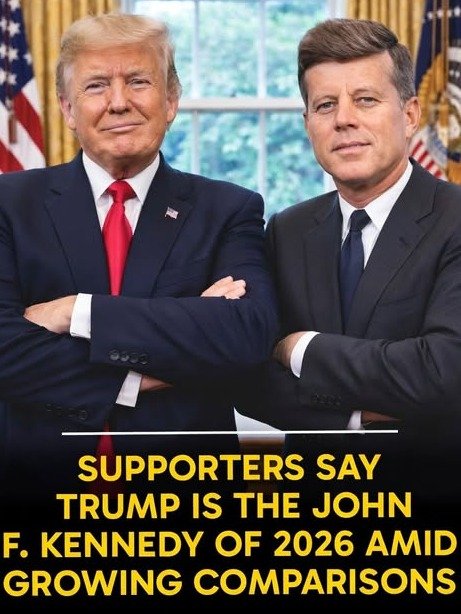
A fascinating and often controversial comparison is currently circulating among certain political circles, particularly within the fervent base of former President Donald Trump. It’s a claim that has sparked both intrigue and intense debate: some supporters are boldly labeling Trump the “John F. Kennedy of 2026.” This isn’t just a casual remark; it’s a profound statement that attempts to draw parallels between two vastly different American political figures, suggesting a shared essence of leadership, charisma, and communication.
But what exactly underpins such an audacious comparison? Why would a segment of Trump’s loyalists look back to the iconic 35th President of the United States, a figure often associated with a different era of American politics, to define their contemporary leader? The answer, according to these proponents, lies primarily in the perceived charisma, communication style, and a certain undefinable popular appeal that they believe both men possess, albeit in their own distinct ways.
The Enduring Allure of John F. Kennedy
John F. Kennedy remains an indelible figure in American history, largely remembered for his youthful vigor, eloquence, and a vision that inspired a generation. His presidency, though tragically cut short, left an enduring legacy built on ideals of service, innovation, and a challenge to the status quo. Kennedy’s ability to connect with the American public was legendary, a skill honed through a combination of charm, wit, and a sophisticated understanding of emerging media.
His speeches, delivered with clarity and conviction, resonated deeply, often calling Americans to a higher purpose. Think of his inaugural address, where he famously declared,
“Ask not what your country can do for you – ask what you can do for your country.”
This wasn’t just rhetoric; it was a powerful, direct appeal that bypassed traditional political jargon and spoke directly to the heart of civic duty. His televised debates against Richard Nixon also showcased his mastery of the visual medium, projecting an image of confidence and composure that captivated millions.
Kennedy’s charisma wasn’t merely superficial; it was intertwined with a sense of optimism and a forward-looking perspective that promised a brighter future. He embodied a certain aspirational quality, making people believe in the potential of America and their own role within it. This powerful blend of charm, vision, and communication established him as a political icon whose influence transcends partisan lines even decades after his death.
Donald Trump’s Unique Appeal: A Modern Charisma
Fast forward to the 21st century, and Donald Trump has undeniably carved out a unique and equally potent form of political appeal. His rise to power challenged conventional political wisdom and shattered traditional campaign playbooks. Trump’s connection with his base is often described as visceral, almost tribal, built on a foundation of direct, unfiltered communication and a perceived authenticity that many find refreshing, even if controversial.
Unlike Kennedy’s polished oratory, Trump’s communication style is characterized by its bluntness, repetitive slogans, and a direct appeal to the grievances and aspirations of his supporters. His rallies are not just political events; they are spectacles, almost rock concerts, where he engages in a free-flowing dialogue with the crowd, often deviating from prepared remarks to speak off-the-cuff. This approach creates an intimate, personal connection, making his followers feel seen and heard.
His masterful use of social media, particularly platforms like Twitter (now X), allowed him to bypass traditional media gatekeepers and communicate directly with millions. This direct line of communication fostered a sense of loyalty and immediacy that few politicians have achieved. For his supporters, this isn’t just a political strategy; it’s a reflection of a leader who isn’t afraid to speak his mind and defy the establishment.
Drawing the Parallels: Charisma and Communication
When Trump supporters label him the “JFK of 2026,” they are often pointing to these shared, albeit different, traits of charisma and communication. Both leaders, despite their contrasting styles, possess an undeniable ability to captivate large audiences and inspire fervent loyalty. Here are some of the key parallels drawn:
- Direct Connection: Both Kennedy and Trump excelled at establishing a direct, personal connection with their respective bases, making individuals feel like they were part of a larger, significant movement.
- Media Savvy: Kennedy leveraged television to his advantage, mastering the visual medium. Trump, similarly, dominated cable news cycles and pioneered the use of social media for direct political communication, bypassing traditional filters.
- Defying Norms: JFK’s youth and Catholicism were seen as novel for his time. Trump’s business background and outsider status similarly broke molds, appealing to those tired of conventional politicians.
- Inspiring a Movement: Both leaders galvanized a dedicated following, transforming political participation into a passionate, almost emotional experience for their supporters.
The
About the Author




