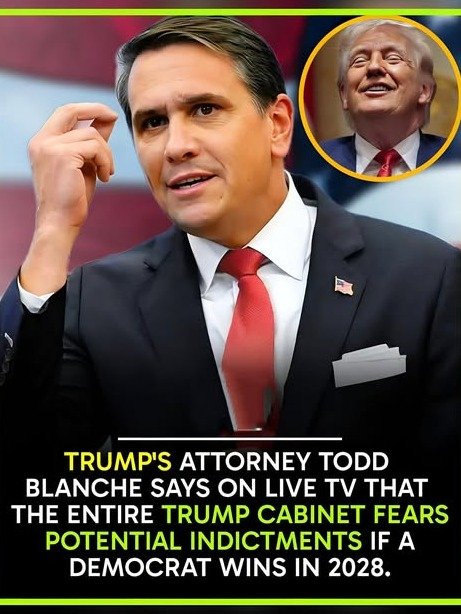
Could the very officials tasked with upholding the law soon find themselves facing legal action for their pursuit of justice? This isn’t a hypothetical question from a political drama; it’s the startling implication of recent comments attributed to Todd Blanche, a prominent legal representative for Donald Trump. His words have not just ‘sparked discussion’—they’ve ignited a firestorm, suggesting a potential paradigm shift in accountability that could redefine the rule of law in America.
The legal landscape surrounding Donald Trump has always been fraught with tension, but this latest development introduces an entirely new dimension. Blanche’s reported suggestion that ‘certain officials could face legal consequences’ for their involvement in cases against the former president has sent ripples through the legal community, raising critical questions about prosecutorial immunity, political motivation, and the future of high-stakes litigation.
The Core Allegation: What Was Said?
While the exact phrasing of Todd Blanche’s comments has been the subject of intense scrutiny and various interpretations, the essence remains clear: he reportedly indicated that government officials, particularly those involved in prosecuting or investigating Donald Trump, might not be immune from future legal action themselves. This isn’t merely a lawyer posturing; it suggests a strategic line of thinking within Trump’s legal defense that could have profound implications.
This assertion moves beyond typical courtroom defense strategies. It hints at a potential counter-offensive, where the legal system itself becomes the battleground for accountability, not just for the accused but for the accusers. Such a stance challenges long-held principles of prosecutorial discretion and the protections afforded to public servants acting in their official capacities.
Who is Todd Blanche? A Key Player in Trump’s Defense
Todd Blanche is no stranger to high-profile cases. A former federal prosecutor, he brings a wealth of experience from both sides of the courtroom. His transition to representing Donald Trump in some of his most significant legal battles, including the classified documents case and the New York hush-money trial, has placed him squarely in the national spotlight.
As a lead attorney, Blanche’s statements carry considerable weight. They are not off-the-cuff remarks but are often perceived as deliberate signals of legal strategy or potential future actions. His background as a prosecutor also lends a certain gravitas to his claims, as he understands intimately the mechanisms of government investigations and prosecutions.
The Legal Precedent: Can Officials Be Held Liable?
The notion of holding government officials legally accountable for their actions is not entirely new, but it is typically constrained by significant legal doctrines. One of the most robust protections is qualified immunity, which shields government officials from liability in civil lawsuits unless their conduct violates clearly established statutory or constitutional rights, and those rights were known to a reasonable person.
However, Blanche’s comments seem to delve into the realm of criminal liability or more direct forms of civil action, potentially for alleged malfeasance, abuse of power, or even malicious prosecution. The bar for proving such claims against officials, especially prosecutors, is extraordinarily high, demanding clear evidence of bad faith or a deliberate disregard for justice rather than mere errors or disagreements over legal strategy.
“The idea of prosecuting or suing officials for their actions in an official capacity is incredibly complex,” noted one legal analyst. “It would require demonstrating a level of malice or clear overreach that goes far beyond typical prosecutorial discretion. It’s a very steep hill to climb.”
The “Malicious Prosecution” Angle: A Risky Gambit?
One of the most direct avenues for pursuing officials, hinted at by Blanche’s comments, could be claims of “malicious prosecution.” This legal concept allows individuals to sue those who initiated criminal proceedings against them without probable cause and with malice. However, successfully proving malicious prosecution against a prosecutor is notoriously difficult.
Courts generally grant prosecutors broad immunity to prevent them from being intimidated or deterred from pursuing legitimate cases. Overturning this immunity requires exceptional circumstances, typically involving egregious misconduct or a clear intent to harm, rather than simply pursuing a case that ultimately fails or is controversial. The implications of lowering this bar could be vast, potentially chilling legitimate law enforcement efforts.
Political Weaponization of Justice?
Trump and his legal team have consistently argued that the numerous investigations and prosecutions against him are politically motivated, a “witch hunt” designed to interfere with his political career. Blanche’s comments fit squarely within this narrative, suggesting that those who participate in such alleged political weaponization should themselves face retribution.
This perspective frames the legal battles not just as criminal cases but as a broader conflict over the integrity of the justice system. By threatening legal action against officials, the defense aims to highlight what they perceive as partisan bias and to potentially deter future investigations or prosecutions against political figures.
Reactions from Legal Experts: A Divided Opinion
The legal community has reacted with a mix of alarm, skepticism, and cautious analysis. Many legal scholars emphasize the importance of prosecutorial immunity for maintaining an independent justice system, warning that frequent challenges could paralyze legitimate law enforcement.
- Concerns about Chilling Effect: Many worry that such threats, even if difficult to execute, could create a “chilling effect” on prosecutors and investigators, making them hesitant to pursue politically sensitive cases for fear of future personal legal repercussions.
- Skepticism on Feasibility: A significant number of experts believe that any attempts to prosecute or sue these officials would face immense legal hurdles and are unlikely to succeed given existing legal precedents and immunities.
- Support for Accountability: A smaller segment, often aligned with the defense’s perspective, argues that accountability for officials is crucial, especially if there is credible evidence of overreach or politically motivated actions. They believe that no one, regardless of their position, should be above the law.
The Chilling Effect on Prosecutorial Discretion
The potential for a chilling effect on prosecutorial discretion is perhaps one of the most significant concerns raised by Blanche’s statements. Prosecutors operate with a degree of independence precisely so they can make decisions based on law and evidence, free from political pressure or fear of personal reprisal.
If prosecutors constantly fear being sued or prosecuted themselves for decisions made in their official capacity, it could lead to a highly cautious and less effective justice system. This could mean fewer investigations into powerful figures, a reluctance to pursue complex cases, and ultimately, a weakening of the rule of law.
Historical Context and Similar Debates
While the current context is unique due to the prominence of the individuals involved, debates about official accountability are not new. Historically, there have been instances where public officials faced scrutiny or legal challenges for their conduct, particularly in cases involving civil rights abuses or clear corruption.
However, the scale and political nature of the current discussion, where the former President’s legal team is openly discussing counter-actions against those involved in his prosecution, represents a significant escalation. It pushes the boundaries of traditional legal discourse and delves into uncharted territory for modern American jurisprudence.
Potential Ramifications for American Governance
The implications of these threats extend far beyond the immediate legal cases. They touch upon fundamental aspects of American governance:
- Erosion of Trust: Constant accusations and counter-accusations between political factions and the justice system can further erode public trust in both institutions.
- Politicization of Justice: If legal actions become perceived primarily as tools for political retribution, the integrity of the justice system as an impartial arbiter of disputes is severely compromised.
- Precedent for Future Administrations: A successful pursuit of officials could set a dangerous precedent, potentially leading to a cycle of legal retaliation with every change in political power, destabilizing the government.
The very fabric of democratic accountability relies on clear distinctions between political opposition and legal process. When these lines blur, the foundations of stable governance begin to crack, inviting a perpetual state of legal and political warfare.
The Public Perception and Trust in Institutions
In an increasingly polarized society, public perception plays a crucial role. For supporters of Donald Trump, Blanche’s comments may resonate as a promise of justice against what they view as a politically motivated persecution. For critics, it may be seen as an attempt to intimidate officials and undermine the justice system.
This divide in perception makes it incredibly challenging to have a unified public discourse about the rule of law. The ongoing discussion surrounding Blanche’s statements will undoubtedly contribute to the broader narrative about the fairness and impartiality of American institutions, further deepening existing societal rifts.
Looking Ahead: A New Era of Accountability?
Whether Todd Blanche’s reported suggestions ultimately materialize into concrete legal actions remains to be seen. The path to prosecuting or suing officials for their actions in high-profile cases is fraught with legal and practical difficulties. However, the very act of making such statements marks a significant moment in the ongoing legal and political saga surrounding Donald Trump.
It signals a willingness to push the boundaries of legal defense, to challenge the conventional protections afforded to government officials, and to use every available tool—including the threat of future litigation—to influence the current legal landscape. This could indeed be the dawn of a new, more contentious era of accountability, where the lines between political battle and legal warfare become increasingly blurred.
Conclusion: An Unfolding Legal Drama
Todd Blanche’s comments have ignited a debate that goes to the heart of America’s legal and political systems. They force us to confront uncomfortable questions about prosecutorial power, official immunity, and the potential for a justice system caught in a cycle of retribution. While the immediate legal impact is still uncertain, the long-term implications for how justice is pursued and perceived in the United States could be profound.
As these complex legal dramas continue to unfold, the nation watches, grappling with the challenge of upholding the rule of law in an era of unprecedented political division and legal innovation. The “unseen threat” hinted at by Trump’s lawyer may yet reshape the very definition of accountability for those who serve in public office.
About the Author




