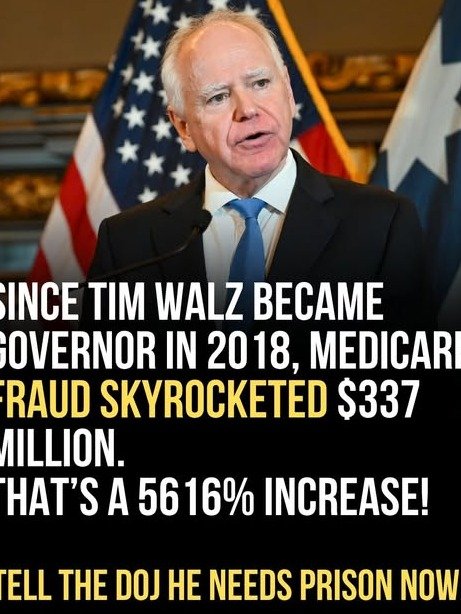
Imagine your hard-earned tax dollars, earmarked for the most vulnerable, vanishing into thin air. Now imagine that ‘vanishing act’ isn’t just a few million, but a staggering sum that has exploded almost 60-fold in just a few short years. This isn’t a dystopian novel; it’s the alarming reality unfolding in Minnesota’s Medicaid program, where suspicious payments have reportedly surged from $6 million to an astonishing $343 million since Governor Tim Walz took office.
The numbers alone are enough to make anyone’s jaw drop. What was once a concerning but manageable $6 million in suspicious Medicaid payments has, according to recent reports, ballooned to an eye-watering $343 million. This isn’t just an increase; it’s an explosion, a nearly 57-fold surge in potential fraud that demands immediate attention and rigorous investigation.
The Staggering Cost to Minnesota Taxpayers
This dramatic escalation represents a colossal drain on public resources, diverting critical funding away from Minnesota’s most vulnerable citizens who rely on Medicaid for essential healthcare services. Every dollar lost to fraud is a dollar that can’t be used for doctor visits, life-saving medications, or vital therapy for children and seniors.
For every Minnesotan taxpayer, this isn’t merely an abstract figure. It translates directly into higher taxes, underfunded public services, or a strain on other crucial state programs. The $337 million difference between the initial $6 million and the current $343 million could have funded countless initiatives, from improving educational facilities to bolstering mental health services.
The sheer scale of this alleged fraud also undermines public trust in government oversight and the integrity of vital social safety nets. When such significant amounts of money are reportedly siphoned off, it creates a crisis of confidence that affects everyone.
Unpacking the Mechanisms of Medicaid Fraud
Medicaid fraud isn’t a single, monolithic crime; it manifests in various sophisticated and often difficult-to-detect schemes. These can range from billing for services never rendered to upcoding procedures to command higher reimbursements. Identity theft, where fraudsters use legitimate patient information to submit false claims, is also a pervasive issue.
Another common tactic involves providers billing for medically unnecessary services or equipment, sometimes coercing beneficiaries into accepting treatments they don’t need. These elaborate schemes exploit vulnerabilities within the system, often preying on the very people Medicaid is designed to protect. The complexity of these schemes makes them difficult to uncover without dedicated resources and advanced detection methods.
A Timeline of Troubling Trends: From Millions to Hundreds of Millions
The stark comparison between the $6 million in suspicious payments observed at the beginning of Governor Walz’s administration and the current $343 million figure paints a grim picture. This isn’t a gradual climb; it’s an exponential surge that points to systemic challenges and potential vulnerabilities that have either emerged or significantly worsened over the past few years.
While the original post doesn’t specify the exact timeframe within Walz’s tenure, the implication is clear: a dramatic escalation has occurred during this period. Understanding the specific policies, program expansions, or oversight changes that coincided with this surge is crucial for pinpointing the root causes of this financial hemorrhaging.
Why the Explosion? Possible Contributing Factors
Several factors could contribute to such a dramatic increase in reported fraud. One significant element could be the expansion of Medicaid programs themselves. As more individuals become eligible and enroll, the sheer volume of claims processed increases, offering a larger canvas for fraudulent activities to occur.
Another critical area to examine is the state’s capacity for fraud detection and prevention. Are the systems in place robust enough to identify sophisticated schemes? Are there sufficient human resources—investigators, auditors, data analysts—dedicated to rooting out fraud? A lack of adequate staffing or outdated technology could easily allow fraudulent activities to slip through the cracks, leading to an accumulation of suspicious payments.
“The complexity of modern healthcare billing, coupled with the sheer volume of claims, creates an environment ripe for exploitation if oversight mechanisms aren’t continually updated and rigorously enforced.”
The COVID-19 pandemic also introduced unprecedented challenges and flexibilities into healthcare systems, including Medicaid. Emergency measures, expedited processes, and a focus on rapid service delivery might have inadvertently created new avenues for fraudsters to exploit, with less stringent checks in place during a time of crisis. These temporary changes could have left lasting vulnerabilities.
The Human Cost: Beyond the Dollar Amount
While the financial figures are staggering, the true tragedy of Medicaid fraud extends far beyond monetary losses. It directly impacts the most vulnerable members of society—children, the elderly, and individuals with disabilities—who rely on these programs for their very well-being.
- Reduced Access to Care: Funds diverted by fraud mean fewer resources for legitimate services, potentially leading to longer wait times, fewer available providers, or cuts to essential programs.
- Erosion of Trust: When fraud becomes widespread, it erodes public confidence in the entire healthcare system and the government’s ability to protect its citizens and manage public funds responsibly.
- Increased Premiums/Taxes: Ultimately, the cost of fraud is borne by taxpayers, either through higher state budgets, increased premiums for other insurance plans, or a reduction in other vital public services.
Imagine a senior citizen being denied a necessary medical procedure because the funds were siphoned off by a fraudulent clinic, or a child with special needs losing access to critical therapy because the state’s budget is strained by illicit payments. These are the real-world consequences of unchecked fraud, impacting lives directly.
Calls for Accountability and Enhanced Oversight
The revelation of such a massive increase in suspicious payments naturally triggers demands for greater accountability. Minnesotans deserve to know what steps are being taken to address this crisis, to recover stolen funds, and to prevent future occurrences. Transparency in investigations and clear communication about findings are paramount to restoring public confidence.
This situation highlights the urgent need for a comprehensive review of Minnesota’s Medicaid fraud detection and prevention strategies. This includes evaluating the effectiveness of current systems, investing in advanced data analytics tools that can identify patterns of fraud, and strengthening enforcement capabilities. Without robust oversight, the problem is likely to persist and even grow.
Moving Forward: Strategies for a More Secure Medicaid System
Combating a fraud explosion of this magnitude requires a multi-faceted approach. It’s not enough to simply react; proactive measures are essential to safeguard taxpayer money and protect vulnerable populations. Here are some key strategies that experts advocate:
- Advanced Data Analytics: Implementing sophisticated AI and machine learning tools can help identify unusual billing patterns, suspicious provider networks, and potential fraud schemes much faster than traditional methods, moving beyond manual reviews.
- Increased Staffing and Training: Investing in more specialized fraud investigators and providing them with continuous training on emerging fraud tactics is crucial. A well-resourced team is the frontline defense against complex criminal operations.
- Stricter Provider Screening: Enhanced background checks and ongoing monitoring of healthcare providers participating in Medicaid can help weed out bad actors before they can cause significant damage, ensuring only legitimate providers are enrolled.
- Public Awareness Campaigns: Educating beneficiaries about what constitutes fraud and encouraging them to report suspicious activities can turn every Medicaid recipient into an additional layer of defense, empowering them to protect the system.
- Inter-Agency Collaboration: Fostering stronger partnerships between state agencies, law enforcement, and federal authorities can improve information sharing and coordinated efforts to prosecute fraudsters, creating a united front against crime.
Ultimately, the goal must be to create a system that is both accessible to those who need it and impenetrable to those who seek to exploit it. This balance is challenging but absolutely essential for the long-term sustainability and integrity of Minnesota’s Medicaid program, ensuring it serves its intended purpose.
The Path Ahead: Restoring Trust and Securing Funds
The alleged explosion of Medicaid fraud in Minnesota presents a critical challenge that transcends political divides. It’s about protecting taxpayer dollars, ensuring access to vital healthcare, and upholding the integrity of a program designed to help those most in need. The reported leap from $6 million to $343 million in suspicious payments is a siren call for immediate, decisive action.
Minnesotans are watching, and they deserve transparency, accountability, and a clear plan to address what appears to be a systemic vulnerability. The future of the state’s healthcare safety net, and the trust placed in its leadership, hinges on how effectively this crisis is confronted and resolved. The time for comprehensive reform and rigorous enforcement is now.
About the Author




