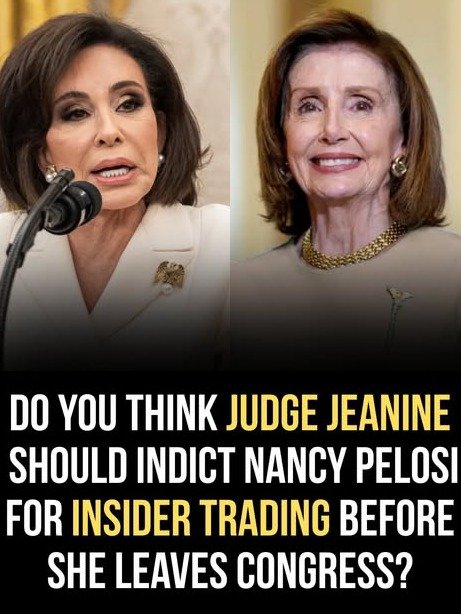
Imagine having access to classified information that could move markets, then being allowed to trade stocks based on that knowledge. Sound like a plot from a thriller? For years, this has been the uncomfortable question shadowing members of Congress, with figures like Nancy Pelosi often at the center of a swirling cloud of accusations regarding suspiciously well-timed stock trades within her household.
The debate isn’t just about one politician; it’s a profound ethical dilemma that strikes at the heart of public trust and the integrity of our legislative process. Are the very individuals we elect to serve the public truly benefiting from their positions through advantageous financial maneuvers?
The Pelosi Enigma: A Closer Look at ‘Well-Timed’ Trades
For more than a decade, former House Speaker Nancy Pelosi and her husband, Paul Pelosi, have faced intense scrutiny over their highly successful stock market activity. Critics often point to a pattern of trades that appear, to many, to be uncannily prescient, particularly in industries directly impacted by legislative decisions or economic shifts that congressional members would be privy to.
These aren’t just minor investments. We’re talking about millions of dollars traded, often in prominent tech companies, defense contractors, or other sectors that have seen significant government interaction. The timing of these transactions, frequently preceding major policy announcements, committee votes, or economic data releases, has fueled persistent speculation.
While no definitive proof of illegal insider trading has ever been publicly presented against the Pelosis, the sheer optics of these profitable trades have created a significant public relations challenge and intensified calls for stricter ethical guidelines for all elected officials. The question isn’t always about legality, but about the perception of fairness and the potential for undue influence.
“The public deserves to know that their elected officials are working for them, not for their own stock portfolios,” a common sentiment among watchdogs, highlights the core of the issue. “When lawmakers consistently outperform the market, it raises legitimate questions about how they achieve such success.”
The STOCK Act: A Flawed Attempt at Transparency?
In response to growing public outrage and a surge of media attention regarding congressional stock trading, Congress passed the Stop Trading on Congressional Knowledge (STOCK) Act in 2012. This bipartisan bill aimed to increase transparency and prevent insider trading by members of Congress and their staff.
The STOCK Act explicitly affirmed that federal laws prohibiting insider trading apply to members of Congress and their employees. Crucially, it also mandated that lawmakers disclose any stock trades made by themselves, their spouses, or dependent children within 45 days of the transaction. This was intended to provide the public and oversight bodies with a clearer view of their financial activities.
While a step in the right direction, many argue that the STOCK Act has proven insufficient. Critics point to several loopholes and enforcement challenges:
- Delayed Disclosure: A 45-day window, while better than none, can still allow significant market movements to occur before the public is aware of a trade.
- Enforcement Gaps: The mechanisms for investigating and prosecuting violations can be complex and are often perceived as weak.
- Blind Trusts Not Mandatory: Lawmakers are not required to place their assets in blind trusts, which would hand over control of their investments to an independent party.
- Spousal Loopholes: While spouses’ trades must be disclosed, the argument persists that information can still be indirectly leveraged.
The act’s limitations have kept the debate alive, leaving many to wonder if it truly addresses the root problem or merely provides a veneer of accountability.
Beyond Pelosi: The Systemic Issue of Congressional Trading
The spotlight on Nancy Pelosi’s family trades, while prominent, is merely a symptom of a much larger, systemic issue: the widespread practice of stock trading by members of Congress. Data consistently shows that many lawmakers, across both parties, engage in active trading, and a significant number consistently outperform the market.
This isn’t necessarily proof of illegal activity, but it undeniably creates an environment ripe for suspicion and ethical dilemmas. Lawmakers are privy to an unparalleled stream of information that can directly impact stock prices:
- Committee Hearings: Access to expert testimony, company executives, and regulatory bodies.
- Drafting Legislation: Knowing which industries will benefit or suffer from upcoming laws.
- Economic Briefings: Insights into inflation, interest rates, and other market-moving indicators long before the public.
- National Security Information: Knowledge of geopolitical events that could affect defense, energy, or tech sectors.
With such a distinct informational advantage, the ability to trade individual stocks presents an inherent conflict of interest. It raises the fundamental question: are these individuals making decisions for the good of the nation, or are their personal financial interests subtly influencing their legislative actions?
The Argument for a Complete Ban: Restoring Public Trust
The most straightforward solution proposed by ethics watchdogs and a growing number of lawmakers themselves is a complete ban on individual stock trading for members of Congress and potentially their immediate families. The arguments in favor are compelling and focus primarily on restoring public trust and ensuring ethical governance.
A ban would eliminate even the appearance of impropriety. It would send a clear message that public service is about duty, not personal enrichment facilitated by privileged information. Such a measure would level the playing field, ensuring that lawmakers are subject to the same market forces as the average citizen, without the benefit of an informational edge.
- Eliminates Conflicts of Interest: Removes the temptation to legislate with personal financial gain in mind.
- Boosts Public Confidence: Reassures voters that their representatives are focused solely on their constituents’ interests.
- Simplifies Ethics Oversight: Makes it much easier to monitor and enforce ethical standards.
- Promotes Fair Markets: Ensures that congressional knowledge isn’t unfairly exploited for personal profit.
Several bipartisan bills have been introduced in recent years advocating for such a ban, reflecting a growing consensus that the current system is untenable. The public’s demand for greater accountability is reaching a fever pitch.
Navigating the Counterarguments and Practicalities
While a ban on congressional stock trading garners significant support, it also faces opposition and practical challenges. Critics often argue that such a ban infringes on a lawmaker’s personal freedom to manage their own finances, similar to any other private citizen.
They contend that members of Congress are highly capable individuals who should be trusted to make ethical decisions and that a blanket ban is an overreach. Furthermore, some suggest that requiring blind trusts or restricting investments to broad index funds is sufficient, allowing lawmakers to still grow their wealth without direct control over individual stock picks.
However, proponents of a full ban counter that the unique position of a lawmaker, with access to market-moving information, fundamentally distinguishes them from the average citizen. The sacrifice of individual stock trading is a small price to pay for the privilege of public service and the maintenance of public trust.
The Road Ahead: Demanding Accountability
The ‘trading cloud’ surrounding figures like Nancy Pelosi and the broader issue of congressional stock trading is more than just political fodder; it’s a critical examination of the ethical foundations of American governance. The perception that lawmakers are using their positions to line their own pockets erodes faith in institutions and fuels cynicism.
As the debate continues, the pressure on Congress to enact more robust reforms, potentially including an outright ban on individual stock trading, will only intensify. The public is demanding greater transparency, unwavering accountability, and a clear commitment from their elected officials that they are indeed serving the people, not their personal portfolios.
It’s time for a system where public service is unequivocally about the public good, free from the lingering suspicion of self-enrichment. Only then can trust truly be rebuilt.
About the Author




