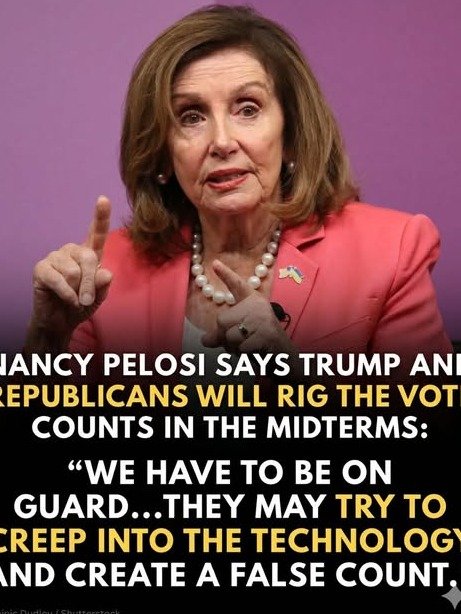
The very foundation of American democracy hinges on the integrity of its elections. Yet, a recent statement from former House Speaker Nancy Pelosi has ignited a fresh firestorm, raising urgent questions about the security of our voting systems and the intentions of political leaders. She alleges that former President Donald Trump is actively seeking to undermine crucial voting technology, framing his efforts as a direct ‘threat’ to the electoral process.
This isn’t just political rhetoric; it’s a stark warning that cuts to the heart of voter confidence. Pelosi’s claims suggest a deeper, more insidious agenda at play, one that could potentially erode the public’s trust in the democratic mechanisms designed to protect every ballot cast. But what exactly is the ‘threat’ she’s referring to, and how does it square with the American public’s diverse views on election integrity?
The Core of the Controversy: Pelosi’s Allegations
Nancy Pelosi’s statements are not to be taken lightly, given her long history at the pinnacle of American politics. Her recent remarks specifically target former President Trump’s ongoing narrative and actions concerning voting technology. She posits that his efforts are not about genuine election security, but rather a deliberate attempt to sow doubt and dismantle trust in the systems that underpin our elections.
These allegations come against a backdrop of heightened partisan tension surrounding election administration. For years, the debate over voting machines, software vulnerabilities, and ballot security has intensified, often becoming a flashpoint in political discourse. Pelosi’s warning suggests a belief that Trump’s interventions are not constructive criticisms but rather a strategic maneuver to delegitimize outcomes he disagrees with.
Decoding the “Threat”: What Does Pelosi Really Mean?
The phrase
“protecting elections constitutes a ‘threat'”
as attributed to Pelosi, can initially sound counterintuitive, even alarming. However, a deeper look reveals her likely intended meaning. Pelosi is not suggesting that the act of protecting elections itself is a threat. Instead, she is likely asserting that Trump’s specific approach to ‘protecting’ elections—which often involves questioning the legitimacy of established technology and processes—is what she perceives as a threat.
From her perspective, attempts to undermine voter confidence through unsubstantiated claims about technology, or advocating for changes that could disenfranchise voters or complicate the voting process, are indeed a threat to the democratic ideal of free and fair elections. She implies that such actions, under the guise of ‘protection,’ actually introduce instability and erode the foundational trust necessary for a functioning democracy. It’s about discerning between genuine security enhancements and politically motivated disruption.
Trump’s Perspective: A Focus on “Election Integrity”
On the other side of this contentious debate stands former President Donald Trump, who has consistently championed a narrative centered on what he terms “election integrity.” His supporters often echo his concerns, citing fears of voter fraud, issues with electronic voting machines, and the perceived vulnerability of ballot tabulation processes. For them, Trump’s actions are seen as a necessary crusade to safeguard the sanctity of the vote.
Trump and his allies frequently call for measures such as stringent voter ID laws, widespread paper ballots, and forensic audits of election results, particularly in states where outcomes were close or contested. They argue that these steps are essential to prevent fraud and ensure that every legal vote is counted accurately, thereby restoring faith in the electoral system. This perspective often views existing voting technology as inherently flawed or susceptible to manipulation, demanding immediate and significant reforms.
The Battle Over Voting Technology: A Deeper Dive
Modern elections rely heavily on a complex array of technologies, from electronic poll books and ballot marking devices to high-speed scanners and intricate tabulation software. These systems are designed to enhance efficiency, accessibility, and accuracy. However, like any technology, they are not without their potential vulnerabilities, which have become a focal point of debate.
Experts in election security often highlight the importance of robust auditing procedures, chain-of-custody protocols, and continuous software updates to mitigate risks. Many argue that current systems, when properly implemented and secured, are highly reliable. Yet, the public remains divided, with concerns ranging from foreign interference to internal tampering, fueling an ongoing demand for greater transparency and verifiable results.
Public Trust on the Line: What Do Americans Believe?
The American public’s view on voting technology and election security is far from monolithic. Polling data consistently shows a significant partisan divide, with Republicans generally expressing more skepticism about the fairness and accuracy of elections than Democrats. This polarization makes it challenging to forge a consensus on necessary reforms or to universally accept election outcomes.
Key public concerns often revolve around:
- Accuracy of Vote Counts: Are machines and software counting votes correctly?
- Transparency of Processes: Can the public easily understand and verify how votes are cast and tallied?
- Security Against Hacking: Are voting systems adequately protected from cyberattacks, both domestic and foreign?
- Fairness of Access: Are election rules and technologies ensuring equitable access to the ballot for all eligible voters?
Restoring and maintaining public confidence is paramount. When a significant portion of the electorate doubts the legitimacy of election results, it can lead to widespread distrust in governmental institutions, reduce civic engagement, and ultimately weaken the democratic fabric of the nation.
The Stakes Are High: Why This Debate Matters
This ongoing debate over voting technology and election integrity isn’t merely a political squabble; it has profound implications for the future of American democracy. The ability of citizens to trust that their vote matters and that election outcomes genuinely reflect the will of the people is fundamental. Without this trust, the very legitimacy of government comes into question.
Eroding confidence can lead to decreased voter turnout, increased political instability, and a more fractured society. It creates an environment where conspiracy theories can thrive, making it harder for objective facts and evidence to gain traction. Therefore, finding common ground and implementing solutions that are both secure and widely accepted is not just desirable—it’s absolutely essential.
Ensuring a Secure Future: Paths Forward
Navigating these complex waters requires a multifaceted approach that transcends partisan divides. One crucial step is to promote evidence-based discussions about election technology, relying on cybersecurity experts, election administrators, and independent auditors rather than purely political rhetoric. Educating the public on how voting systems work, their safeguards, and their vulnerabilities can help demystify the process.
Furthermore, investing in modern, secure, and auditable election infrastructure is vital. This includes:
- Implementing robust post-election audits, especially risk-limiting audits, to verify results.
- Ensuring a paper trail for every vote, allowing for manual recounts and verification.
- Providing ongoing training and resources for election officials to combat new threats.
- Fostering bipartisan oversight committees to build trust and consensus on best practices.
These measures, coupled with a commitment from all political actors to uphold the integrity of the process, are critical for safeguarding the future of our elections.
Conclusion: Bridging the Divide for a Stronger Democracy
Nancy Pelosi’s warning about former President Trump’s alleged attempts to undermine voting technology underscores the deep ideological chasm currently impacting American elections. While both sides claim to be protecting election integrity, their methods and interpretations of what constitutes a ‘threat’ diverge dramatically. The challenge lies in bridging this divide, recognizing that a shared commitment to free, fair, and secure elections should be a unifying principle.
Ultimately, the health of our democracy depends on a voting system that is not only secure and accurate but also inspires widespread public confidence. Addressing the concerns raised by both Pelosi and Trump’s supporters with transparency, expertise, and a genuine desire for solutions, rather than political advantage, is the only path forward to ensure that every American’s vote truly counts and is counted fairly.
About the Author
This article aims to provide a balanced overview of complex political statements and their implications for election security. The views expressed herein are based on publicly available information and common interpretations of political discourse.
About the Author




