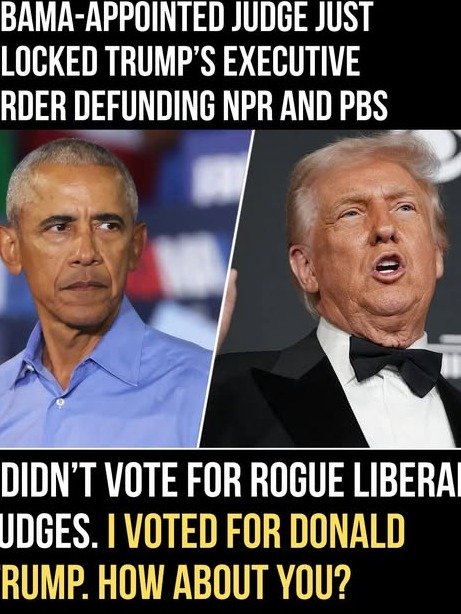
Imagine a world where the trusted voices you rely on for news, education, and cultural enrichment suddenly fall silent. For years, the very existence of public broadcasting in America has hung in the balance, caught in a relentless political crossfire. Now, a new legal ‘bench blockade’ threatens to bring former President Donald Trump’s long-standing campaign to defund NPR and PBS to a dramatic head, potentially reshaping the media landscape as we know it.
This isn’t merely a political squabble; it’s a high-stakes legal showdown that could fundamentally alter how millions of Americans access vital information and diverse programming. The fight over taxpayer funding for public media has once again landed in the courtroom, adding another complex chapter to a familiar pattern of challenges against these long-standing institutions.
The Enduring Battle Against Public Broadcasting
The push to strip taxpayer funding from National Public Radio (NPR) and the Public Broadcasting Service (PBS) is far from a new phenomenon. For decades, a significant segment of conservative politicians and commentators has advocated for ending federal support, arguing that these organizations are biased, unnecessary, or represent an inefficient use of public funds.
Former President Donald Trump, however, elevated this long-simmering debate to a central point of contention during his presidency. He repeatedly proposed eliminating or drastically reducing federal appropriations for the Corporation for Public Broadcasting (CPB), the non-profit organization that distributes government funding to NPR and PBS member stations across the country.
A Familiar Pattern of Financial Threats
Throughout his time in office, Trump’s budgets consistently targeted the CPB for defunding. These proposals often cited a desire for fiscal responsibility and a belief that public media should stand on its own without federal assistance, particularly in an era of abundant private media options.
Despite these persistent efforts, Congress repeatedly pushed back, ultimately maintaining funding for the CPB. This consistent congressional support highlighted the bipartisan appreciation for the services public broadcasting provides, from local news coverage to educational children’s programming.
The Core of the Conflict: Bias and Necessity
At the heart of the argument against federal funding lies the accusation of political bias. Critics often contend that NPR and PBS lean left in their reporting and programming, making taxpayer support inappropriate for what they perceive as partisan outlets. They argue that in a diverse media landscape, public funds should not subsidize specific viewpoints.
Conversely, proponents of public funding emphasize NPR and PBS’s commitment to objective journalism, in-depth reporting, and a wide range of educational and cultural content not typically found on commercial channels. They argue that federal funding ensures these vital services remain accessible to all Americans, regardless of their ability to pay for subscriptions.
Understanding the Corporation for Public Broadcasting (CPB)
To truly grasp the implications of this legal battle, it’s crucial to understand the role of the Corporation for Public Broadcasting (CPB). Established in 1967 by an act of Congress, the CPB is a private, non-profit corporation that serves as the steward of federal funding for public broadcasting.
The CPB does not produce programming itself. Instead, it acts as a critical buffer, distributing federal dollars to over 1,500 local public radio and television stations across the United States. This structure is designed to insulate programming decisions from political influence, ensuring editorial independence for the stations.
The Current Legal ‘Bench Blockade’ Unpacked
The latest development in this ongoing saga is a new legal challenge, dubbed a ‘bench blockade,’ that has once again put the future of public broadcasting funding in jeopardy. While specific details of the current lawsuit are often complex and evolving, these legal battles typically revolve around the executive branch’s authority to unilaterally cut or redirect congressionally appropriated funds.
Legal challenges often arise when presidential administrations attempt to bypass congressional approval processes or interpret existing laws in ways that would allow them to defund agencies like the CPB. These lawsuits become a critical check on executive power, ensuring that funding decisions remain within the purview of the legislative branch.
Arguments from the Legal Trenches
Those challenging the defunding efforts often argue that such actions violate established statutes and the separation of powers. They contend that Congress, through its power of the purse, has clearly mandated funding for the CPB, and any attempt by the executive branch to circumvent this is unlawful.
On the other side, proponents of defunding, or those defending the administration’s actions, might argue for broad executive discretion in budgetary matters, or they may challenge the constitutionality or necessity of ongoing federal funding for public media in general. These legal arguments often hinge on intricate interpretations of appropriations law and executive authority.
Why Public Broadcasting Still Matters
Despite the persistent political attacks, NPR and PBS continue to play an indispensable role in American society. They are often the primary source of local news in underserved communities, providing in-depth reporting that commercial outlets, facing budget cuts and consolidation, can no longer afford to produce.
Furthermore, PBS is a cornerstone of early childhood education through beloved programs like Sesame Street and Daniel Tiger’s Neighborhood, reaching millions of children who might not have access to other educational resources. NPR offers nuanced discussions, cultural programming, and global news coverage that broadens horizons and fosters civic engagement.
- Local News Coverage: Filling critical gaps left by declining commercial media.
- Educational Content: Providing foundational learning for children and adults.
- Cultural Enrichment: Showcasing arts, history, and diverse perspectives.
- In-depth Journalism: Offering comprehensive analysis beyond soundbites.
- Emergency Information: Serving as vital communication hubs during crises.
The Dire Consequences of Defunding
If the legal ‘bench blockade’ were to ultimately succeed in cutting federal funding, the consequences for public broadcasting would be severe and far-reaching. While federal funds constitute a relatively small portion of the overall budget for many stations (often around 10-15%), this money is disproportionately critical.
Federal funding often serves as foundational capital, allowing stations to leverage additional donations from listeners, viewers, and local businesses. Without it, many smaller, rural stations would face immediate closure, leading to vast news deserts and a loss of essential community services.
“Federal funding is not just a line item; it’s the bedrock that allows many local stations to exist and serve their communities, especially in areas where commercial media has abandoned its post.” – A Public Broadcasting Advocate
The loss of federal support would also likely lead to a reduction in programming quality and diversity, as stations would be forced to rely even more heavily on corporate sponsorships and listener donations, potentially influencing editorial decisions or favoring more broadly appealing (and thus less niche or educational) content.
What This Means for You
This ongoing legal battle isn’t just about political ideologies; it directly impacts the information and entertainment available to you and your family. The potential silencing of NPR and PBS could mean fewer trusted news sources, a decline in educational programming for children, and a reduced platform for diverse cultural voices.
It highlights the fragility of public institutions in an increasingly polarized political climate. The outcome of this ‘bench blockade’ will not only determine the fate of NPR and PBS but will also set a precedent for how future administrations can interact with congressionally mandated funding for public services.
The Road Ahead: An Uncertain Future
As this legal ‘bench blockade’ unfolds, the future of taxpayer funding for NPR and PBS remains uncertain. The courts will weigh the arguments, interpret the laws, and ultimately make decisions that could have lasting repercussions for public media in America.
For now, the fight continues – a testament to the enduring value, and vulnerability, of public broadcasting in a nation grappling with questions of media trust, civic responsibility, and the role of government in supporting essential services. Staying informed about these developments is crucial, as the silent war for your public airwaves rages on.
About the Author




