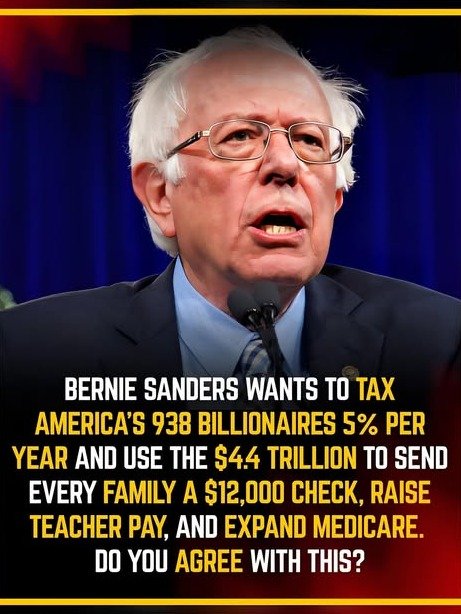
What if the wealthiest individuals in America, the top 0.1%, were asked to contribute a significant portion of their immense fortunes each year to fund vital public services and directly benefit every American? This isn’t a hypothetical thought experiment from a utopian novel; it’s the core of a groundbreaking new proposal championed by Senator Bernie Sanders, designed to fundamentally reshape economic inequality in the United States.
Senator Sanders has once again ignited a national conversation, introducing a bold wealth tax aimed squarely at the nation’s highest earners. This isn’t just another tax adjustment; it’s a comprehensive strategy to tackle the escalating wealth gap, promising to funnel billions into crucial social programs and even deliver direct payments to citizens. But what exactly does this audacious plan entail, and could it truly be the seismic shift our economy needs?
Unpacking the Wealth Tax Proposal: Who Pays What?
At its heart, Sanders’ proposal is an annual tax on the net worth of the country’s richest individuals. Unlike income taxes, which target earnings, a wealth tax assesses the total value of assets a person owns – everything from stocks and bonds to real estate, private jets, and even yachts, minus their liabilities. This distinction is crucial, as much of the ultra-wealthy’s fortunes are held in assets that appreciate, rather than traditional income.
The plan specifically targets a tiny fraction of the population: the top 0.1% of U.S. households, those with a net worth exceeding a staggering $32 million. For billionaires, the proposed rates escalate significantly. Sanders envisions a tiered system, ensuring that those with the most contribute progressively more to the national coffers.
“At a time of massive wealth and income inequality, we need a wealth tax to ask the billionaires to pay their fair share,” Senator Sanders has frequently stated, emphasizing the moral imperative behind his economic vision. “We cannot continue to have a situation where the very rich get richer, while so many Americans struggle to make ends meet.”
Addressing America’s Widening Wealth Gap
The impetus behind such a radical proposal stems from a stark reality: economic inequality in the U.S. has reached historic levels. While the stock market soars and corporate profits climb, many ordinary Americans grapple with stagnant wages, rising healthcare costs, and the crushing burden of student debt. The pandemic only exacerbated this disparity, with billionaires seeing their fortunes skyrocket while millions faced job losses and financial hardship.
Critics argue that the current tax system disproportionately benefits the ultra-rich, allowing them to accumulate vast fortunes that are often taxed at lower rates than the earnings of middle-class families. This proposal aims to correct what many see as a fundamental imbalance, ensuring that wealth contributes to the public good, not just private accumulation.
- Stark Reality: The wealthiest 0.1% of American households now own roughly 20% of the nation’s wealth.
- Pandemic Effect: Billionaire wealth surged by trillions during the COVID-19 crisis.
- Systemic Imbalance: Many believe the current tax code allows the rich to avoid contributing their ‘fair share.’
Funding Public Goods: From Direct Payments to Social Safety Nets
So, where would all this collected wealth go? Sanders’ plan is not just about taxing the rich; it’s about investing in the future of all Americans. A significant portion of the revenue generated by the wealth tax would be allocated to crucial public services and initiatives that have long been underfunded.
One of the most appealing aspects for many is the promise of direct payments to citizens. While specific details can vary, this could manifest as universal basic income (UBI) programs, expanded stimulus checks, or other forms of direct financial relief designed to boost the economic security of working families and those in need.
Beyond direct payments, the wealth tax revenue would be a game-changer for critical social programs. Imagine robust funding for:
- Universal Healthcare: Expanding Medicare to cover all Americans, reducing out-of-pocket costs, and ensuring access to quality care.
- Affordable Education: Making public colleges and universities tuition-free, alleviating student loan debt, and investing in early childhood education.
- Climate Change Initiatives: Funding green energy projects, sustainable infrastructure, and job creation in environmentally friendly sectors.
- Housing Affordability: Investing in affordable housing programs to combat homelessness and rising rents.
These investments, proponents argue, would not only improve the quality of life for millions but also stimulate economic growth from the bottom up, creating a more stable and equitable society.
The Mechanics: How Would a Wealth Tax Actually Work?
Implementing a wealth tax is no small feat, and the details of Sanders’ proposal attempt to address some of the inherent complexities. The plan calls for an annual assessment of net worth, requiring a sophisticated valuation process for a wide range of assets, some of which are not easily appraised.
For instance, privately held companies, art collections, or complex financial instruments would need expert valuation year after year. To prevent tax avoidance, the proposal includes robust enforcement mechanisms, such as increased IRS funding and stricter penalties for non-compliance. It also includes provisions to discourage wealthy individuals from renouncing their citizenship to avoid the tax, potentially through exit taxes or extended residency requirements.
“We understand that taxing extreme wealth is complex, but it is not impossible,” noted a policy brief supporting Sanders’ plan. “Other nations have implemented similar measures, and with modern technology and a commitment to enforcement, we can ensure that this tax is both effective and fair.”
Arguments For: Fairness, Funding, and Economic Stability
Supporters of the wealth tax champion it as a matter of fundamental fairness. They argue that in a society where a few accumulate unimaginable riches while many struggle, it is morally imperative for the wealthiest to contribute more to the common good. This isn’t about punishing success, they contend, but about ensuring a level playing field and preventing extreme concentrations of power.
Economically, proponents believe the tax could help stabilize the economy by reducing speculative bubbles often fueled by concentrated wealth. The revenue generated would provide a stable funding source for essential public services, reducing reliance on regicitve taxes that disproportionately affect lower and middle-income families.
Furthermore, by investing in education, healthcare, and infrastructure, the wealth tax could foster a more productive and innovative workforce, ultimately benefiting the entire economy. It’s seen as a long-term investment in human capital and societal well-being.
The Hurdles: Constitutional Challenges and Implementation Headaches
While the vision is compelling for many, a wealth tax faces significant opposition and practical challenges. One of the most prominent concerns is its constitutionality. Critics argue that a wealth tax might be deemed an unapportioned ‘direct tax,’ which is prohibited by the U.S. Constitution unless it’s applied uniformly across all states based on population – a practically impossible feat.
However, proponents counter that the Sixteenth Amendment, which allows for income taxes, could be interpreted to permit a wealth tax, or that new legal precedents could be established. The legal battle would undoubtedly be fierce and could ultimately land in the Supreme Court.
Beyond legal questions, the practical implementation poses substantial hurdles:
- Asset Valuation: Accurately valuing complex and illiquid assets annually is a monumental task, prone to disputes and loopholes.
- Capital Flight: Critics warn that wealthy individuals might move their assets or even themselves to countries without a wealth tax, leading to a loss of capital and tax revenue.
- Administrative Burden: The IRS would require massive expansion and new expertise to administer such a complex tax system.
- Economic Disincentives: Opponents argue that taxing wealth could discourage investment, entrepreneurship, and job creation, ultimately harming economic growth.
A Global Perspective: Wealth Taxes Around the World
The concept of a wealth tax isn’t entirely new; several European countries have experimented with it in the past. Nations like Norway, Switzerland, and Spain currently have some form of a wealth tax. However, many others, including France and Germany, have repealed their wealth taxes due to challenges like capital flight, administrative difficulties, and limited revenue generation.
Lessons from these international experiences are hotly debated. Supporters of Sanders’ plan argue that previous failures were due to poor design, low thresholds, or weak enforcement. They believe a well-designed, robust wealth tax, targeting only the ultra-rich with high rates and strong anti-avoidance measures, could succeed where others have faltered.
The Political Battleground: What Are Its Chances?
The political landscape for a wealth tax is as challenging as its legal and practical aspects. While popular among progressive voters, it faces strong opposition from Republicans and even some moderate Democrats who fear its economic repercussions or question its legality. Passing such a transformative piece of legislation would require significant political will and a seismic shift in congressional dynamics.
Public opinion, however, often leans towards the idea of the wealthy paying more. Polls frequently show a majority of Americans support higher taxes on the rich, even if they don’t always agree on the specific mechanisms. This public sentiment could provide the necessary pressure to push such a proposal forward, but the road ahead is undoubtedly long and arduous.
The Path Forward: A Defining Economic Debate
Senator Bernie Sanders’ wealth tax proposal is more than just a legislative idea; it’s a potent symbol in the ongoing debate about economic justice and the future of capitalism in America. It forces us to confront fundamental questions about who benefits from economic growth, who bears the burden of societal costs, and what kind of society we truly want to build.
Whether it ultimately becomes law or not, this proposal has undeniably shifted the conversation, pushing the idea of taxing extreme wealth into the mainstream. It challenges conventional thinking and demands a serious examination of how we can create a more equitable and prosperous nation for all, not just the privileged few. The debate is far from over, and its outcome will undoubtedly shape the economic landscape for generations to come.
About the Author




