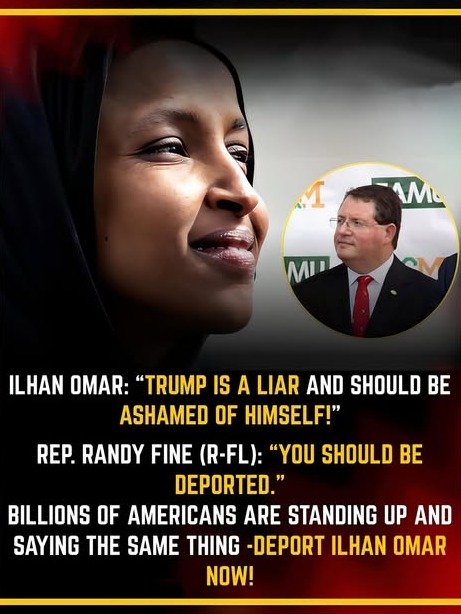
Did a single politician just ignite a firestorm that reveals the deepest cracks in American political discourse? Randy Fine’s recent statements about Congresswoman Ilhan Omar have sent shockwaves across the nation, sparking intense debate and exposing the raw nerves of a deeply divided public. This isn’t just about two politicians; it’s about the very definition of patriotism, loyalty, and the right to criticize one’s own country.
The controversy began with Fine’s outspoken remarks, which quickly went viral, drawing both fierce condemnation and fervent support. At its heart lies a fundamental disagreement over how public figures, especially those in government, should express their views on the United States and its policies. For some, Omar’s past criticisms cross a line into disloyalty, while for others, they represent legitimate dissent and a cornerstone of democratic freedom.
The Spark: Randy Fine’s Provocative Stance
Randy Fine, a prominent political figure known for his unreserved rhetoric, recently made comments that directly targeted Congresswoman Ilhan Omar. While the exact wording varies across reports, the essence of his statements centered on his belief that Omar has consistently shown a critical, if not adversarial, stance towards the United States. These remarks were not subtle; they were designed to provoke thought and, indeed, reaction.
Fine’s comments quickly circulated through social media and news outlets, amplified by both his supporters and his detractors. His intention, it appeared, was to highlight what he perceives as a pattern of behavior from Omar that he deems unpatriotic or un-American. This direct challenge immediately polarized audiences, forcing a re-examination of what constitutes acceptable political criticism.
Unpacking Ilhan Omar’s Public Persona and Criticisms
Congresswoman Ilhan Omar, a Democrat representing Minnesota’s 5th congressional district, has long been a figure of both admiration and controversy. As one of the first two Muslim women elected to Congress and a former refugee, her background provides a unique perspective on American society and foreign policy. However, it is her outspoken criticisms, particularly regarding U.S. foreign policy, Israel, and domestic issues, that have often placed her in the national spotlight.
Omar has frequently voiced concerns about various aspects of American policy, from military interventions to economic inequalities. While many of her supporters view these criticisms as courageous and necessary for progress, her detractors often interpret them as undermining the nation or being disloyal. This divergence in interpretation is precisely what fuels controversies like the one ignited by Randy Fine.
“Criticism of government is not disloyalty. It is, in fact, the highest form of patriotism.” – Howard Zinn
For those who defend Omar, her statements are seen as a vital exercise of free speech and a commitment to holding power accountable. They argue that true patriotism involves striving to make one’s country better, which often requires pointing out flaws and advocating for change. This perspective suggests that silencing dissent or labeling it as disloyal is antithetical to democratic values.
The Heart of the Controversy: Patriotism vs. Dissent
The core of the strong reactions to Randy Fine’s statements lies in the deeply personal and often emotional definitions of ‘patriotism’ and ‘loyalty.’ When a public figure like Ilhan Omar voices strong criticisms, it forces many to confront their own understanding of what it means to be an American and how one should express love for their country.
For one segment of the population, particularly those who align with Fine’s viewpoint, there’s a strong expectation that elected officials should project an image of unwavering support and pride for the nation, especially on the global stage. They may interpret Omar’s critiques as divisive, ungrateful, or even dangerous, believing that such statements undermine national unity and strength.
The ‘Strong Reactions’ — A Deep Dive into Public Opinion
The immediate aftermath of Randy Fine’s comments saw a rapid and intense polarization of public opinion. Social media platforms became battlegrounds, with countless individuals weighing in on the debate. This wasn’t merely a political disagreement; it tapped into deeply held beliefs and values, igniting passionate responses from all sides.
Those Who Agree with Randy Fine
- Concerns over National Image: Many who sided with Fine expressed anxieties about how Omar’s criticisms might be perceived internationally, fearing they could weaken America’s standing or provide ammunition to its adversaries.
- Questioning Loyalty: A significant number of individuals felt that Omar’s statements crossed a line from legitimate criticism into outright disloyalty, particularly given her position as a U.S. Congresswoman. They argued that her role demands a higher degree of national allegiance.
- Frustration with Perceived Anti-Americanism: For some, Fine’s remarks resonated with a broader frustration over what they perceive as a growing trend of ‘anti-American’ sentiment from certain political factions, viewing Omar as a prime example. They felt Fine was simply saying what many others were thinking.
These supporters often emphasize a more traditional view of patriotism, where national pride and unity are paramount. They believe that while internal debate is healthy, constant or severe criticism, especially from elected officials, can be detrimental to the country’s morale and global reputation.
Those Who Defend Ilhan Omar
- Freedom of Speech and Dissent: A large contingent of Omar’s defenders passionately argued that her criticisms are a fundamental exercise of free speech, protected by the First Amendment. They contend that questioning government actions is a vital component of a healthy democracy.
- Criticism as Patriotism: Many believe that true patriotism involves striving to improve one’s country, which necessarily includes identifying and critiquing its flaws. They see Omar’s statements as a form of constructive engagement, aimed at creating a more just and equitable society.
- Targeting and Identity Politics: Some defenders also highlighted what they perceive as a pattern of unfair targeting against Omar, often attributing it to her identity as a Muslim woman of color. They argue that such attacks are often thinly veiled attempts to silence diverse voices in politics.
This group often champions a more progressive view of patriotism, where the nation’s ideals are continuously strived for, and criticism is a tool for achieving a more perfect union. They see Randy Fine’s comments as an attempt to stifle legitimate political discourse and marginalize a prominent voice.
The Broader Implications: Political Polarization and Public Discourse
The intense reactions to Randy Fine’s statements and Ilhan Omar’s perceived criticisms are not isolated incidents. They are symptomatic of a deeply polarized political landscape where nuanced discussions are often replaced by ideological clashes. In such an environment, statements are quickly amplified, distorted, and weaponized, making it difficult for the public to engage with the actual substance of the debate.
This controversy also highlights the growing challenge of distinguishing between legitimate political criticism and perceived disloyalty. In an era of heightened nationalistic sentiment and identity politics, the line between these two concepts has become increasingly blurred. What one person views as a thoughtful critique, another may see as an attack on the very fabric of the nation.
The Role of Public Figures in Shaping Narratives
Public figures like Randy Fine and Ilhan Omar wield considerable influence in shaping public perception and discourse. Their words, whether delivered in a legislative chamber or on a social media platform, carry significant weight and can galvanize large segments of the population. This power comes with a profound responsibility, as their rhetoric can either bridge divides or deepen them.
When politicians engage in highly charged debates, it sets a precedent for how the public discusses contentious issues. The language used, the accusations made, and the willingness (or unwillingness) to engage in respectful dialogue all contribute to the overall health of a nation’s political discourse. The Fine-Omar controversy serves as a stark reminder of this powerful dynamic.
Navigating the Information Landscape
In today’s fast-paced media environment, statements like Fine’s can go viral in minutes, often without full context or detailed explanation. This rapid dissemination of information contributes to the intensity of reactions, as people form opinions based on headlines and short clips rather than comprehensive analysis. Understanding the full scope of a politician’s views and the nuances of their statements becomes crucial but increasingly challenging.
For the average citizen, discerning truth from rhetoric and understanding the underlying motivations behind such political clashes can be an arduous task. It requires critical thinking, a willingness to seek out multiple perspectives, and an awareness of how political narratives are constructed and deployed.
Conclusion: A Mirror to America’s Divisions
The strong reactions sparked by Randy Fine’s statements concerning Ilhan Omar are more than just a fleeting news item. They are a powerful reflection of the profound ideological and cultural divisions currently shaping the United States. This controversy forces us to confront fundamental questions about what it means to be patriotic, how we define loyalty, and the acceptable boundaries of political criticism in a democratic society.
As the debate continues to unfold, it underscores the urgent need for more constructive dialogue and a greater understanding of differing perspectives. Whether one agrees with Randy Fine or defends Ilhan Omar, the conversation sparked by their clash is essential for America to navigate its complex present and build a more cohesive future. Ignoring these deep-seated tensions will only allow the cracks in our national discourse to widen.
About the Author




